
Translated material
"I had my own war"
The New Times publishes the chapter from the book about Kaha Bendukidze - "How to make Reforms"
Kakha Bendukidze, suddenly died on November 13 in London, will go down in history as one of the most outstanding reformers of the 21st century. The last eight months of his life, the architect of Georgian economic reforms devoted to help Ukrainian society realize the scale of the problems facing him. A familiar economist, having heard about the death of Kakha Avtandilovich, bitterly joked: if Russia bombed the government and the presidential administration in Kyiv, the damage from this would be less than from the death of Bendukidze. Since February, Kahoy and I wrote a book dedicated to his life, his reforms, his fate. The first conversation took place on February 22 - on the day of the final victory of Euromaidan. And at the end of September, we talked with Bendukidze about what was the main theme of his life - “how to make reforms.” The New Times publishes a magazine version of this chapter
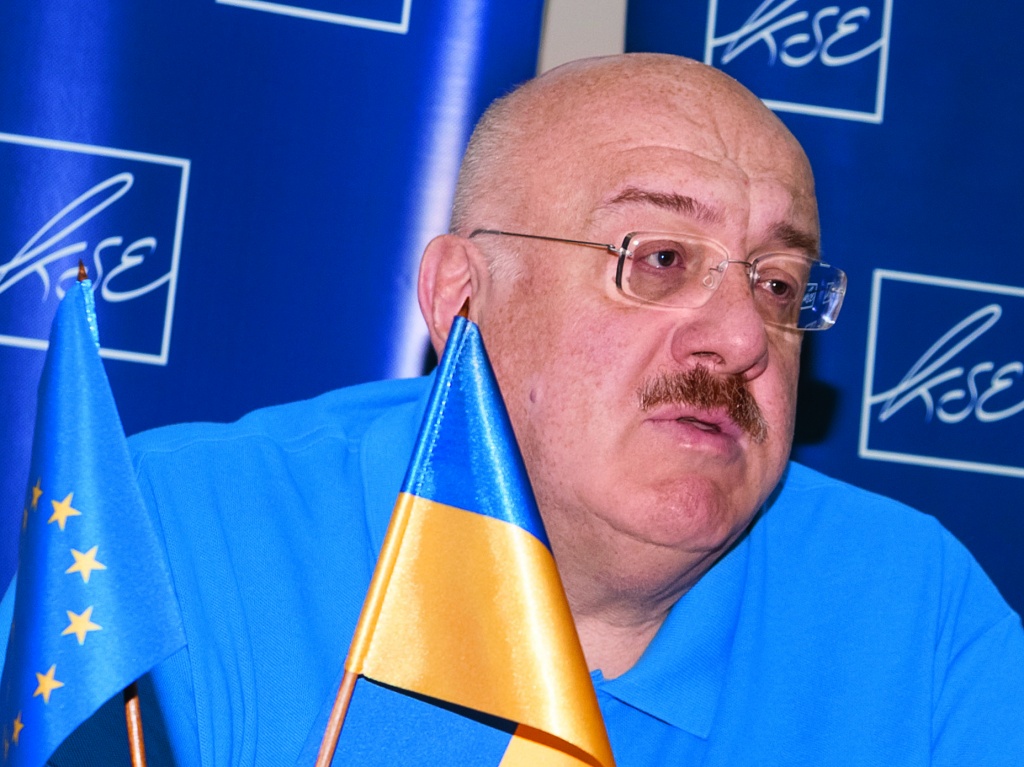
Photo: Oleksandr Mikovich
Two years ago, I edited the book of Pyotr Aven and Alfred Koch “The Gaidar Revolution”*...
| *Peter Aven, Alfred Koch. “The revolution of Gaidar. The history of the reforms of the 90s first-hand. " M: Alpina Plisher, 2013 |
Great book, just wonderful.
Aven and Koch wanted to figure out why Gaidar's reforms were half. How to make successful reforms?
I just told one Ukrainian statesman yesterday about whether it was possible to have a reform plan. I think the reform plan is possible, but only in the conditions of a totalitarian dictatorship. Dictatorships of one person. When you give a damn about everyone. Then you can develop a plan. For a while about unpredictability, “black swans”, Lorentsery processes, for example, we have a determinist future. The dictator calculated everything: you must first reform it, then then, first to privatize this company, then that, first to cancel this law, then adopt that law.
In the 1970s, this was called Sofe-a system of optimal functioning of the economy.
This is what Academician Yaremenko did ...
Yes, Soviet mathematical economists.
If the players who affect the reforms will behave inappropriately, the dictator can simply suppress them. In all other cases - if you have more than one person makes decisions about reforms - it is already impossible to act according to a strict plan. Some interests, coalitions, alliances, retreat back and forth begin, and in the end you cannot carry out the planned phased reform with many priorities. It is simply impossible.
"So far the rooster does not bite"
The Higher School of Economics has investigated how Gref was implemented in the early 2000s. It turned out that in the region of 35 % - which is not so bad.
Yes, only you had to write a program for this. There is still such a moment: time is spelling of the program. “Wait, don’t do anything, now we’ll write the program, wait, wait.” What is the importance of time? Reforms are carried out when there is some kind of screening, some kind of crisis. In 2009, Valdis Dombrovskis (Prime Minister of Latvia) committed, in my opinion, a heroic act and reduced the budget by 10 % of GDP. A few years before that, he was the Minister of Finance, but did nothing similar to the budget. Reforms do not occur - it is very important to understand - until the rooster pecks or the thunder breaks ...
"
"This is very important to understand - until the rooster pecks or the thunder will break ..."
”And when the thunder pecks, you have a coalition for reforms. You can’t live on, let's do something, this coalition, of course, is fragile. After some time it will break up. If Gref’s program was written within a day, I am sure that a lot of it would be fulfilled. Because the opponents of certain reforms would not have time to group.
Why is the reforms in Georgia before the war (in South Ossetia) - this is not connected with the war, it just happened - they passed easier, and then there were no big reforms? Including because there was a consolidation of the political elite and bureaucracy. If in 2004 or 2005 I proposed to eliminate some kind of agency, then it was clear to everyone that there were enemies who specifically extorted bribes from them. And they could tell a lot of cases from life.
Almost all reforms after the war-2009, 2010, 2011-were, let's say, bloodless. For example, how best to carry out this or that regulation, how more transparent, faster, it is cheaper to issue a certificate that is already issued. But such as to close departments or remove entire regulations, there was no longer. The only serious reform that was started and completed after the war is pharmaceutical.
You talked in 2011 about the owners of the three largest pharmacy networks, which had to be pulled to their side or neutralized.
What was important? The opposition, which did not think about any reform at all, began to “stink”: there is no state regulation of drug prices, expensive medicines, the people are suffering. Let's open municipal pharmacies-they carried some nonsense. The parliamentary majority was supposed to once answer this attack. It could answer: yes, we will fulfill your order, we will introduce the state regulation of prices. But we achieved that it answered differently. State regulation is pointless. And a political statement was made that we would open the market.
The right answer to the left question.
The right answer. This was the only major reform that was made from beginning to end after the war. The remaining reforms in 2009-2011 made a positive contribution to the economy, but all these were improved such reforms.
Obviously, the pathos of these reforms was already completely different. But also very nice - how to offer citizens all the best and best services.
In general, now we can already say that there were two waves of reforms, Quick and Dirty, and then ...
Slow and Clean.
You might think: how they all calculated well. Without a proper degree of honesty, we can say that from the very beginning we have conceived everything. It will be a lie. It was as if Columbus, having lived to old age, repeated that he always knew that in the western part of the Atlantic there was a new continent.
Presidents and reformers
Does what reforms depend on and how they are made, on the initial conditions? Gaidar carried out reforms against the backdrop of the collapse of the economy. In Georgia in 2004, the economy grew up, tax revenues grew, plus the government spurred the moral panic of citizens who were tired of living in a failed state.
Ukraine now has to make reforms in a situation even worse than Gaidar. How to act in such an environment?
So even better. Instead of moral panic, you have a specific panic. It seemed to me that everything that is happening in Ukraine, all the negative should vice versa ...
"
“I came to the prime minister, he says: no, no, no. Then I knelt and say: I beg you. The picture was still "
“ You yourself said in March that the situation in Ukraine is so bad that you don’t know what to take on. Economic reforms are all known. But as soon as you start making them, there is a threat of the collapse of the country.
The lack of reforms will definitely lead to decay. Yesterday I asked one senior official: if he promises ten hryvnias by the end of the next year from the budget and write it to the budget, then how much will he buy this obligation today? Well, here you are - how much do you buy?
250,000 - 300,000 hryvnias I would pay.
But he said: 10 % - or 100,000 hryvnias.
You see, I believe in Ukraine more.
He just knows better.
Koch and Aven have one of the red threads: the reforms were therefore so bad that the reformers in the Yeltsin team did not occupy an independent political position, and therefore, as soon as everything stabilized a little, the “old goats” came to everything ready and pushed pushed back. Have you had any political position in the Saakashvili team?
The minister is always a political position. It forms a policy in the direction. The political position in relation to the president is what I'm talking about.
Yes, I remember this passage, where they (Koch and Aven) write, “we refused to fight him” (with President Yeltsin) ... No, I did not have such a position. And it seems to me that this has nothing to do with anything. They describe a very specific situation: if they fought, they would get a small mandatics for some other piece of reform. I don’t even know what they mean, what reform.
They would have brought financial stabilization to the end - they would not be replying her Fedorov with Primakov.
I'm afraid that they no longer had a agenda. Or there was a small agenda. Which was recently voiced by Kudrin: to dismiss some of the teachers. Well, this is a penny.
I can say about my position. I had my own war. The team is good. We do everything for the country. But to myself, I thought that I should carry out as many reforms as possible, which I consider correct, and for this I used people around me. There is no need to perceive my words cynical, but I considered my associates an instrument in achieving my goals: opening markets, liberalization, and so on.
"I knelt down"
“Yeltsin served us”-it seems that it was formulated by the political mentor of Gaidar Gennady Burbulis in an interview with Aveno-Kochu.
We all served these goals, I would say so. I told you, in my opinion, about how we actually reset the imported tariffs?
Not told.
This is to the question - how to carry out reforms. We (in Georgia) had an idiotic system - 13 different bets of imported tariffs - in which it was mixed and (many) lobbying and stupid things. And it was clear that the tariffs should be reset. Here, the former Prime Minister of Estonia Mart Laar, who began to say that he dug the tariffs and everything turned out well, arrived. In the parliamentary majority there was a group of deputies, who grabbed and began to promote: "Elections in a year, it is necessary to reset." Then the president supported this idea. The premiere (Zuraba Nogaidiyd. - NT) was not very comfortable that this initiative came from the deputies. He considered this as an encroachment on the dominant role of the government. The vote in parliament will begin, and the prime minister is against.
I came to the premiere, he says: no, no, no. Then I knelt and say: I beg you. The picture was still. If someone entered at that moment: the prime minister at the table, I am on my knees. He became inconvenient. “Okay,” he says. “Only 12 %will leave for agricultural products.” But this was irrelevant, because we had the main import (agricultural production) from neighboring countries with which we have duty -free trade.
They opened the country.
"We must leave something." Well, what to leave? They left a 12 percent fee for Marakuya. I didn’t see anyone in Georgia to import Marakuya. In general, reforms should be carried out in accordance with the principle of "fire, bayonet and butt." Everything will fit.
In principle, it was possible to go differently. Put the vote - maybe. Get ready together, go to the president, ask Laar to come again. And maybe it would work. Or maybe it would be postponed. Here they sometimes decide for a day.
Another example. The end of 2007-the beginning of 2008. Parliamentary elections are on the nose, and we wrote a law on the privatization of part of the forestry. The head of the presidential administration called me and says: the president wants to voice this tomorrow, will you prepare the main theses? And I made an unforgivable mistake. I said: we haven’t written everything yet, give me another week. What was great stupidity, because the president did not read out the text of the law. The old fool, ah! The head of the administration says: okay, okay. And then…
The moment was missed.
Forests are still in state property. Such a sad story. And it was only necessary to say: yes, now. Many such cases can be gained when a minute of delay, they say, will be better tomorrow than today - but this is not tomorrow.
When I became a minister, I proceeded from several things. First: I thought that everyone would hate me. Because if it is possible to carry out all the reforms that are needed, they will affect each person, including on the bad side, either a relative will be reduced, or they will take the feeder, or something else. And I believed that the perfect outcome is when everyone hate, but the result is good. And the second: I thought that they could ask me from the government at any time. When, at the end of 2004, I became a state minister of reform coordination from the Minister of Economics, I once again became convinced that my hypothesis is correct, that I need to do what you can do today because tomorrow it may not be.
Why do you think Ukrainian Prime Minister Arseniy Yatsenyuk, calling his office “Kamikaze Government”, did so little in these six months? Do you observe at close range?
It seems to me that one of the problems is that no one brought shells. Someone must write a specific law on the liquidation of some agency and its functions. The ministry that does this will never write it. What, will they reduce themselves and reduce their functions? In principle, this should have done the Ministry of Economic Development, which, for some divine reason, did not. As a result, no one brought shells, but the prime minister - he is not in writing, he should be in shooting.
The absence of a critical mass of reformers?
Perhaps you can say so. Or the absence of a critical reformer.