
Translated material
Russian spring
Why did it end in anything and what can result in the future
** On December 5, it takes three years, as first on the purebred boulevard later, the next day, on the triumphal square and further on Bolotnaya, Sakharov - in the capital, and on various squares in 90 cities of Russia and in large cities of Europe and North America, mass protests under the slogans “Putin must leave” and “return the people to the people”. This ended with searches and arrests, three processes and 12 prisoners sent for different periods to the camps. Why did the protest turned out to be so easily suppressed, whether it made sense whether to wait for the new spring in Russia - The New Times represents two views on the court of readers both on the past and the future protest ** 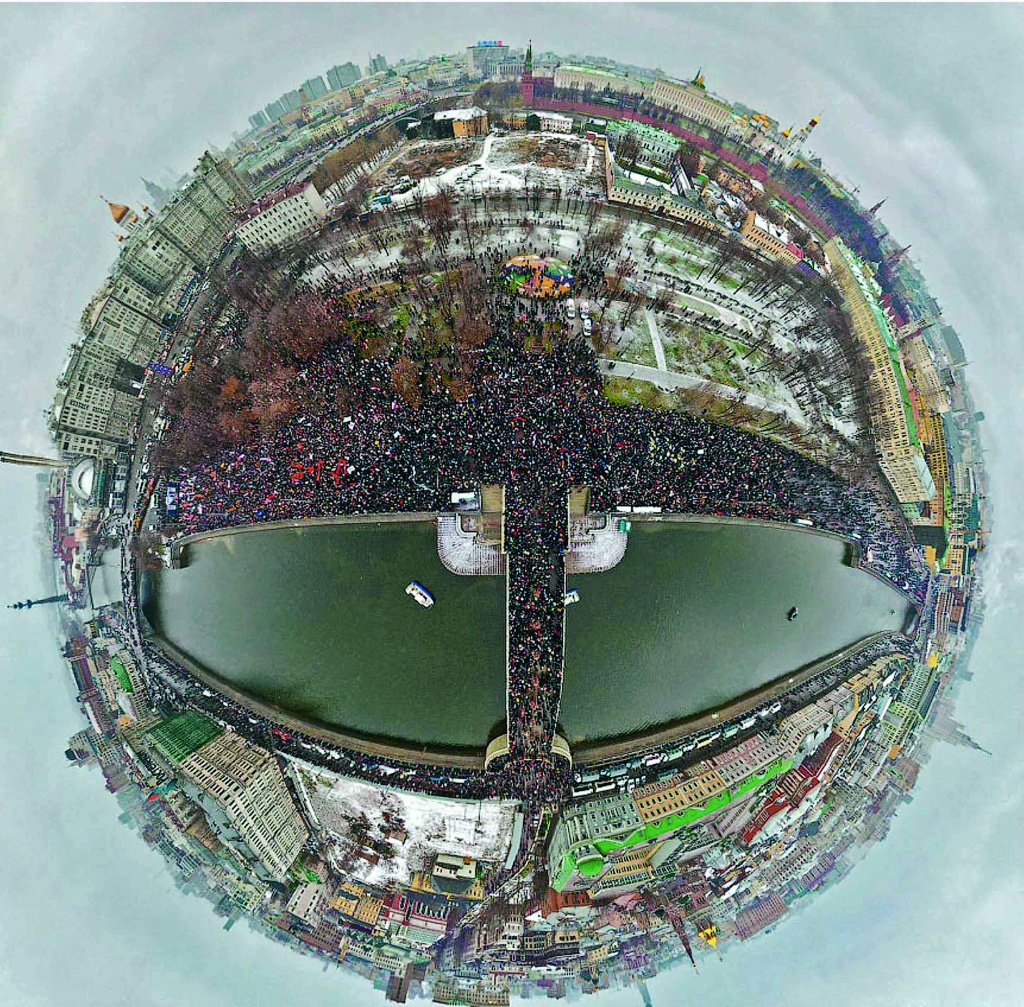
A rally in Bolotnaya Square "For Honest Elections" gathered tens of thousands of people. Moscow, December 10, 2011/ Photo: Stanislav Sedov/ aripano.ru
"Non -resistance to evil leads to its absolutization"
Lukino Visconti about the film "Death of the Gods", 1969
Three years ago, a new type of protest movement began in Russia, which was then called “swamp” - according to the name of the area located, according to the exquisite irony of history, directly opposite the house on the embankment, the “House of Ghosts” of the Stalin era. When peaceful protests began, when the authorities did not know how and with what to answer them, when it imagined that the ethics of freedom could become the glue that the people would re -unite, at the intellectual meetings, the dispute was spent only about one thing: how many Putin’s regime remained. I remember that at one of these meetings, Marietta Omarovna Chudakova gave this Ancien Regime for two years ... Three years passed, and the landscape after the battle looks dull and hopeless, as during the years of stagnation, when the time was "old", the protest was atomized and spread out in the kitchens, and the regime, as well as then, seems to have three or four years ago, seems eternal.
Where and why did the protest disappeared? Or did not disappear?
The catching up the revolution
Now no one remembers this, but one of the reasons for political turbulence - although not the main one - was Dmitry Medvedev’s refusal from modernization and run for a second term of his right. In other words, the “castling” of September 2011, when Putin’s return to the presidential post and “compensation” by the locomotor in the form of the prime minister’s chair was announced.

"Screaming" only gave food for thought and an occasion for indignation. But the defiant, deliberate, not hidden dishonesty of parliamentary elections on December 4, 2011 blew up public opinion. On December 5, during the rally on the Moscow Chistoprudny Boulevard, more than 300 people were arrested. On December 10, about 150 thousand people gathered in Moscow in Moscow. It was in its pure form an ethical protest - that is why people who were never interested in politics came to Bolotnaya Square, and Putin was quite satisfied for the time being.
The basic ethical motivation was described decades before this by the famous Soviet dissident Larisa Bogoraz, who explained to the court in his last word, why she went out on August 25, 1968 to protest against the introduction of Soviet troops into Czechoslovakia: “I faced a choice: to protest or remain silent. For me to keep silent - meant to join the approval of actions that I do not approve. To keep silent - it meant to lie for me. "
But, in addition to ethical, there was and - conscious or spontaneous - political motivation. The state, which needed social and political modernization, actually openly stated that there would be no transformations from above - Medvedev's inglorious departure and dishonest elections became evidence of this. The society, in any case, is the best part of it, and by no means chamber in scale (although the “chamber” according to the consequences of civil activity), the state was ahead of its development. And presented the demand for changes.
The authorities were not ready to satisfy this demand, without realizing that the revolution does not happen on the streets and squares, but in the heads of people.
The protests of 2011-2012 became an attempt (which cannot but repeat it, because the country is not modernized, but is archaized even more than before) to complete those processes of democratization of the policy and liberalization of the economy that were not completed during the Gorbachev perestroika and Gaidar reforms. This, in the terms of the philosopher of Jurgen Habermas, "the revolution of reverse rewind", or "catching up with the revolution." It is precisely the nature of the “color revolutions” and any “spring” - even Arabic, even Russian.
President of not all Russians
Swamp Square and the subsequent reactionary turn of the authorities after the presidential election (Anti -Ezen - 2012) ended with the model “President of all Russians”. Vladimir Putin decided to represent the interests of a certain part of society, but not of all Russians: in the class oriented on the value of democracy and the class market, he was disappointed. And did not forgive the protest of 2011-2012. Hence, by the way, its budget fetishism is at any cost to raise money to the budget in order to buy the loyalty of security forces and closely close social strata to him, which are part of a very extensive “class below average”.
He has a separate social contract with representatives of this class: he does not allow them to fall into poverty, without requiring any increase in labor productivity there, in exchange for which they show indifference to external circumstances of life and vote for it (according to the Russian economist Tatyana Maleva, “class below average” includes 70 % of the population, and 40 % of this number-a group of risk of poverty).
A similar case is described by Karl Marx in the work of “18 Brumer Louis Bonaparte”: “Bonaparte would like to play the role of a patriarchal benefactor of all classes. But he cannot give any class without taking away from the other. ”
"
“The authorities were not ready to satisfy this demand, without realizing that the revolution does not happen on the streets and squares, but in the heads of people”
“Hence the model of the artificial division of society into the right and the wrong:“ Swamp ”against“ Poklonnaya ”,“ Bobrous fur coats ”against“ Uralvagonzavod ”,“ Fifth Column ”against the“ Man of Labor ”,“ White Ribbon ”against the“ St. George ribbon ”.
The Kremlin chose the strategy of a very strict “plum of protest” of citizens who are focused on changes. For the same reason, a course was chosen to suppress unauthorized civil activity. The state speaks with the help of a budget with their own part of the population, which is successfully replenished due to the devaluation of the ruble. True, with impaired resources. And if the authorities are afraid of protests, then it is precisely to the part of the society that she herself holds for "her".
And another important detail of that stormy winter. In the civil protest of 2011-2012, nationalists were lost, who dreamed of entering power in the wake of the public movement, which raised all the boats. Although they managed to partially discredit the opposition and its coordination council (the researcher of Russian nationalism, Alexander Verkhovsky, writes: “Firstly, xenophobic slogans were little involved and unpopular in the protest movement. Secondly, the vast majority of radical nationalists did not consider it possible to participate in general marches with liberals and left.” “Ethnic policy of the federal government and activation of Russian nationalism.” Having turned patriotism and nationalism into mainstream, the power of the nation, the authorities, in turn, marginalized the actual nationalist movements, clearly demonstrating who the main nationalist is here.
This circumstance, among other things, contributed to the lower radicality of marsh compared to the Maidan.
Protest evolution
The willingness of citizens to protest both by political and economic reasons to almost historical minimums.
Personal readiness to participate in political protests in October 2014 - 8 %, in economic - 12 %.
On the one hand, this is understandable: a high wave cannot be endlessly long, and the hard response of the authorities discourages - not everyone wants to sit in prison. Patriotic postcrymic carbon fumes objectively reduced the degree of protest activity. In addition, the “flight of freedom” turned out to be a more massive phenomenon than a civil protest. In the classical work of 1941, Erich Fromm wrote: “Having become part of the force that a person considers to be incomplete, eternal and beautiful, he becomes involved in her power and glory. The individual completely renounces himself, refuses the strength and pride of his “I”, from his own freedom, but at the same time acquires a new confidence and new pride in his involvement in the power to which he can now consider himself. ”
However, while the authorities were dealing with the threat of a “color revolution”, in its complacency it looked at new forms of protest - an example of this is the protests of doctors in Moscow, the degree of which could be more radically. Moreover, the protests themselves begin to come from the “socially close” layers for power, whose loyalty the Kremlin is very valuable. This is no longer an ethical protest, but social. But like the ethical protest, it has been politicized, and the social carries similar risks. The population begins to notice the connection between the policy of the authorities (Crimea, antisancies, tax pressure) and a decrease in the quality of life and inflation.
Swamp VS Maidan
There are several reasons why the protest movement in Russia did not lead to a change in the political regime.
One of them: there is no oil in Ukraine. The absence of oil and gas rents does not leave a maneuver for the purchase of loyalty of the population with point social payments.
The second - unlike Ukraine, which is divided into two parts, Russia consists of many Russia with its way. According to the concept of economy geographic, Natalia Zubarevich, there are four Russia: the country of large cities; country of medium -sized industrial cities; The country villages, villages, small cities; North Caucasus and South of Siberia. In this sense, it is more difficult to consolidate the protest movement of the Russian Federation.
The third - to the protests on Bolotnaya, unlike the Ukrainian Maidan, did not join the most aggressive participants in the revolution. However, the Russian government arranged demonstration processes and sent to prisons and camps for three “swamp affairs” 12 people for terms of 4.6 (daring) to 2.3 (Belousov) years, thereby trying to consolidate the idea of the “frostbite” of the Russian opposition.
Finally, the Russian State Spopaganda did everything to imagine the Ukrainian Maidan as a “fascist Sabbath”, which he was in no way, despite the fact that the radicals were also enough there. The television picture and even more comments on it for many made it in our country to move away from the protest movement. Krymnash gave a convenient reason to support the authorities.
The revolution in Russia is a lasting process. And this process is not finished. The political regime is marked by the seal of Bonapartism-“current stability with long-term instability” (V. Mau, I. Starodubrovskaya, “great revolutions: from Cromwell to Putin.” M., 2010, pp. 519-520). The tripod “President, Church, Army” is kept on the Klee “Crimean”. But there is no second glue, and the policy of the authorities has already led to stagflation and confidently leads to recession. Power await new challenges.