
Translated material
Days of science in Ukraine under a microscope

Is it possible to independently select DNA from an apple? What do human blood cells look like under a microscope? Why do transgenic mice shine in an ultravioletus?
Scientists of Kyiv and Kharkov answered the above and many other questions during the days of science on November 8–9. And not academic, but giving the opportunity to consider, feel or make it ourselves, of course under the strict leadership of the demonstrators.
The days of science are a public initiative, a project organized by young scientists of the National Academy of Sciences (NAS) of Ukraine to popularize science. Its format is largely different from such events that were organized earlier and made the main emphasis on lectures and seminars for fairly trained listeners and round tables for scientists. The main idea of science days is to make all scientific events as popular as possible, as well as convey information about the event as a wide range of people. That is why demonstrations, popular science lectures, excursions and master classes were available to everyone who is interested in science, regardless of the level of knowledge or age. An important component was that those interested could visit directly scientific institutions where demonstrations were held, and to some extent see the scientific world from the inside.
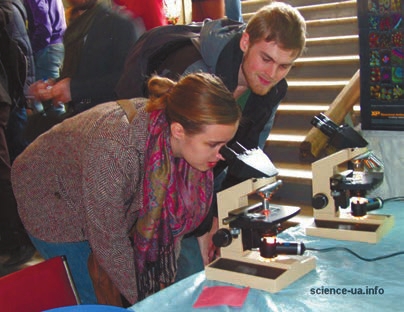 It began closer to dinner on Saturday: the people of Kiev had the opportunity to visit museums of Kyiv National University (KNU) to them. Tarasa Shevchenko: archaeological, zoological, geological, KNU history. After lunch, the door for those who wish was opened by the National Museum of Medicine and the Department of Folklore of the Institute of Philology KNU, whose employees conducted master classes for children and adults, as well as a lecture with elements of demonstration and the participation of a folklore group. Toward the evening, astronomy lovers were accepted by the main astronomical observatory of the National Academy of Sciences of Ukraine and the Astronomical Observatory of KNU. Here, in addition to the tour of the observatory itself, you could look at the moon, Mars, and also listen to fascinating lectures.

On Sunday, the festival of science continued. From morning to evening, the demonstration and lectures took place at once at three institutions of the National Academy of Sciences of Ukraine: mathematics; molecular biology and genetics; physiology named after O.O. The pilgrim. In the first, visitors had the opportunity to play mathematical games, dumping interesting puzzles, tasks, and listen to popular science lectures in mathematics. In two other institutions, it was possible to see fixed drugs of bacteria, mouse, rat tissues under the microscope, a person’s cell cultures, observe how the frequency of contractions of the isolated heart of the rat changes, learn to secrete DNA from the apple with “improvised” means, see how transgene mice glow in the ultraviolet, and many more interesting things.
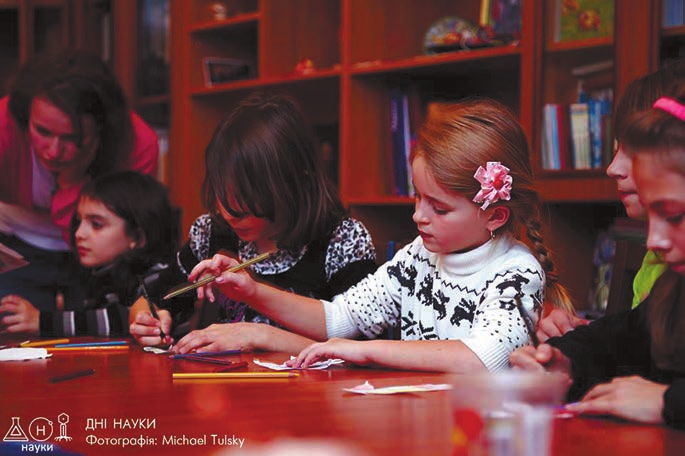 In Kharkov, fans of science on Saturday and Sunday had the opportunity to visit the Landau Center of the Kharkov National University (KhNU) named after V.N. Karazina and the cultural center Indie. Employees of two institutions of the National Academy of Sciences of Ukraine (the Physics and Technical Institute of Low Tempeks named after B.I. Verkin and the Radio Astronomical Institute), Khnu, as well as participants of the Kharkov “KhackerSpace” (KhackerSpace ”, the Boteon Robotics Center, representatives of the Boteon Courses (external independent evaluation) and GIA, held their demonstrations. Cosmos, student team of international optical communities (Ire-Sosa Student Chapter and Ire-Spie Student Chapter).
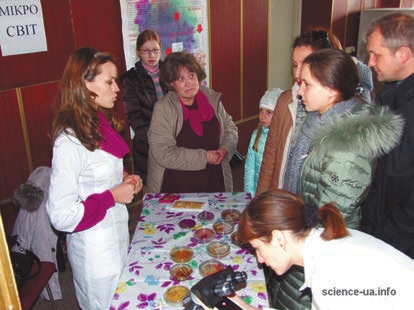 As the organizers in the field noted - and in total, in the days of science, more than a hundred employees of 15 institutions of the National Academy of Sciences of Ukraine, 7 museums and 3 universities were involved - the flow of visitors did not stop until the closure of the demonstrations. Schoolchildren, students, parents with children, as well as their grandparents came. Science, it turned out, is interesting to everyone - from five -year -old peanuts to ninety -age old men! It is not surprising that in just two days of demonstrations, popular science lectures, excursions in Kyiv and Kharkov visited from 2.5 to 3 thousand people!
It should be noted that the exhibition “The Art of Science”, which worked from October 30 to November 30 in Kyiv (Metrograd shopping center, Bessarabskaya Square, 2), was an important component of science, its highlight. The exposition included more than 30 large-format images of micro- and macromir obtained by scientists of the National Academy of Sciences of Ukraine using modern equipment: confocal, electronic, scanning tunnel, nuclear-power microscopes, radio telescopes and powerful computers.

Of course, such a large -scale event as the days of science, the forces of some young researchers, representatives of the Soviets of young scientists of the National Academy of Sciences of Ukraine, would be almost impossible to make. It was realized thanks to the support of many more people and organizations. The co-organizers of the days of science were the public organization Unia Scientifca and the Popularizatorship project “My Science”. The main partners of the event were the National Academy of Sciences of Ukraine and the State Unitary Enterprise “Humboldt Club”. Information support was provided by the Self -Help OO “Self -help”, the project “Scientific picnics”, as well as the Small Academy of Sciences of Ukraine.
The days of science are only a small drop that contributes to an almost dry source of popularization of science. A lot of work still has to do. But the results are already inspiring today. I would like to believe that over time the source will turn into a stormy river. After all, science is actually unusually exciting and interesting!
Photo a . Tyutyunnikova