
Translated material
The end of the world and the edge of the world
 The laureates of the Enlightener Award for the best popular science book of the year were the young scientific journalist Asya Kazantseva , who told us about the nonsense that we are forced to perform the brain, and the gray-haired historian Sergey Yarov , who told about the everyday life of the besieged Leningrad. The presentation ceremony was held on November 20 at the Russian Academic Youth Theater.
Behind the edge of the world
Two books on biology and two books on physics, including “Breakthrough over the World”, Boris Stern, Dr. Fiz, fell into a short list of natural sciences. -mat. sciences, chief edges of the newspaper "Trinity version - science", which you are holding in your hands.
- A beautiful, eternal, immortal engraving with a man who pierced his head with his head of a known universe ... What would he see there now? The same heavenly machinery? -the presenter Evgenia Timonova, familiar to the general public under the program “Everything like animals”, dreamily.
- Now the analogue of that person is studying the subtlest signals and adjusts the theory to completely insignificant effects that the cosmic telescopes of microwave radiation see. Behind the edge of the world is an infinite number of other universes that are completely unlike ours. Or maybe, on the contrary, similar, even inhabited. But we will never see them. We can only reconstruct. But is it bad?
Gennady Gorelik, a researcher in the Center for Philosophy and the History of Science of Boston University, was nominated for the award for the book “Who invented Modern Physics?”.
- Literally one name: who? - exclaimed another host, book critic Konstantin Milchin.
Gorelik did not hesitate:
- Galileo!
- Why? The great popularizer Mitio Kaku in two minutes tells the theory of Super Strun. Can you retell your book in two minutes?
- Why Galileo, I can’t say. Geniuses are born where the Almighty wants, ”the scientist retorted and noticed that in that era not only modern physics was born, but also new music, and also expanded a person’s ideas about geography.
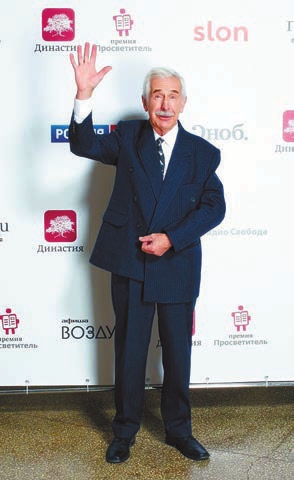 Sergey Izhevsky, Doctor of Biological Sciences, Professor of the Department of Ecology and Forest Protection of Moscow State University of Forest, one of the co-authors of a generous illustrated album “Life of wonderful beetles”, shared unexpected information about his wards:
- Beacles, by your information, 300 million evolutionary years. And a person exists 200 thousand years. The beetles are much ancient and acquired in the process of evolution a lot of properties that we do not even think about: for example, flight abilities, extraneous digestion (a terrible thing, unknown to you, but very exciting), range and much, much more.
The audience began to whisper: are all these miracles waiting for our grandchildren?
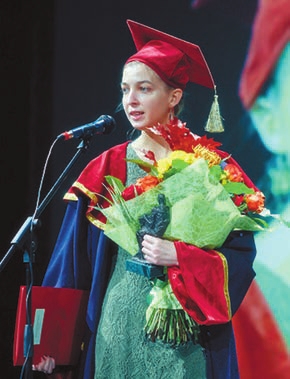
Scientific journalist Asya Kazantseva, author of the book “Who would have thought?”, Was concise and ambitious:
- To live, knowing how much nonsense it makes us make the brain, much more fun, more interesting, more exciting than
If you do not know about it, because of any stupid things you can make fuel for great life achievements.
The results were summed up by a member of the jury Ilya Kolmanovsky, a biologist, a school teacher, a journalist and a civil activist:
- In my memory, this is the most difficult year of the jury in natural sciences. All books of the short list are very strong. An amazingly transparent, easily readable history of physics, which allows us from antiquity it is very comfortable, it, it is possible to reach the present. The book “Breakthrough beyond the World” for the first time in my memory of participation in the jury is a very direct, authentic, direct broadcast of the invaluable voices of leading scientists in the field of cosmology living around the world. Almost no one does this. The third book is very, very many beetles. The very number of this detachment outweighed all the arguments in my eyes ... We thought to give two or three bonuses at once, we had a dispute about how many bonuses it could fit on the tip of the needle. For the jury it was an agony. Then we pulled ourselves into our hands and awarded one award: the book by Asa Kazantseva "Who would have thought?" The book is great published, well sold. I hope we are a sip of its sales. In fact, the choice was simple. We live in the era of the third epidemiological revolution, when the duration and quality of life is no longer determined by either wars or epidemics. The duration and quality of life is determined by the personal choice of each person:
Should I play sports? Do you consume sweet and fat? The most toxic environmental element for our brain, which has not changed biologically in a hundred years, is calories. We live with someone else's creature inside us. He has no hands and eyes, but he makes all decisions for us. How to negotiate with him? You will find an answer in the book of Asi. In addition, you will find out how much you can eat and why a woman turns into raspberry jam. But personally I found under
This cover is much more valuable. Temporarily forget about the nominee that we are honored today. There is a lyrical hero here: a person with a good education and a good taste, but not a specialist, although he should figure it out. A person who has common sense, the ability to fold two and two and another vital skill: read in English.
 This figure, it seems to me, is savvy for the situation in which we are all. The lyrical hero is breaking through an important barrier. In the sciences of the brain in the last ten to twenty years, new knowledge has been accumulating very quickly. And the lyrical hero is aware of everything, he is on the tip of the needle. He gives an important signal to everyone who knows how to read: let's figure it out, let's apply common sense. And the author chooses the language of equal dialogue with the reader, he clearly draws a line: it is clear how everything works, but here I myself do not understand - maybe you will understand? The author freely balances, applying fundamental knowledge to everyday life. This is done all over the world, but in Russian, in my opinion, such a book is published for the first time.
Asya Kazantseva accepted the award more than modestly, even self -fascinating:
- According to the mind, you need to give a bonus for books in physics. With the popularization of biology, everything is not bad in the country, and with the popularization of physics worse. It is probably important to support her. I have a version why they gave me the award. This is probably something like a quota for representatives of small nationalities. As far as I know, a girl never received a prize in this nomination before, especially a 26 -year -old girl. This is probably not to me a bonus, this is a signal to all other girls: you can write such books and receive bonuses.
- You see: she has a hypothesis, and she wants to figure it out. She checks, including my patience, ”Ilya Kolmanovsky smiled.
In the face of the end of the world
Adelaide Svanidze, Doctor of Historical Sciences, Professor of Moscow State University, employee of the Institute of General History of the Russian Academy of Sciences, the mother of the famous TV presenter, was not able to attend the ceremony due to an advanced age, but her performance was founded by vital energy:
- The topic of the Vikings has been interested in me for a long time. But then we only had a scientific school in the literature of the Vikings. It was headed by Academician Mikhail Ivanovich Stublin-Kamensky, a Leningrad, who created a completely magnificent school of Sagutians. They translated brilliantly, I can’t translate it like that. But these were people not busy with history. They considered sagas as artistic works. I saw in the sagas the richest source of historical information that especially excited me, and this is why: about sagas it was written a lot abroad, but basically historians write about conquerive campaigns, about Viking robbers and Viking-traders. I was interested in something else: their inner life, their civilian life. How did they live at home? What was their family? How was the marriage organized? What were the relationship between a woman and a man? What was the power? The structure of society? Who dominated, who obeyed? What was their farm? What did they eat and what did they drink? - Then the face of Adelaide Anatolyevna broke into a smile. “And how did they get this food?” In what way? How did they relate to wealth and poverty, work and laziness, honor and dishonor? I wanted their life to look alive for us so that we would approach the Vikings and see the living people in them who suffered, worried, fell in love, cheated, revenge, defended their honor, sued. And then I realized that I should write a book in a very special language. This should not be the language of scientific works that I wrote until then. It should be a free language of free Russian speech. I adore it and write poetry on it. The book about the Vikings is the best that I have done in life. I know that! I have 7 books, 400 works of various types and class. But the book about the Vikings is my joy. She was released to my 85-liter anniversary, making me an incomparable gift. I'm happy. This book is my happiness!
Olga Weinstein, author of the book about Dandy, Doctor of Philological Sciences, senior researcher at the Institute of Higher Humanitarian Research of the Russian State University, was not so verbose and limited to paradoxical words that the dandy of the XIX century could be laid in many ways of modern PR techniques (you can read a lecture on the rules of dendism in the Trv-Sales No. 166: [1] ).
Further, the ceremony passed to a pathetic register: it was a question of the disasters of the past century.
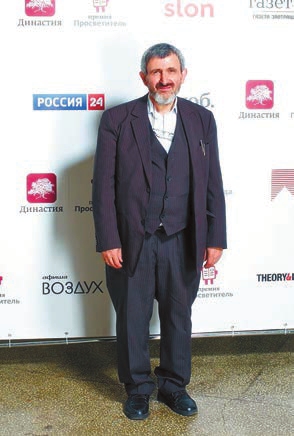 Initially, Pavel Polyan, a researcher with versatile interests, took the stage: a specialist in the geodemography of coercive migrations and the work of Mandelstam, a translator and commentator miraculous diaries of Auschwitz Santercommand, who, by will and willy, were forced to work with the Nazis at the same time.
- In the book, one motive is often repeated: "We were no longer people, we were animals." At what point does a person cease to be a person? - unexpectedly seriously asked before that cheerful presenter.
“This, it seems to me, is not immediately, but quite sharply,” Pavel Markovich answered after a long pause. -When a person understands that in the Circle of forces that he individually cannot overcome, he surrenders, and the processes of dividing begins to prevail. You can’t defeat them alone. When a community of people who understand what is happening to them is formed, understanding that something can be done together, then something happens that allows these people-everyone separately and to everyone together-still try to return to the human state. The uprising of the Auschwitz Sonderkommandy on October 7, 1944, as it seems to me, is just an attempt to such liberation.
The topic was continued by Sergey Yarov, Doctor of Historical Sciences, Professor of the European University in St. Petersburg, the author of the book on the daily life of the blockade Leningrad.
- We just talked about how sociality helps people remain people. And what mechanisms are launched in society when conditions incompatible with life arise around? How does society save itself from destruction? - the presenter was inquired. - You wrote a lot about the blockage politeness - about the phenomenon that previously not exist ...
- I think the main mechanism is to resist. When you see that living space is narrowing around you, resist. When you see that people are falling, resist. Resist any path, in any environment, - a historian said quietly, but firmly.
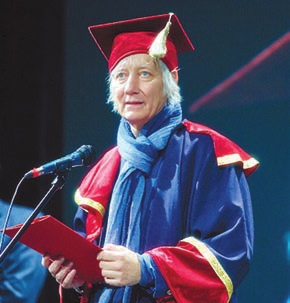 The winners in the section of the humanities were represented by one of the members of the jury philologist Slavist Viktor Sonkin. He scattered in compliments to the authors:
- If you retrospectively look at the short list, it turns out: all these books are incredibly relevant. A book about dandy says: you can be a good person and think about the beauty of nails, including in the era of historical collapse and decay. People who think about the beauty of nails often turn out to be much more sensible than those who think about something else. At the moment when the issue of consumption, fashion, food, Hamon suddenly became politically painted, this book was incredibly relevant. The remaining three books amazingly speak of the same thing. They are all about the end of the world, regardless of how this end of the world is called: Ragnarok, Holocaust or the blockade of Leningrad. It seems to me that there is no need to explain why this is relevant. But in each of these books there is a bit of hope for all of us. The book “Vikings” refers to civilization, which is no longer there, but if we look at the states that are now on the traditional lands of the Vikings, we will see: these are the most prosperous and happy states in Europe, and maybe the world. It is clear to me, as a person who wrote a book about Rome, that any barbarians cease to be barbarians sooner or later. In this sense, the Vikings are hope for all of us. The book about the Jewish Sonderkando makes it very clear: even in the most terrible episode of the history of the 20th century, everything is very difficult, there are no one hundred percent villains and one hundred percent
Angels, even in the history of the Holocaust, not all black and white, there are gray areas. It seems to me that right now it is important to realize: the world is difficult, it is impossible to immediately divide everyone into lambs and goats. The book about the besieged Leningrad says: even in the most monstrous situations, a person can remain human. In the days when all news and thoughts rush in a small gap from eschatological to apocalyptic, it is quite important and, if you like, an optimistic thought.
The winner was Sergey Yarov. He accepted the reward in a restraint:
- I do not overestimate the virtues of my work. The main thing in the book is evidence of the blockade themselves, and those who died in this monstrous disaster, and survivors. The evidence is terrible, amazing. They make them not just get acquainted with how it is customary to say, but to re-make. They make a person cleaner, noer, softer. This is a moral act: to return to life evidence of the suffering, torment, inhuman tortures of these unfortunate people. I will give only one example. We found in the archives a blockade diary of an unknown girl. It turned out that she worked after the war with a plaster, lived in a hostel, then in a communal apartment, often treated, did not create family, did not give birth to children. She had nothing, only the memory of the blockade. For three years, this diary was reprinted in ten countries, the responses were colossal. The publication of this kind of documents is primarily a moral act.
P.S
After distributing elephants, members of the jury and laureates went on stage for a shamanistic action called “Collective Selfie”. The final words said the founder of the Dynasty Foundation Dmitry Zimin:
- I pray to the Almighty that among the slurred all of our traditional Russian holidays (some with tears in their eyes, and some generally meaningless), we would have a holiday of enlightenment, a festival of knowledge. However, it seems that it has already taken place today. Hooray!
Alexey Fire