
Translated material
Ukraine and Russia: Historical gap Part III
Around Russia
 Ukraine and Russia: Historical gap Part III
December 3, 2014 Vladimir Nadein
Democracy against the vertical
The war would not have been needed, but Putin was not lucky with Ukraine. The wrong country. Failed. Everyone will breathe a sigh of relief if it disappears from political maps. Putin began to openly talk about this ten years ago. True, at closed meetings. He explained this to the presidents of Bush, Obama and Sarkozy, the Secretary Generals of Hu and Si, Chancellors Schröder and Merkel, Prime Ministers Blara, Cameron, Tusk, Medvedev, Erdogan, Berlusconi. Only Medvedev really understood him.
The obstinacy and impudent self -will of the Ukrainians always annoyed Putin, but at first they seemed a legacy of bad childhood. The disconnecting of gas and the diplomatic severity of the "older brother" were supposed to accelerate re -education. But time passed, and what looked like a random was manifested by a deeply rooted essence. The viciousness of Ukraine was innate.
This manifested it with particular distinctness after 2000. Even if not soul to soul, Yeltsin nevertheless got along with Ukrainian colleagues Kravchuk and Kuchma. Serious conflicts began under Putin, gaining momentum every year. During all the years of his long rule, Putin ruthlessly exposed the “color revolutions” of Ukraine, and the rebel Maidan stigered as a source of all Ukrainian misfortunes. This criticism has met support from a significant part of the Ukrainian community. Only a year and a half ago, public opinion polls showed that 47 percent of the population of Ukraine belonged positively to Putin. Neither Viktor Yanukovych, then the president of the country, nor his irreconcilable rival Yulia Tymoshenko, who was sitting in a Kharkov prison, nor, moreover, the progressive oligarch, three times retired minister and ordinary deputy of the Verkhovna Rada Petro Poroshenko about such ratings did not dare to even dream.
All these years, Ukraine looked from the Kremlin windows with a beggar and ragged, longing for a hard Soviet hand. Half of the Ukrainian politicians signed monthly in the Moscow Gazette. Two -thirds of the Ukrainian generals carefully collected copies of everything that was in the safe of the Ministry of Defense, and, not particularly hung, sent them to Moscow. The mayor of Luzhkov entered Crimea solemnly, like Heydrich in Prague. The most printed Ukrainian newspapers were published for gift rubles. It is simply unbelievable that Ilovaysk needed such a limp country for reasoning.
Ilovaisk, a railway town on the very border of Ukraine and Russia, in the Russian media has already been called a mini-stalingrad. At the dusty walls of this provincial village in August, the main battle of the "Hybride" was held. The Ukrainian military leaders created a shock group in order to cut off the rebellious Donetsk and Lugansk from the supply bases in Russia and close a huge hole in the state border. The operation had a chance of success, but Russian artillery hit Ukrainian battalions. Firing positions were placed at the border itself, but on its own, Russian territory. Now it has come back to normal, and then it was a curiosity. Reply with fire to suppression meant to unleash a large real war. Observers claim that Kyiv abandoned the return fire just because Moscow voluptuously anticipated just such a turn of events.
A thousand Ukrainian troops died near Ilovay. Losses “from the eastern side”, as usual, are strictly classified. The Ukrainian media, which do not know censorship over themselves, consider Ilovaying events an unforgivable defeat of their army and require the punishment of the perpetrators.
In the wake of Ilovaisk, the Prosecutor General of the country opened a criminal case. The Ministry of Defense of Ukraine was angry. The highest military leaders categorically objected to the fact that civil officials evaluate their operational art. The head of the army Valery Geletey promised to announce the details only after the operation to liberate Ukrainian prisoners will be completed. And the adviser to the Minister of Defense said that “excessive attention to the situation around Ilovaisk is the plan of the special services of the Russian Federation. The enemy aims to provoke panic and protests among Ukrainians, to promote the organization of rallies demanding to resign the heads of the General Staff, the Ministry of Defense and the ATO command. As well as paralyze the victorious spirit of the patriots. ”
The familiar position of the Soviet general: Beat your own, so that strangers are afraid. These arguments are still respected in Russia. In a democratic country, they are not afraid to “paralyze the spirit”. From the presidential administration where the generals complained, there was a strict explanation that from now on it would be necessary to get used to civil control. At the same time, General Geletey was also removed - the third minister of defense over the past six months.
In the Verkhovna Rada, a deputy commission was created for the investigation, but now, after extraordinary parliamentary elections, the commission is likely to be updated and only then - the resumption of work. In the new composition of the Rada, the commanders of the National Guard are widely represented, they have accumulated claims to the army command, and this can also slow down the parliamentary investigation.
So far, success gives each of the parties a reason for careful optimism. Ukrainians won Slavyansk, Kramatorsk, Mariupol, but missed a painful blow near Ilovaisk. The gap in the border is not closed, in the day and night, the columns of trucks are snooping back and forth. The assault on Donetsk and Lugansk is unlikely to be possible in the foreseeable future. In the Epistle of the Verkhovna Rada about the position of the country, Petro Poroshenko had never said the word “Crimea”, somehow without the previous militancy he also spoke of “peace in the Donbass”. The impression is that he had already reconciled with the idea that it was Russia that would be given the honor to supply, feed and maintain both the unpromising peninsula and the former “All -Union Stove -up” beaten by all artillery.
If we summarize the intermediate results of the period of the war, which ended with Ilovaysky, then we can say that the democratic structure of Ukraine and the personalist state system of Russia show themselves in a completely predictable way. In the already mentioned extraordinary message about the situation in the country with which Poroshenko spoke to the newly chosen Verkhovna Rada, he said: “In the end, the main difference between Ukraine and Russia is not only and not so much in the language as in the political culture, which was demonstrated during the elections and during our revolution of dignity. In different types of relations between power and society and in different attitude to freedom. ”
The difference between the two modes, undoubtedly, manifested itself in the elections of the president and parliament. However, it is more visual and versatile. It is reflected in the nature of the war. It would seem that it was in the battle of the mumble-democrats that are blown away and worthless, while the cloth stick of the indisputable leader drives the soldier forward, making them heroes from hopelessness.
Ukrainians through their teeth, but still admit that they lose to Russia in propaganda. Not without envy, they look at 85 percent of Putin's support. In Russia, silence and order, this is a fact. In Ukraine, vanity and confusion. The hryvnia rolls down, and people in the squares and through television screens pester their leaders with claims, and often curses. Democracy equally allows both.
The ruble in its fall daily sets records, far ahead of the hryvnia. But Russian screens are babbling comforting nonsense, and ministers for direct conversations are inaccessible. Putin said that the empty ruble makes his homeland richer, and this deliberate delirium became indestructible axiom.
Only the Minister of Internal Affairs of Kolokoltsev came down to communicating with the masses, albeit not face to face. The minister honestly warned the fellow citizens so that they would not think to frivolously enjoy their constitutional rights to meetings and rallies, at least remotely reminiscent of the Maidan, since "this will never, in any of the scenarios, would take place in the Russian Federation."
If dozens of Kolokoltsev’s predecessors in internal affairs, from the shot minister Plee to the fired Minister Pugo, could be from where they are now, to suggest something useful to their descendant by profession, they would say: never say. Because the people, even so nailed and bent as current Russians, know how to create such fantastic scenarios that not to predict, not to disperse and shoot a single cop. And what is insulting, the fantasy of the Russian masses in the smallest degree depends on the internal troops in Balashikha, and in the largest-on the Sheikhs of some Er-Riyad.
And yet, you see, this is very strange. Putin's rating is in space heights. The helpful VTsIOM not so long ago outlined the approval of the leader with fantastic 100 percent. With such an adoration - why and internal troops? To crush something-who?
The rating of President Poroshenko, for the first time in the many years of chosen by Ukraine in the first round, barely exceeds 50 percent. Does this mean that the Ukrainian Armed Forces will run from trenches twice as of the cowardly Russians? It is unlikely. Democracy and despotism have very different arithmetic. It is proved by history: if the people leads round roundabouts around the leader in such a simple -minded glee as in present -day Russia, it means that something vital is rotten in the womb of the state. It’s just that your percentage does not stink.
President Poroshenko invited the parents of Mikhail Zhizhevsky and handed them the order of heavenly hundreds, which was posthumously awarded a young Belarusian from Gomel. Mikhail died on the Maidan, he was the only son in the family. Of course, we were often deceived, and we know that all these big bosses are also large masters in part of television fakes for a gullible public. It is enough to recall the Greek amphoras from the bottom of the Taman Gulf or President’s race and the prime minister on corn combines. But there was something completely different. It is difficult to retell, you need to see and hear. Twenty minutes, eyes in the eyes, the president respectfully talked with two elderly people, explaining why he would certainly do this, but here he could not, but he will try.
For all the years of his reign, Putin was not close to ordinary people three times as Poroshenko does daily. Between Putin and his interlocutors, no matter how carefully they were searched in the dressing rooms, the security cordon is always strictly observed, where the entrance is forbidden to outsiders.
And outsiders - who? In the bloody "events in the east of Ukraine" they died, became disabled, thousands of Russian soldiers and officers were injured. "Resters"? Unemployed volunteers? Unknown losers who accidentally fell under random mines on unknown maneuvers? What difference does it make! Neither the President of Russia, the Prime Minister, or even the Minister of Defense, did not want to communicate with them or their inconsolable families.
In vain in the Kremlin, they think that the barbecue of disgust for people in the war does not affect the course of the war. The despots are always deceived, hoping that living people, becoming a “cargo 200”, are numb forever. They will be convinced that times will be scrolled and “cargo 200” will speak.
“Why can there be a connection between the country's choice - to start or not to start a war - and the political regime?” - Associate Professor of the Higher School of Economics asked in the Vedomosti newspaper, Alexei Zakharov answered: “In many ways, this is a matter of benefits and costs for the first persons who directly make the main foreign policy decisions. In a undemocratic country, the leader does not always carry equal (like the rest of the country) costs if the country loses the war. History knows many examples when the defeat in the war seems to be a victory by official propaganda and only strengthened the power of the dictator. ”
The author does not consider it possible to limit his analysis by general provisions, specifying it as follows: “But what about Russia? Our authoritarian regime is protected from liability under the control of the media, the ability to manipulate the results of the elections and the absence of the judicial system. All this reduces the costs of the highest political leadership in the event of a military defeat. ”
People in the Kremlin understand their institutional advantages, but they also see inevitable losses, political, material, propaganda. Military defeat as a process has already begun. Ukraine is not a little Georgia, where something happened on the three vineyards. Already today the open front extends by 40 kilometers. A very probable line of combat clashes can reach the length of the Ukrainian-Russian border, one of the longest in the world. On both sides will speak in mutually understandable languages, communication is inevitable, and it will not be easy to give defeats for victory. What again confirms the already announced thesis: Ukraine for Putin is an uncomfortable country.
What about Putin for Ukraine? Last year's approval figures now, to zero, was washed away by the ninth shaft of hatred personally to the President of Russia. His words, his actions, his own appearance became a powerful negative brand in Ukraine. Songs are singing about him and sought by poems that, presumably, are unlikely to be fulfilled in the residence of the “Bochars stream”. Many unexplored Bandera, including the Right Sector, persistently propose to erect a monument to Putin in the center of Kyiv for special merits in the National Renaissance of Ukraine. He says Petro Poroshenko: “Not the last way thanks to Russia, because I don’t see what else to explain this, the number of supporters of Ukraine’s entry into NATO has increased.”
This is what a funny equation: Ukraine is inconvenient for Putin, but Putin is convenient for Ukraine.
The President of Russia, who is also the Supreme Commander, proved his outstanding political myopia. He did not see that Crimea was a hot pan with a handle, which Ukraine was tightly swept. He looked that the country he thirdly, only by the will of the chance, was helpless, but in fact has a powerful military potential. He did not foresee that the world would be outraged by its arbitrariness, would not be pleased with its lies and would not be afraid of either a gas shutter or a nuclear bomb. He did not calculate that Donetsk and Lugansk would hang in Russia on his neck with weights that are ashamed to drop and wear hard. And he still cannot believe a simple evidence that there is no forces to conquer the earth under the Gains born by the dreams of Novorossia. Money in the treasury is melting, Western sanctions are fierce, the bridge to the Crimea will never be built, and where to go with the world football championship is completely incomprehensible.
Only a year ago everything looked much more radiant. A weak fraternal neighbor, torn by straightforwardness and supreme theft, led a miserable personality, which has long been a snack with an outskirts of GB. Defense ministers dreamed of Russian pensions. Spies were reported first to Moscow, then to their own in Kyiv. The arrogant fanfaron came some Glazyev and taught Ukraine to live. In Washington and Bonn, in Paris and Beijing, people knew: you want to talk about a serious business with Ukraine - call Moscow. NATO did not occur to him to approach Russian possessions.
In Milan, German Chancellor Angela Merkel patiently expected Putin, who was late for four hours. The conversation began at midnight and lasted almost until the morning. The German woman spent another four hours in conversations with Putin in the Australian city of Brisben. And there and there, the chanclerin was tormented by one question: why? It was clear to her that the “Russian world” was a fiction that was not worth attention. That the liberation of the Donbass from the indistinguishable in the European microscope of the "Right Sector" is nonsense, not suitable even for the preposition to start a war. That neither Putin, nor Medvedev, nor Timchenko with a millionaire friends and for nothing need the resurrected Soviet Union from Vladivostok to the Carpathians.
Then - why? Putin is the main and probably the only person on the planet on which it directly depends on whether a large European war will erupt. What made him, an ignorant, impudent, cynical, but, of course, reasonable and possessing incomparable power, go to this strange adventure with the seizure of Crimea and the invasion of the Donbass?
When it comes to a personal despotic regime, the first thing is to look at the personality. Penetrating into Putin’s inner world is very difficult. This person is closed, dodgy, does not believe anyone and can professionally control himself. But the war breathes in our face, we don’t have any other way out, why we will go forward, not disdaining with little things and not fearing mistakes.
I invite you, my dear reader, in the next publication.
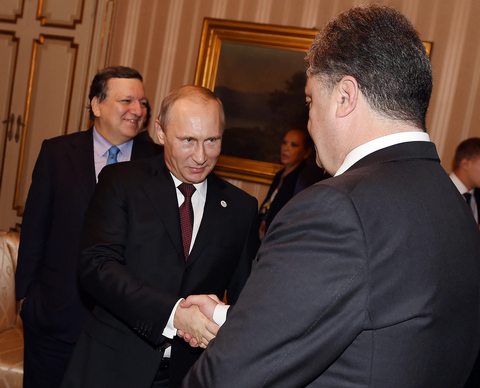
In the photo: 10/17/2014. Summit of the Asia-Europe forum in Milan.
Photo Daniel Dal Zennaro / ERA / TASS