
Translated material
Wrap you?
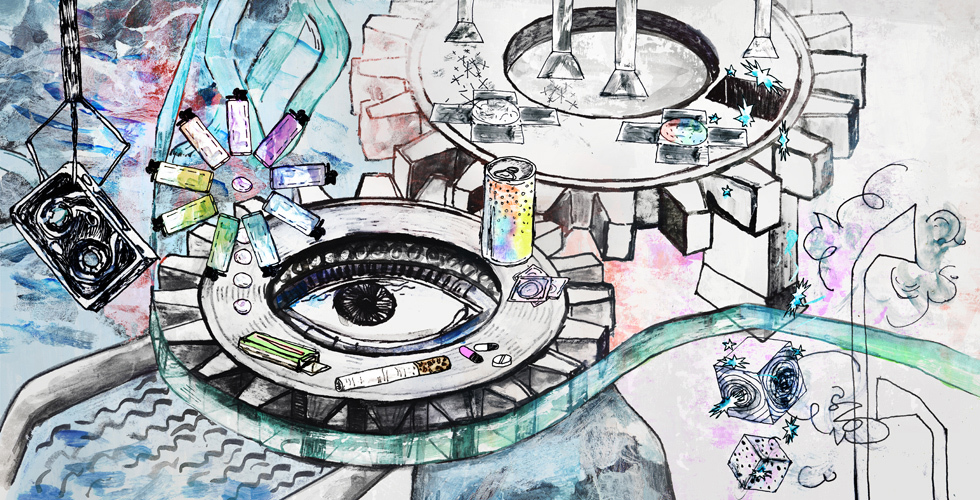
The Nazis were the first to start a state campaign to combat smoking, motivating it with concern for the health of the people - although from the moment when Columbus’s ships brought tobacco to Europe, and before Hitler came to power more than 400 years. Why did no one catch up before? Just smoking really massively started only by 1920, and all due to the fact that tobacco changed the package.
In 1875, the American schoolboy James Bonsak specially abandoned his studies to make and patent the machine for wrapping tobacco in paper in factories : until then it was done mainly by hand, the cigarettes went expensive, and sales did not go into any comparison with the current ones. Of course, the former tube, cigar and chewing tobacco were not suitable for consumption at a natural pace for cigarettes: took out - set fire - sent the cigarette butt with a click under his feet. For several decades, lung cancer has turned from medical curiosity into a common cause: before the onset of the 20th century, doctors described only 140 cases of the disease.
The consumption society made possible canned food and cigarettes, cartridges and tubes.
Papisor paper played a large role in this than Nicotine itself. Wrap, container, format, method of delivery is quite often more important than contents. And they make the wheels of progress spin, the authors of the book say. Robert Priktor, a professor of the history of science in Stanford, published several monographs about the fight against cancer in America and medicine of Nazi Germany. Gary Cross, a professor of Pennsylvania University, is an expert on the history of the 20th century, and, judging by the list of publications (“playful crowd”, “social history of pleasure”), consumerism in all manifestations is one of his favorite topics.
The consumption society made possible canned food and cigarettes, cartridges and tubes. The main turning point for modern medicine is considered to be the discovery of antibiotics-and Prikor and Cross propose to free this pedestal for a syringe invented in the 1850s. He allowed the drugs directly into the bloodstream, instead of that the patient swallow them. Why are pills and powders bad? The stomach neutralizes many drugs partially or completely; To achieve at least some result, you need a horse dose that causes a lot of side effects, and in the case of some substances it does not help. The syringe discovered a huge set of drugs, including the same antibiotics, the opportunity to reach our hearts - and literally, too.
Opium has been known about the anesthetic effect of opium, but in order for anesthesia for surgical operations to appear, it was necessary to “re -final”. In 1804, the acting substance of opium, morphine, which the doctors were finally able to finally dose - which could not be done with the MLC MAC juice, the composition of which changes from a portion to a portion and strongly depends on storage conditions.
The practical difference between the willow bark containing aspirin and the aspirin tablet is as between regular classes on the treadmill of 40 minutes a day and walking around the room from corner to corner.
In this example, by the way, it is easy to explain why conversations about “natural medicines” and generally New Age Clopes before the medicine of traditional crops, which, before the invention of tablets and ampoules, allegedly owned the secrets of healing herbs with roots. The willow bark containing aspirin and the tablet of aspirin is not the same thing at all; The practical difference between them is as between regular classes on a treadmill for 40 minutes a day and walking around the room from corner to corner when he gets bored with lying on the sofa. The essence seems to be one, but the packaging is different - and this turns into different results.
Behind the obesity epidemic are sweet soda in aluminum banks and SNECs, packaged 50-100 grams - examples of “super -eaters” and “hypereda” invented in the 19th century.
They learned to construct food in such a way that the nutritional value, taste and texture were combined in it arbitrarily. The brain expects from the taste endings of the forecast, which portion will give the body the right number of calories, but carefully repacticized ingredients make it make mistakes a larger or lesser direction. Jelly, exemplary surrogate of food, was born in 1896. Water, flavor, a little sugar-and gelatin, a tool for their packaging, invented by chemists 50 years earlier: it is he who is in the answer for the deceptive feeling of a voluminous piece of something edible. The chocolate, on the contrary, poses itself as a less high -calorie food. In 1847, the Swiss Lindt and the British Fry thought of mixing sugar with cocoa in the form of powder and oil, and then compress into tiles. The bitterness of cocoa allows you to consume more sugar, without feeling cloying sweetness. When, after 30 years, the product began to add to the mixture, the product completely conquered the world: in 1860, a million pounds of chocolate (450 tons) were eaten in the United States, and in 1898 - already 26 million pounds (11 thousand tons).
The authors interpret the word "packaging": in the sense in which the vinyl plate is packaged music, and the American slides are a packaged adventure. This can be considered the development of the design of the book by Susan Umbrella “On Photography”: instead of talking about chiaroscuro and composition, I decided to look at the photograph as a way to cut a piece of reality, pack it in a flat rectangle and start into circulation.
The plate contained two or three minutes of sound, and the songs should have been fitted into this interval. So there was a modern standard for the duration of the track.
Phonography, the authors say " Package Pleasures ” , could follow the path of photography. When Edison designed his phonograph in 1877, he did not even think of replicating music. The device was interested in it as a modification of the phone, which instead of transmitting sound through the wires, repeats it behind the speaker. The main function would be a sound recording, and in each house a heavy apparatus appeared for dictating thoughts and fixing family celebrations. The industry preferred another option: already in the Berliner gramophone, the prototype of Soviet players, the recording function was disconnected - and the gramophone became a device for the consumption of detached arias and symphonies. But first - genres with a rank lower: from an artistic whistle (literally) to episodes from operett.
The plate contained two or three minutes of sound, and the songs should have been fitted into this interval. So there was a standard for the duration of the track, the “units of music”, which did not change much by the time of the appearance of iTunes . About the same thing happened with the idea of an “album” - a set of gramophone records in envelopes collected under one binding.
The function of music every time changed with the advent of a new carrier - a way to pack it. Sony portable cassette player In 1979, Walkman made a public “loneliness in the crowd” : it is easier for a person in headphones to isolate himself from others in the subway or in the elevator, while the cassette tape recorder or gramophone promises nothing like that.
What else can you pack? Natural landscapes and landscapes after the battle: this is the subject of diorams in the pavilions. To feel like a criminal and a bold violator of the rules allows an adventurous movie. So that everyone could feel the mortal danger personally, in the 1890s they came up with American slides and entertainment parks.
Each of these “packaged entertainment”, from candies and morphine to cinema and musical albums, eventually turned into a cultural phenomenon, incommensurable with the original plan. The main thing is to build the right package, and it will not slow down to fill with something worthwhile. The case of scientists and inventors is to build a box, decorate it with labels, leave it open. And wait until the new entity unknown to culture is taken inside.