
Translated material
Chechnya. Silence
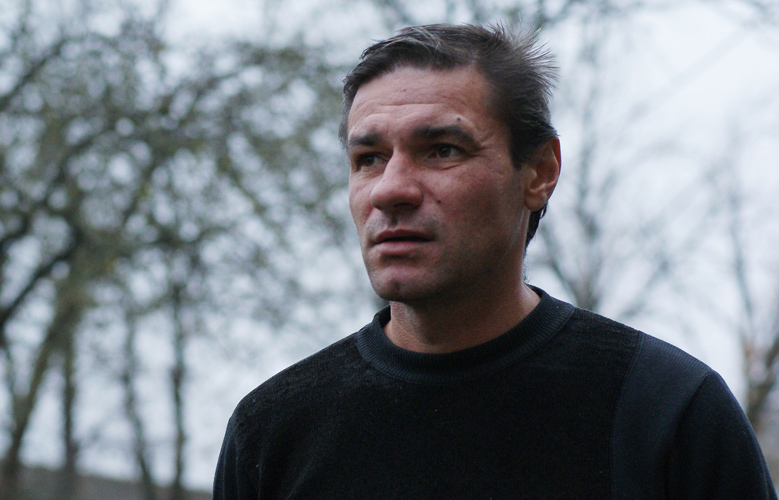
20 years ago, December 11, 1994, the entry of troops began to the Chechen Republic. There was a terrible war that broke thousands of lives, once again dividing the history of Russia into “before” and “after”. To understand this war and leave it in the past, it must be talked about. And first of all, veterans should speak.
Edik. There are many of them
Before our conversation, Edik takes a cigarette out of the pack and goes to the landing. Before he got into Chechnya, he did not smoke at all, which was a rarity among the guys from the village of Shakhovsky Oryol region.
- Called in the ninety -ninth year. In the fall, just. November 19. In short, right immediately to the part of us were thrown there-in Ulyanovsk, the 31st brigade (Airborne Forces- Ed. ). We served about six months. Then they hit the field output, damn it. They told us right that, like, you will be sent there and there-to the Chechen Republic.
Edik sits on the edge of the sofa, crossing his arms and legs. The village outside the window is gradually plunging into the evening dusk, but the light in the room remains turned off. At some point, I begin to distinguish only the silhouette of Edik. He is trying to talk about the war.
-99th, 2000. The most. When the gang of Hattaba walked there.
Eduard Raikov got to Chechnya in September 2000. He was then twenty -three. Three and a half months the paratroopers stood in the field near Shali. The gunners are located nearby. It was “relatively calm” there, especially when compared with Argun. The "nasty town", as Edik called him. In January 2001, the battalion of the 31st brigade was transferred there.
- And then it began ...
Various tasks were set in the argon. Escorting columns, stripping, exits to the mountains. Shooting, shooting, shooting. The checkpoints attacked by the militants strengthened. Not far from the location of the battalion was just such a post.
- We often wandered there, as they say. Here and the same checkpoint was constantly sherself. And he is from us - a kilometer by strength. And there. Only from there we will come, they were again covered. We again - there. Well ... Well, that's okay, - muttered under his breath, interrupted in half a word.
After Chechnya, Edik began to drink. Life is not rich. It turns out with the work - that is, then no.
In this phrase, everything that Edik never told me that evening. “Well, it's okay” - this is about losses, about concussion, about the dead militants. In the army, it is customary to say “destroyed”. Edik avoided mentioning what war was doing to war - about death.
- Well, this is ... - A long pause. Sigh. The voice begins to tremble. -It's hard, damn it, just tell, e-mine, on this topic. - A deep breath. Again a long pause. -When boys, damn it, drag, e-my ...
- But in order to free yourself from such gravity, you need to try to tell. Once, another. Then it will become easier.
“Not ...” Edik breathes breathing. - It does not work.
The junior sergeant Raikov returned home in May 2001. All twenty people returned alive, whom he, the deputy commander of the platoon, was given in direct subordination. Only one was injured. For the fact that he retained the soldier, they promised to present to high awards. I haven't received it. However, Edik was not interested in their fate. At first, at first, as he himself says, he flew in the clouds, did not understand the world around him. Not let go. At night - Chechnya again. But over the years, he has become less common in a dream. Each on August 2 travels to an eagle to meet with friends-prisoners. They talk, drink. After Chechnya, Edik began to drink. Life is not rich. It turns out with the work - that is, then no.
And if the war begins in Chechnya again, will you subscribe to the contract? - Certainly! Mania there.
From most veterans who passed Chechnya, whom I asked for an interview, I heard a categorical “no”. Why again remember? If the journalist is not transferred, then no one can understand anyway.
- Those who were on Kukuevka did not get into the bee, damn, what do they understand? - says Edik.
- Is the war ended?
-She ended ... for someone ended, but for someone-no.
“Do veterans continue to live in war?”
- Yes. There are many of them.
- And if, for example, now in the Caucasus, in the same Chechnya, the war will suddenly begin again, will you go to sign a contract?
- Certainly! - The fastest and most confident answer of Edik. I look at him inquiringly. - Mania there.
Edik of those for whom the war did not end. There are many of them, but they do not like to talk about it.
War as a life experience
In psychology, there is such a term - post -traumatic stress. It is expressed, in particular, in the fact that a person is not ready to recall and talk about some unpleasant events that occurred to him. These memories are still so painful for him that they can cause an unpredictable reaction.
“The best thing is when everything that happened negative in life is simply in life experience,” says Olga Valerievna Borisova, a psychologist of the Moscow Center for Social Adaptation of civil servants dismissed from military service, from law enforcement agencies, and members of their families. - Naturally, a person will never forget about it. But if it turned simply into some kind of life experience-this is good. In a person, this does not remain relevant with which he still lives, fights, fights, cannot win there in any way. So he is stuck in his war, still remains there. And this condition begins to destroy his psyche. If some traumatic event, the situation, the period pass simply into a person’s life experience, then this war-it seems to be over. And a person begins to just live on.
Among those who come to Olga Valerievna for psychological help, veterans of the Chechen war are rarely found:
- They generally turn little. This is not accepted. They do not believe that they have something wrong with something, or that they need some help. I mean psychological help. Our attitude to psychologists in people is not yet as psychologists, but partially as to psychiatrists. And who recognizes himself sick? This, unfortunately, is not very true.
Branch of veterans
Above the iron porch is a cartridge in the arms of a black tulip. On the sleeve in red letters it is written by Afgan . Behind the iron door in the basement on the outskirts of the city, a local branch of the Union of Afghanistan Veterans was located. Local is in the city of Zheleznogorsk Kursk region.
Alexander Ilyich Chuvaev, chairman of the department, is a veteran of Afghanistan. He is not one of those who say: "What do you want?" He greets and waits for me to appear. As soon as it becomes clear to him why I came, it nurses a tall man passing along the hall with large facial features.
- Here is Sergey. "Chechen". He fought in the first campaign, ”Alexander Ilyich tells me, and then Sergey:“ Go, sit down in that room, and tell me. ”
-What to tell? - with the surprise of a person who suddenly got into the spotlight, Sergey asks.
- Go and tell.
Not discussed.
We pass into the spacious hall, forced by tables and chairs. On the wall - photos of Zheleznogorsk residents who died at various hot spots. Most did not return alive from Chechnya.
Sergei Danchin speaks quietly, in no hurry, carefully picks up words. I got to Chechnya at the end of May 1996. And he was there until they began to withdraw troops in October.
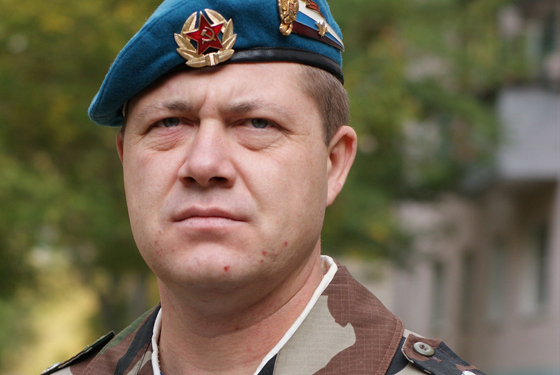 © Dmitry Chagin Sergey Dantchin
-When I went there, I wrote a letter to my mother: “I am to Moscow ... a business trip there ... build something ... back and forth.” And then at one fine moment my mother writes bad words to me: "Kozel ... back and forth ... shrugged." Then I found out that she carried the letter to work. Women boast there, back and forth, discuss. And the other woman had a son in Chechnya. And there is one address - “Moscow 400”. This means a hot point. And so she found out because of this. “Moscow 400” is all, this is Chechnya. I wrote: “Mom, I'm sorry! How could I report? "
Served as part of the combined battalion of the 7th Guards Airborne Division. The battalion stood near Khankala, from where they went to tasks, accompanied the columns. Once Sergey Danchin, together with his colleagues, was put up in a checkpoint in the direction, from where, according to intelligence, the militants planned to attack federal troops. However, the attack did not happen.
- We shot one grandfather there. Exactly 400 meters before this area was. Then we went - grandfather with a fishing rod. We threw it with stones - and that’s it. There were no 20 km nearby where to fish. Where he went with a fishing rod is unknown. Then they came to us at the checkpoint Chechens. Not on a checkpoint itself, but there, we went to them with a foot. We talked, agreed. “Why did your grandfather kill?”, Back and forth. Well, we explained everything. Miraculously dispersed.
Sergey works at one of the local enterprises. Married, two children. But not all his colleagues have developed life after the war.
- I know that some of the drugs only got down. Someone is thumping, but someone is no longer alive. And so, and so, - Sergey shares those who could find themselves after the war, and those who did not succeed. - Half - such, half - such. Who is in Moscow, they are somehow worse.
Veterans in the Union participate in commemorative events: Afghanistan and Chechnya - the input and withdrawal of troops, February 23, May 9. They go to schools with their stories. Sergei knows exactly why this is needed:
- for the development of patriotism of youth. Because youth - look at them: smoke, alcoholic drinks, drugs. You can’t cure adults anymore. So that the children know that not only it is, everything is shit.
Stories by the head of intelligence
Lieutenant Colonel Oleg Ivanovich Pronkin, although he does not consist in any veteran organizations, are invited to meetings with schoolchildren two to three times a year. Oleg Ivanovich has something to tell - both Chechen campaigns behind him.
We are sitting in one of the cafes of the city of Vladimir, where Oleg Ivanovich moved after leaving the service in 2010. In his gaze confidence. A strong -willed chin with a dimple. Graying hair is briefly tonsured. On the left side of the face from the forehead along the cheek with a deep furrow stretches a scar. When I start asking questions about Chechnya, Oleg Ivanovich picks up a paper napkin. He will pull her until the waiter puts coffee and ice cream before him.
In the early days of January 1995, Oleg Ivanovich, who was at that time with the rank of senior lieutenant, was sent to Chechnya to replace the wounded intelligence commander of the 129th regiment of the Leningrad Military District. The regiment, among other units of the Russian army, stormed Grozny.
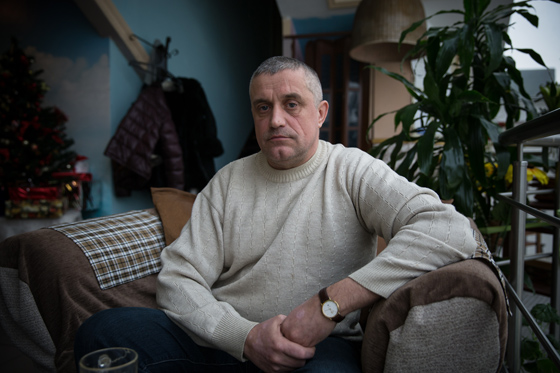 © Dmitry Chagin Oleg Ivanovich Pronkin
“They flew to Mozdok,” says Oleg Ivanovich. - In the morning they had to fly out in Grozny. And in Mozdok at that time there was a group headquarters. We were placed there in some shed. And the comrade came to the hop slightly, "like Vysotsky’s in the song, a colonel at that time, a representative of the personnel headquarters department of the personnel headquarters. Having a modest look, he said: “Sorry that I am in this state. The order came to me here, I'm washing the order. ” Apparently, there, sitting in Mozdok, he earned the order. Well, it happens. We live wonderful in the country, right? And he asked: “Please fill the leaflets - surname, name, patronymic, military unit, title. Put in the sleeve and in the breast pocket. ” Well, two pieces of paper. I handed out pieces of paper to us. Well, how - why? “Well (Oleg Ivanovich parodies the indifferent intonation of that colonel) when you are killed, then it will be easier to identify and send your bodies.”
In the first campaign, Oleg Ivanovich was wounded twice. When they shot his shoulder, he did not begin to evacuate from Grozny. But on the 25th day of the business trip, his reconnaissance fell under the fire of his own artillery. The commander sharc struck his leg, could not walk. I had to replace and spend six months in the hospital. For participation in the assault on Grozny, they awarded the Order of Courage and the medal "For Courage". By the way, a scar on his face is a memory of the shelling of it.
All night, the battalion of our regiment in good faith fought with our same Marine Corps battalion. Only in the morning we figured out that the mistake came out.
- At that time, everything was unhealthily in the country in general, frankly. Including in the army, ”says Oleg Ivanovich. - And, of course, the low moral spirit of the army was. The salary was not paid for six months to people. Many not the worst officers at that time were pleased, searched for themselves in some other matters. Naturally, all this affected. And the level of training even officers, commanders of a higher level, was very low. The connection was terribly organized. The interaction between the branches of the troops was terribly organized. Here we even had a case in the regiment when the battalion of our regiment in good faith fought conscientiously with our same Marine battalion. Both sides suffered serious losses killed and wounded and only in the morning they figured out that the mistake came out. Well, how would it be ... - Oleg Ivanovich, for a second, shakes up for a second and continues with a painful stress to the word "was." - Yes, unfortunately, it was. This is our story, you won’t get anywhere, you won’t sleep. It was. Of course, when the second campaign began, the organization itself and the command of the troops were not only an order of magnitude higher, but several orders of magnitude higher, when compared with the first Chechen campaign.
In the Second War, Oleg Ivanovich participated from 2000 to 2002. He was already the head of the regiment’s intelligence - set the tasks, controlled the implementation, organized “certain events”, for one of which received the second order of courage. The commander paid special attention to maintaining discipline:
- Here, for example, during the second campaign no one has ever consumed alcohol. I mean soldiers. And in other units, there were cases, because of this they hung, shot, undermined on grenades, on mines-and everything else. I have not a single one. This may be wrong, but the first that we got drunk, we chained. They drove the scrap into the ground, chained, and he stood in a bent position for a week there. This is a mockery, this is wrong. This is fundamentally wrong, right? He stood like this for a week in the rain, under the snow, under the sun. We then put him on a helicopter and sent him, fired. But the whole company saw it. And I said to everyone: only I find out that someone drinks-look, you are a living example. Nobody thumped for me. And I think that we have saved several lives.
Do you know what is the best way to clean the vest? When you cut your throat, the blood is whipping. It is necessary to let her bake, and she is removed with a film with mud.
Over the years of both Chechen wars from among the soldiers commanded by Oleg Ivanovich, three were killed. Sergeants Mifodiev and Tarasov - in January 1995 in Grozny, in the area of the tram park. Sergeant Andrei Kamorin - in August 2001, when he tried to save two builders who fell in the gorge during the construction of a pipeline across the Argun River.
Now Oleg Ivanovich works as the head of the security service in a large shopping center. Married, raising two daughters. Continues to keep in touch with the soldiers and officers with whom he served.
-When we gather in our midst, officers, and we talk about the war, no one presents this as some heroism-“Here I am, Rambo, did something there!” On the contrary, this is all somehow with humor. And sometimes about very terrible things, the conversation goes on with a certain share of humor. Either this is professional cynicism, like doctors ... Any profession deforms the psyche, personality of a person, right? Well, I can’t call it cynicism. Probably, this is just some kind of protective reaction of the body: if you take everything seriously, you will go crazy. As one comrade told me ... Well, the body armor, when you often wear it, it is greasy. It is clear that greasy clothes are dirty. In the field you can’t wash. He says: "You know, Oleg, what is the best way to clean the vest so that it looks like new?" - "No. Which?" - “When you cut your throat, the blood is whipping. Then you have to give her bake, and she is removed with a film with mud. ”
Once in 2008, Oleg Ivanovich sat down at the computer and wrote several stories in one night.
-Probably, there was some kind of inner need. Maybe even unconscious, ”the author explains. - But to say that “in memory of a friend” I sat down to write or “so that no one would forget these events,” - no. I just wanted to, sat down and wrote.
All these small stories are published on the Internet . Those about Afghanistan are from the words of the colleagues. About Chechnya - autobiographical. In one of them, Oleg Ivanovich asks for forgiveness from mothers whose sons could not protect in the war.
“And it’s no longer written, I honestly say,” he assures. - I don't know why. I still have 50 pieces, probably, stories, but they are all in varying degrees of incompleteness. Some is written to the middle, some-only the beginning or almost the end. But I can’t squeeze anything else out.
- Is it important for veterans to tell and write about these events?
- Probably, this is not important for the veterans themselves, but perhaps for everyone else - that these are all sorts of political games, to which all this can lead to.