
Translated material
Unknown world
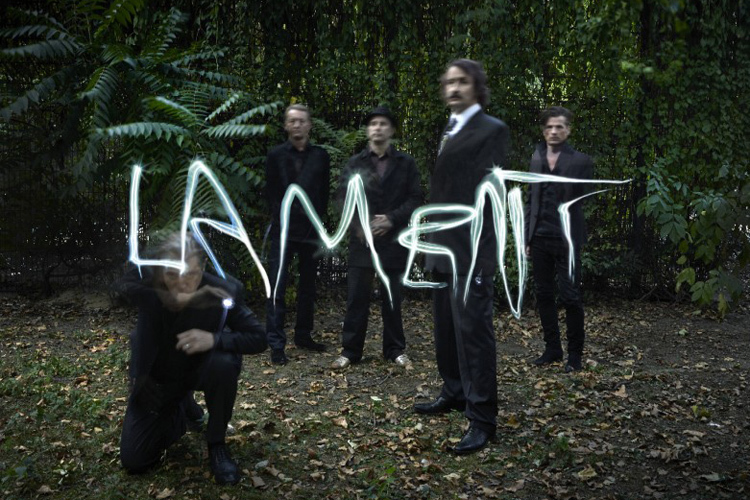
In early November, Einstürzende Neubauten released the Lament multilayer album about the unknown First World War. This week, EN should have played in Moscow with St. Petersburg, but at a concert in Rome the leader of the Blax Bargeld team broke his leg, and all the shows were postponed by the end of the year. Radif Kashapov compiled a guide for the album requiring comments - based on an interview with Bargeld, which he gave him before the failed visit.
Dikmoyide
In October 1914, this Belgian city became the center of a bloody battle in the Izra, in memory of which a tower was erected in Dikmoyide. Last year, Blax Bargeld received an offer to make a performance about the First World War and show it as part of the project “ Against the Neglection: Gone West, The Fall of Diksmuide 1914-2014”. “I went there, studied the materials, then returned to Berlin and told about the whole group, asked if they wanted to take part or not. It depended on the decision of the group whether we would go to this. They agreed, and after that we had a year to do everything. It was hard work. ”
Bargeld insists that Lament is not an ordinary einstürsende neubauten plate: “This is not an album at all. This is a documentary fixation of the performance. To understand what it is, we must come to the performance and see it. ” For EN , which of fierce noise, have long turned into experimenters who are seriously interested in theater, this is not the first experience of connecting arts: they participated in Biennale de art festivals Paris and Documenta in Kassel, collaborated with filmmaker Peter Tsadek, playwright Werner Schwab and Heiner Muller, celebrated the 100th anniversary of the classic of the avant-garde John Cage.
Theater
As Bargeld explains, Lament is built according to the chronological principle. First, the group builds a sculpture on the stage - the machine of war under the clang of the composition “Kriegsmachinerie” . Bargeld does not sing, but demonstrates posters with inscriptions like "War does not begin suddenly, it waits."
This is a theatrical technique, ”he says. - As if I act as a director and comment on the action with these texts. I wanted to make the words sound very loud there. But there it sounds loud noise. Therefore, I decided to express myself using posters. "
Next is the Hymnen , where Neubauten takes a common melody of the anthem for many countries and perform pathos songs about the statehood of Great Britain, Germany and Canada in the same track. In a word, the spiral of the war is spinning measuredly and scary.
When we did Telegrams, there was a Crimean crisis. We realized that topographically the conflict zones are repeated. And this did not make us happy.
The theatricality of the performance is also emphasized by the fact that programs are handed out to the audience. Otherwise, how to understand that “Der 1. Weltkrieg (Percussion Version)” is arranged, in fact, very simple: each blow means one day of the war, and at the right moment of voice in the composition announces when which country or colony entered the war. Initially, the group played it at a pace of 60 beats per minute - as long as 26 minutes, but then accelerated.
“And at the very end there is a song about the death “ How different I Die? ” we are leaving for BIS, where we give out “Sag Mir Wo Die Blumen Sind” (German version of the song “Were have all the flowers gone” by Mest Siger performed by Marlene Dietrich. - R.K. ), as well as “All of Man's Land IS OURS” and two old things, “Let's,“ Let's Do it a dada ” and “ Ich Gehe Jetzt, ” Bargeld explains the structure of the concert performance. - They correspond to the topic. In addition, for the first time in 10 years, we started working with compressed air again, which we have not done since 2004, from the album “Perpetuum Mobile” . ” Also , the string group plays on Lament with EN , in which, by the way, the violins of Leila Akhmetova and Olga Pak are seen.
Drafts
Also, among the tracks, which, perhaps, EN will be performed at concerts, “Armenia” is mentioned. “In general, we have even made the song “ Armenia 3 ” now. But we did not put her in “Lament” , because we worked on it after recording tracks in the studio. ” In addition, Bargeld mentions that during the preparation of the tracks he liked one of the Flemish soldier's songs - but she also simply could not fit into the context.
Russia
Talking about the First World War, En , of course, affected the theme of the Russian Empire. One of the songs “The Willy - Nicky Telegrams” is fully consisted of texts of telegrams, which were exchanged by cousins, Kaiser Wilhelm II and Emperor Nicholas II. It sounds like a pop hit.
“Yes, because we used Autotyun,” says Bargeld. “But for another reason, not for the one that is usually.” In telegrams, Kaiser and the Russian king lie to each other. They say something that they do not really mean. Therefore, we used AutoTyun. Alex himself asked to sing for Nicholas. ”
We could not help but ask whether the events in Ukraine somehow influenced Lament . “This did not inspire us at all,” Bargeld sighs. - Because when we did Telegrams , the Crimean crisis happened. We realized that topographically the conflict zones are repeated. And it did not make us happy. ”
Cry
“Lament ” - the composition that gave the name to the album - consists of three parts. The title is very laconic and ends with the words “Macht Krieg” (“power”, “war” or “start the war”). “ABWARTSSPIRALE” is built on a pattern, which are based on four numbers that make up the end of the war - 1918. The key part, the third, “Pater Peccavi” , is based on the motot “The Prodigal Son” of the Netherlands composer of the 16th century Jacob Clementa, was buried in a dixmoeid. It also sounds about 36 votes of long -dead prisoners, some also speak in dead languages. These records were stored in Berlin, at the university. Humboldt, on wax cylinders - on them people in camps in different languages read a parable about the prodigal son. En indicated that they did not use the notes to give the compositions to authenticity, but carefully tried to make them pour into the song: the musicians brought small speakers from where they sounded, to microphones, comparing acoustic boxes with fragile eggs, inside of which there is a creature or treasure.
Finds
And these are not the only archival discoveries made by EN . In preparation for the performance, the group received a lot of new information for themselves from a special team of researchers.
In the tracks of “Achterland” and “In de Loopgraaf”, the group used the texts of the writer Paul Van Den Brock, a native of Antwerp, a pacifist, who, however, went to serve, despite his health in order to survive the war. He destroyed most of his creations.
The songs “On Patrol in No Man's Land” and “All of Man's Land Is Ours” are owned by Harlem Hellfighters , the orchestra of the first African American regiment, which was sent from Harlem to fight to Europe. The regiment was attached to the French, racism was a common place among the white American military. The music performed by this military orchestra can be called a protojaz.
War does not suddenly arise, like a plague. She is always here.
In addition, EN used its own findings. "How different I Die?" Born from the song “Die Rote Melodie” by the famous Berlin journalist and satirist Kurt Tukholsky, who committed suicide after the Nazis came to power; This is a song about his military experience - she was dedicated to Erich Ludendorf, a German general, infantry. “War is not a peppy thing at all. And this song, about a man in war, sounds very depressive. I came up with how I died. It was very difficult, ”says Bargeld.
EN for 14 years made attempts to record Sag Mir Wo Die Blumen Sind , and it succumbed to them only to Lament . The day after the group finished the record, the author of this famous anti -war song died - Pete Sieger .
Howl and barking
Note that “Lament” is not at all a definitely tragic recording. “This is just the name of one of the songs by which we called the album, this does not mean that the whole disk should be weeping,” Bargeld summarizes.
Here, rather, the case is in context. For example, Bargeld himself found in the archives of the radio a recording of a certain Joseph raft, who in 1923 portrayed the First World War with the help of animal votes. And, in particular, he mentioned Hitler there, at that time not particularly known to anyone - he was depicted by a peacock. This became the basis for the mini-pesh “Der Beginn des Weltkrieges 1914 (Dargestellt Unter Zuhilfenahme Eines Terstimmenimitators) , that is,“ The beginning of the World War in 1914 (represented by an animal vote) ”, where Blings barking and grunting. In 1936, the raft went through Switzerland to South Africa, then to England, where he worked for BBC . After the Second World War, he worked in the theater, as well as on television - as a speaker and actor.
War is always here
Bargeld emphasizes that he first tried to present the first world on Lament using little -known facts. “There is a lot of information about World War II. Oversaturation occurs. But, in fact, there is no difference between the two world wars. It was one big war, which lasted all these years, given the civilian in Spain, in Greece and so on. ” The press release about “ Lament ” says: “War is not what appears and disappears. War is what is always here. Sometimes it sets in motion, sometimes it calms down. It does not suddenly arise, like a plague. She is always here. "
Noise and silence
Like all the later works, En , “Lament” is not an endless noise, but on the contrary, very delicate work with silence. At the same time, of course, you will not achieve at concerts of cemetery silence. “Yes, this is inconvenient,” Bargeld agrees. “But over time, you begin to take it for granted.” Once in the USA we played when Stone Temple Pilots performed in the next room: Imagine what a mishmash of sounds was. For us, such cases are not another way to beat the situation and realize yourself artistically, it is just reality. ”
Russian concerts of Einstürzende Neubauten were postponed to 2015 - the exact dates will be announced later