
Translated material
All power to the imaginary!
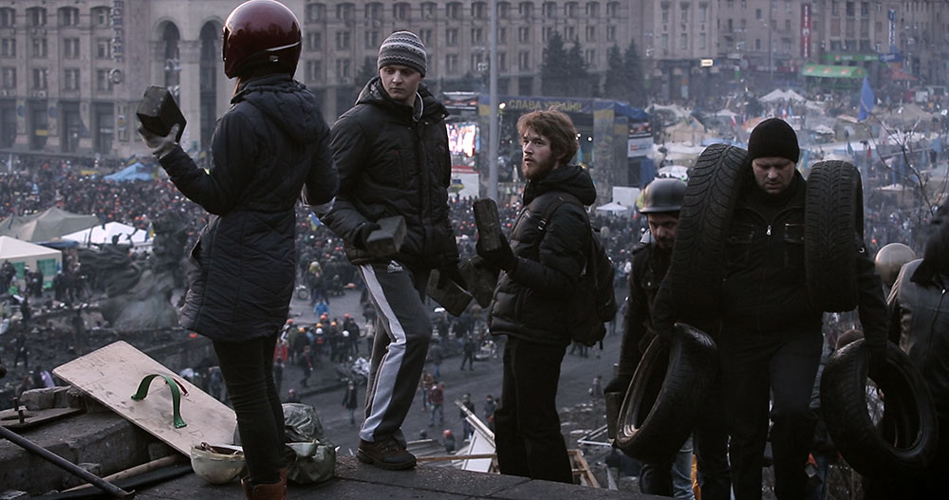
The day after tomorrow at Artdokfest will be the Russian prime minister of Maidan Sergey Loznitsa. Almost a year after the events shown in the film, Vasily Koretsky watched this two -hour video memory of the birth of the nation - and thought about the appropriateness and the possibility of combining spectacular and political in our time.
“Gentlemen, the terrible days that we are experiencing now will become an elegant color movie. And wouldn't you want to play in it? So hold on so that a hundred years later the audience does not meet your appearance on the screen with a whistle. " So in April 1945, the audience at the premiere of Kolberg Joseph Goebbels advanced.
The Maidan participants did not have to wait a hundred years: the Cannes premiere of the film about them took place just a few weeks after the end of the great and terrible days of the Kyiv revolution, and the audience met their appearance with tears and applause. It would be too excessive for peaceful combatants about an invisible, but picky look of history - millions of eyes looked at them already; At some points of the area, the number of operators was comparable to the number of protesters. The horizon of the future did not really occupy the participants of the Maidan, entirely immersed in here-and-now and not too concerned about looking at this horizon outlines of the post-revolutionary society. It is customary to evaluate the absence of leaders and a clear ideology on the Maidan as the undoubted dignity of this revolution, but the lack of power of the idea, hierarchy - in general, the symbolic order - over the rebellious masses, it seems, was hypercompensated on the Maidan of the total power of images. There is a protest as a spectacle localized in a limited, almost stage space, played for cameras and for himself, often noticeably in documentary plots about individual episodes, people, and situations of the Maidan. But the grandeur of this self -playing performance, comparable in terms of directing and scope of action with a multimedia stadium show, is visible only in a large -scale panorama. Such as the "Maidan" of the Loznitsa.
 © Atoms & Void
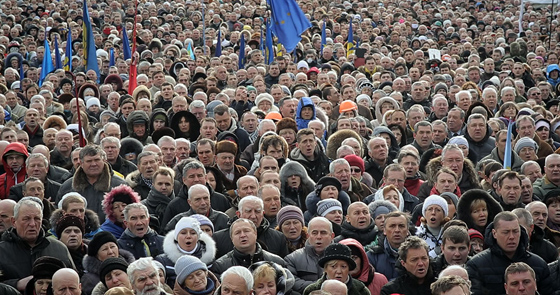
The obvious plot of "Maidan" is the birth of a collective community (the heroes of the film call it Ukraine and nation) from an atomized, chaotic crowd. Individual people, of course, appear as the heroes of the film. Passing by the camera, they shout slogans, sing songs, often perform from the rostrum. But, unlike other films about Kyiv events, the “Maidan” does not give directly the words to atomas (although he pretends to give ordinary people the opportunity to share their aspirations). This is neglect of the individual - an extremely insightful directorial move. Who, in fact, is interested in the aspirations of a simple person, the same always and everywhere? Freedom, well -being, meaningfulness of life. Happiness. There is nothing more boring than listening to other people's dreams. Moreover, the group portraits of the first weeks of the Maidan, which make up the first part of the film, do not hint that "this is a film about dignity." They cause rejection rather than empathy: middle -aged exalted women, peasants in drinking, buoy and just madmen. Chaos of inconsistent throwing. The confused faces of the flankers who went to the Maidan to touch the action. A meaningless rebellion (the slogans seen from today for European integration seem to be pure McGaffin, if not by absurdity: how can one combine the desire to join the transnational European structures and the rise of national consciousness?). This motley, which is in carnival euphoria, is both actors and spectators at the same time: after all, there is another theater, the one that is played on stage and broadcasts into huge screens in the square.
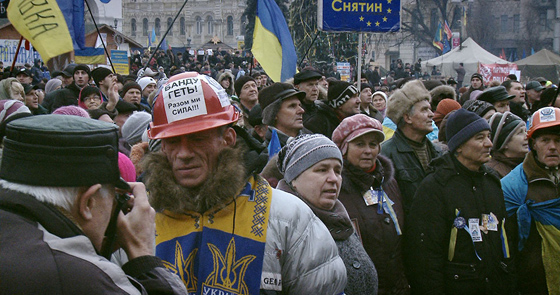
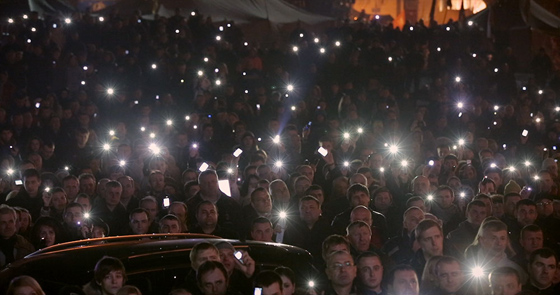
The key point of the film, hidden somewhere at the mounting joint, is a change of scenery and troupe. At some point (it is a plot of it by the titer reporting the beginning of the use of firearms with a “golden eagle”) Buyana and women disappear from the square, the expression of faces in the again and again singing the anthem of the crowd. Yes, this is not a crowd already, but a system, phalanx, whose actions are accurate, rational and subordinate to orders coming from the stage. Blessed euphoria on faces is replaced by concentrated businessiness. This concentration reaches the peak in the final act - night vigil over the graves of the "heavenly hundreds".
 © Atoms & Void
For the Loznitsa, the Maidan is an end-ec, a sketch toward the future, truly Eisenstein tragedy “Babi Yar”, the hero of which will also be not individual individuals, but a crowd who voluntarily goes to the slaughter. The theme of sacrifice becomes key in the Maidan (the director directly speaks of this in the interview ) - it is death, according to the logic of the film, that turns the crowd into people. From the point of view of narrative, this tragic climax is ideal. But the understanding of history - and politicians - as the theater of self -sacrifice carries not very pleasant connotations (see the first paragraph of the text).
It is not at all difficult to put on suitable quotes from his wife, umbrella and Benyamin to stigmatize the Maidan, and so that the right roll had obviously. Both Loznitsa and Protest participants considered what was happening on the Square of the National, Antiolonial Revolution. The conviction is rather short -sighted: the revolution - at least starting with French - is almost always international. Russia, Hungary, Algeria, Vietnam, Tahrir and Taxim - all this shook the whole world, the society was redone far outside the country. Especially today, in the era of the media sphere. It would not be a big exaggeration to say that the Maidan did not take place on Independence Square in Kyiv, but on the TV, on the screen, in the field of pure representation (even the Russian-Ukrainian conflict is still more in the field of images).
 © Atoms & Void
Such a total performance of street policy makes the well -known statement of Benjamin that the aesthetization of politics is the essence of fascism. The word “fascism” in relation to Maidan in the last 40 years, in relation to the Maidan, does not make sense to recall not in the wide context of the camps, repression, the elimination of state institutions and the replacement of their party institute (all this is more likely similar to Russian affairs), but exclusively in the aspect of destructiveness, non -functionality. The politician turned into art does not work, how the Tatlin glider could not fly, and fascism is, in addition to everything, the suicide of politics (or suicide policy). By art here, of course, it is necessary not to understand the art of political marketing and image make -ups, but “art for the sake of art”: replacing social and economic content with pure visibility of a ceremonial or revolutionary gesture, replacement of rational interest in affect, voluntary rejection of a boring (and completely discredited years of failure) of a constructive agenda for the sake of ecstasy of pure negligence. “We will all go to the barricades, we will punish for freedom and die!” What is happening now in the southeast of Ukraine, even more reveals this topic: a heroic self-sacrifice for the benefit of the Motherland becomes the only accessible form of civil activity; The same is true for ideological participants in the conflict from the pro -Russian side.
The transformation of politics shown in the “Maidan” into an object of exceptionally sensual, aesthetic (a common panoramic look, creating the effect of the sociological reliability of the screen picture, takes away suspicion of manipulation from the director and makes you believe in the objectivity of such a transformation), has already played a cruel joke with a “swamp movement” in a total installation. But the Maidan case is more curious - turning into a work of art such as a promotion or performance, the revolution seems to be in the space of total technical reproduction. The Maidan, played in Kyiv, barricades in the spring Donetsk, the burning tires of Pavlensky on a slightly-adolescent bridge-what is the difference between them? The inarticulate context of the context that gave rise to the revolutionary text does not make this text “clean”, which does not carry the political conjuncture virus, on the contrary, this purity makes it as vulnerable to manipulation. Not seeing the political real (contradictions, tension, a complex game of interests), reliably hidden behind the Barricades inspiring a media way, like the walls of the theater that fenced off the square from the rest of the country, the difference between the original revolution and the fake has to be made on the basis of the presence of the aura, trusting exclusively to taste. Those who were lucky enough to get a good aesthetic education receive a good revolution. Those who have bad things with this is bad .