
Translated material
Spatial relations
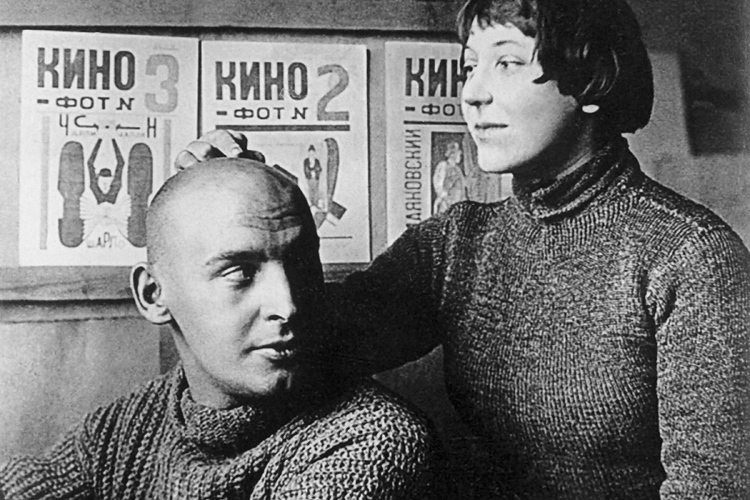
In connection with the recent dates (November 5 - Barvaria Stepanova’s birthday, December 5 - Alexander Rodchenko), the exhibition “Visiting Rodchenko and Stepanova” was opened in the Pushkin Museum . Alexandra Novozhenova explains why, more than logical, that shortly before the opening of this exhibition in the same museum, they showed Berdsley .
At the very beginning of the general biography of Rodchenko and Stepanova, there is a strange episode, which does not really fit among the researchers with all the subsequent - advanced, avant -garde, Soviet, technological, chopped: their love correspondence around 1915, when it had already moved to Moscow, and he was still in Kazan. No explanations for this episode, except that they were young, romantic (read: provincial) and in love, usually not proposed. Meanwhile, in this correspondence, he calls her queen Nagutta, she - King Leander, sends him a sonnet, and begins the letters with the appeal “High Lord”, but anticipating him with energetic “Listen!” And stating unequivocally sexual claims to possess this magnificent lord of the surroundings: "And I will be proud of the possession of the possession."
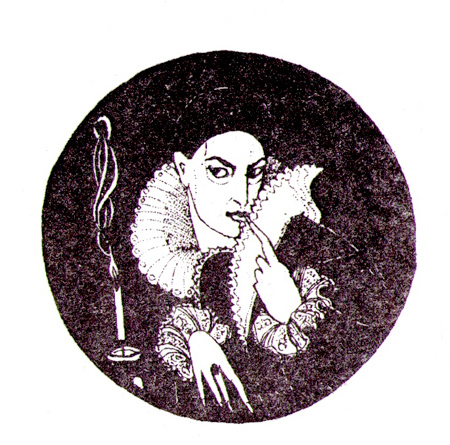 © Archive V. Stepanova drawing V. Stepanova (Portrait of Anti (Rodchenko)), 1915
With the help of the most hidden symbolist metaphors - “your lips like blood”, “languid eyes”, “lace of desires”, “corals on the lips” (Stepanova) - they both construct in these texts an absolutely abstract, distinguished from the vicinating of rooms, plans for moving, studying in Moscow, talking about exhibitions and their own work. This is a virtual place where the meetings of their imaginary masks are held, structured as a dream and has distinct spatial characteristics: of course, the laws of attraction (“Your soul hung in strange dreams”), it is non -linear, confusing and intermittently (“You have dissolved your networks ... my hands have lost their labyrinths”). fluid, variably and is described through the effects of indirect vision through reflections and glare (“you are all mysteriously elusive as a reflection of a dead opal”, “in a deep mirror of water”, “on the magnificent halls you mockingly slide / like a long beam of a silver moon / in dark clouds”, and for greater unclear aromas, smokes and poorly lit: mainly there, mainly there, mainly there, there. Of course, there is a night in the blackness of which the lights of the eyes flicker, then the lights go out, then silver sparks flash. From the abundance of comparisons, it seems that there the apple has nowhere to fall due to the beautiful objects that have fallen from metaphors like swans, feathers and diadem.
It is worth paying attention to the coloristic epithets: a symbolist canon set by a “blue bird” and also relevant for painting ( “blue rose” and its blue products) - all shades of blue and blue. Stepanova, like Rodchenko, although they use the symbolist dictionary inherited by him by inheritance, there are a lot of coloristic epithets, but this is almost exclusively black, white and red. Entire poems are built only on the alternation of these coloristic epithets: “You are a royal flower ... Sensitive and strange, torn by the blood of black lips”, “I drink corals of your lips”, “Like a black night blanket.” Or in one poem in a row there are “white lilies on my chest”, “and corals on passionate lips”, “a black knight with a yearning gaze”. Or in the poem “My King”: “Oh my white king, your lips is like blood ... Oh my Black King / and in crazy nights / We will merge to a bright flame ... In a long bedspread / snow -white feathers ... in black diademe / Phantom -ghost stones.” Or in the “Korolev’s dream”: “I saw angels in white clothes / with black lilies in golden hair ... / And in the black coffin you lie / I saw blood on the satin pillows.”
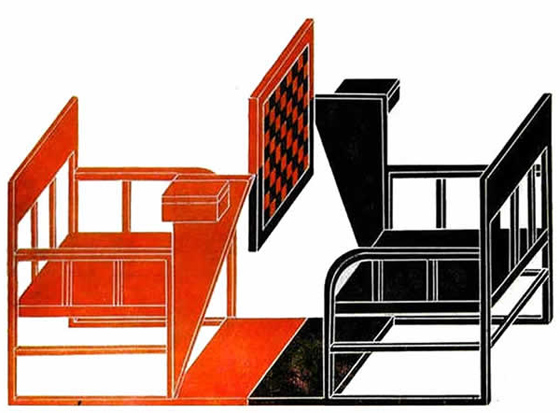 Alexander Rodchenko. Chess table for the "Working Club"
If you look at the visual products of both related to this time, then, of course, it is determined by a very provincial imitation of Obri Berdslei-and not straight, but through imitation of vignators of schedules-symbolists in the Apollo magazine that reached Kazan. The graphics of Berdsleya and his epigones were built on the alternation of flooded and unscrupulous areas. Despite the symbolism and pretentious, fabulously erotic imagery, the graphics of Berdslei and Apollonians were the first school of modernist professionalism, focused not on the direct perception of the image, but on its technical reproduction through the print medium. Berdsley, not being at least a deft naturalistically drawingman, hid the shortcomings of his “hand” with a black fill-that which did not work out, it was always possible to cover with a “bedspread of night”, and the expression or gesture of hands, white as lilies, could always be reduced to the worked out a bride, where lily is just a line.
In the sense of Berdslei’s academic skill, it can be called a primitive. Exactly the same impression of the primitive is the figure painting of Rodchenko. But in the alternation of black and white on a sheet, in advance for printing reproduction and, thus, for the inevitable reduction for the elementary relations of black/white/red, Berdsley and after him, Stepanov and Rodchenko reached high professionalism, or, in terms of production, which are very different from symbolist in style, highly qualified.
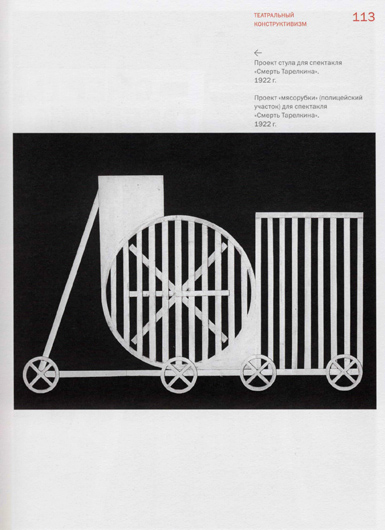 V. Stepanova. Installation for the play "Death of Tarelkin." From the book of A.N. Lavrentiev. Varvara Stepanova. Foundation "Russian Avangard". M, 2009
In the early stages, while studying at the Kazan Art School, for Rodchenko and Stepanova, unfamiliar with the achievements of cubism, who have not yet met Vladimir Tatlin and Casimir Malevich, the only accessible dictionary of modernist forms was the symbolist vocabular who managed to expire to holes. Nevertheless, the symbolist alternation of red, white, black, black can be considered as a tool for building a space where the functioning of a pure difference involved in their “naive” poetic metaphors, the differences on which the abstract relations of the Black King and the White Queen in behind the gas station are built. In their future products, you can see this black/white/red as alternating stripes of solid fills and voids in the behind the medium: lilies, blood and bedspreads, having lost their plot content, become typographic colors, and virtual, without a top and bottom, the space of love relations between two becomes a virtual space, which can be placed in general - whatever can be placed in general. Any objects, that is, not only swans and the king with the queen, but also the statistics of industrialization, and the advertising of Mosselprom goods, and the picture, and the text.
This is the structural difference, the alternation of emptiness and filling, on which all their production work is ultimately built in the construction of any utilitarian structures, whether it is printing structures for streamlining data (posters, magazine layout, packaging) or “installation” (installation structures) for theatrical performances and club supplies.
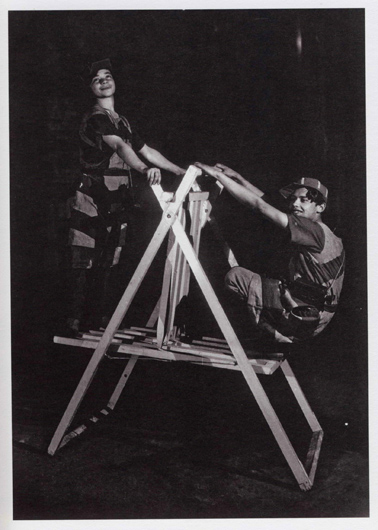 V. Stepanova. Trick furniture for the play "Death of Tarelkin." From the book of A.N. Lavrentiev. Varvara Stepanova. Foundation "Russian Avangard". M, 2009
As in the beginning, in 1915, this alternation of black/white/red was never just an abstraction or a formal course - it was always a question of relations in space, as they expressed, “disdain” relations, a disinfected dynamic social connection, which can be expressed and simultaneously designed with the help of a spatial modular structure. The fact that at first gained its form on the material of the relationship of love, then began to formalize and simultaneously express social relations. This is happening in the installation for the Death of Tarelkin (1921) Stepanova and in the project of the “Working Club” (1925) Rodchenko. Both there and there, in fact, nothing but the alternation of black and white or red and white areas, which should work as a grid that structures, as in a modular layout of a printing medium, what happens in this space between people. Constructivism and production, what Stepanov and Rodchenko did throughout the 1920s have never been a story about technological things and the most economical technical constructions-they have always been a story about sprouted social interactions, that is, about relations, whether love or class.