
Translated material
Donbass: Glamor of war
This is the text of the report that Alexander Morozov read as part of the Rethining program Russia at the Bochuma University on December 11, 2014.
1.
In the past, military photographers emphasized various aspects of war. Once the images of a heroic attack, a fight, and a combat clash had great value. The visual concept of war as “hard male labor” was popular. There was another concept - “mass victims” - during the Second World War and up to the Vietnamese. The image of the victim - a separate civilian, child, women - remains still common in conflict photographs. But at the end of the twentieth century, it becomes obvious that the “horrors of war” are often transmitted not through corpses, but through images of destroyed infrastructure, “wildness”, archais. Global mass media avoid images of “mass victims” in documentary shooting, fearing to provoke unpredictable audience reactions.
With an attack on Manhattan (2001) and Iraqi War (2003), a new period of visualization of war begins. Her political planners already know what a huge role the visual image of each side of the conflict for world public opinion plays. And therefore, the war is planned taking into account the "visual effects".
What do we see from this point of view in the photographs (from the partisans) in the Donbass war? We see a large array of household group pictures, where partisans pose in equipment and with weapons.
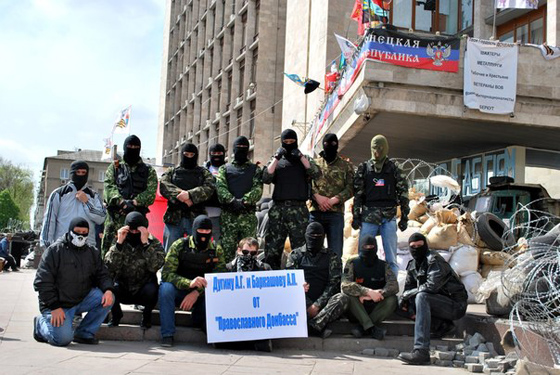
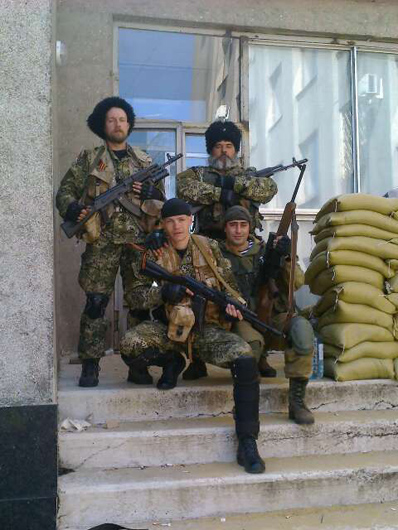
The need for group household photography is great, approximately as during the First World War. But during this period, reporting capabilities were technically limited. And most importantly - group military pictures were no different from family pre -war family. Their limited circulations suggested that such photos would fall into the home albums of the war participants. Their goal is to "leave memory." Today's group photos work differently: they are intended for immediate replication in social media. And thereby their production is not related to memory, but primarily to communications, to the media. Social networks quickly “sell” the consumer images of an attractive “uprising”, aesthetized war.
2.
What does the sociologist see on group photographs of the partisans of Donbass? First of all, the atmosphere of joy from demonstrating yourself in a rather intricate ammunition: vests, knee pads, various portups, holsters. Before us, in a sense, a review of amateur military fashion . In the same way, you can see the desire to pose not just with weapons, but with heavy small arms - heavy machine guns, anti -tank rifles, etc. It is enough to compare the arrays of photographs of the Syrian rebels and the Donbass Paramilitaries , and it immediately catches the eye that the war in the Donbass is a war in the "rich lands", in Richland . In other words, before us is the "glamorization of war." The Donbass partisans have good financing, allowing them to be equipped with all the necessary combat gadgets.
The war in the Donbass, in my opinion, realizes a pure desire to add an additional “glamor with risk” over the “glamor”.
Here, the Schwarzenegger is present, that is, the visual image of a super -soldier from Hollywood cinema or computer games. Interestingly, the participants themselves are aware of this. In the advertising election leaflet, which depicts the field commander of Motorola, PR, turning to the population of the Donbass, they write : “Outside, in shape, Motorola looks like a ranger from a Hollywood blockbuster, and inside, in content, Russian Orthodox Knight.”
Psychologists can say that we are dealing with the ousting of “losers”: people who lost in civilian life finally “took place”, finding themselves in the ammunition and with the weapons of “terminators”. This is partly so. But we must not forget that among these paramilitaries there are many representatives of a completely successful Russian middle class. And, perhaps, for them this war is a continuation of paintball or extreme tourism. Extreme tourism also involves expensive and aesthetically high -quality equipment.
3.
Next to this War Fashion array, we see some of the exact opposite images of the rebel. They are built on emphasized simplicity, poverty and "nationality" of the partisan. If we take a closer look at the images that the authors of the militia site use, we will see that this is not a heroized “Hollywood Ranger” or “Orthodox Knight”, but an ordinary urban or rural resident reminding us of the Balkan war in Kusturitsa’s films. Before us is a focused stylization of militias as "defenders of the hearth."
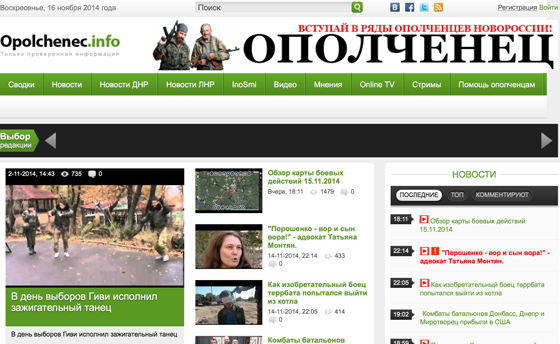
Here we see a complex propaganda and counter -propaganda visual struggle around the image of a “quilted jacket”.
In the mass reaction of social media users to Ukrainian conflict, the pattern plays a huge role “Look at these people!”. It is assumed that the visual image of primitiveness, inadmissibility and even ugliness does not require other evidence of “barbarism”, except for a visual certificate. That is why the word "quilted jacket" was established in the language. There is a famous early photograph of the Donbass rebels who seized the administrative building and posing in the captured boss office.
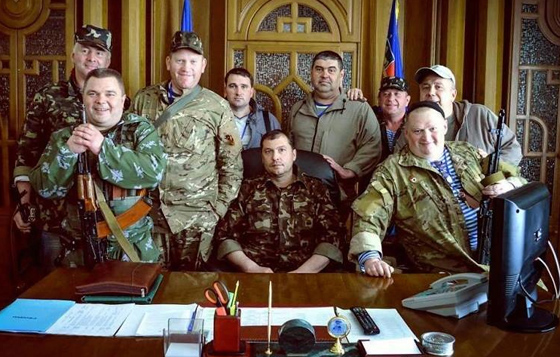
On it we do not see any “Hollywood rangers” or well -equipped representatives of the middle class. Before us are ordinary unsportsmanlike men, dressed worse than employees of a private company guarding the provincial market. After the stream of gloating fell on these images (“gopniks, quilted jackets, a punks, raggers, how can these people can be entrusted with something”)-there is a “reverse branding” of the “quilted jacket”. Even a well -known self -irony is possible in response: “Yes, we are quilted jackets!” This is demonstrated by the site "Militia".
In my opinion, the fact that such a meaning is attached to the “nobility” of the appearance of the participants in the conflict, again suggests that the war is going on to Richland . It is impossible to imagine that the argument of distrust during the war in Africa or in the Middle East was the emphasis of external ugliness, inferiority. It would require a presentation of real cruelty, real atrocities. The visual ranks of the Russo-Ukrainian war show the opposite-endless accentuation of “disgusting faces”.
4.
Now let's pay attention to the visual images of the commanders and their headquarters. Here, not just the presence of symbols inevitably arising in the course of the formation of combat detachments (stripes, banners, coats of arms of units), but a conscious and exaggerated stylization under several ideologically significant images, is striking. At first, the militia Babai was very popular.
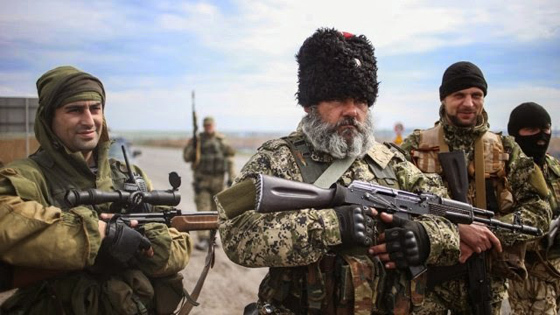
Obviously, he deliberately stylized himself under the “partisan of 1812”-an image that is well recognized by millions of people in the post-Soviet space thanks to the ligament of the “clubs of folk war” near Leo Tolstoy and famous paintings of Russian artists, depicting a partisan war with Napoleon. (By the way, it is appropriate to recall that in the 1920s, the early pro-fascist Freikors also erected their history to the partisan German Freikors of the war with Napoleon.)
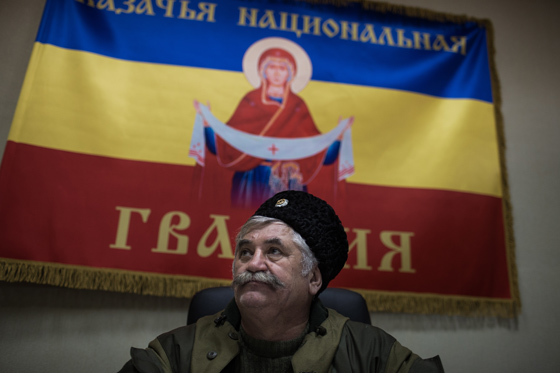
A little later, among the warriors in the Donbass, four large groups were more clearly visible - each with a pronounced ideological discourse. These are neo-imperialists (“Riflemen” and “Eurasians”), Negality (“Kozitsyns”, etc.), National Bolsheviks (“Prilepinians”) and ultra-right (“Russian Orthodox Army”). Unlike the usual “hearth defenders” who do not have an ideologically sharpened social ideal (their literary reported in their reports from Donbass, Moscow journalist Marina Akhmedova), each of these four groups is strongly indocated. Strelkov is white. He fights for an imaginary Russian empire not within the boundaries of the former USSR, but within the boundaries of the 1917 empire. Cossacks - on the contrary - realize the idea of a “self -governing Cossack republic” and, to a much greater extent, “separatists” actually. National Bolsheviks fight not for reasons of “neoimpricalism”, but for the social ideal of building an “autonomous territory”, in which nationalization and social life is organized according to principles close to the ideals of anarchism. The “Russian Orthodox Army” fights for the “Russians”, which are understood ethnically. The word “Orthodox” in their self-support is associated with the extremely right, racist discourse and mystified Russian history, originating in the books of Metropolitan John (Snychev) of the early 1990s, and then at Dugin.
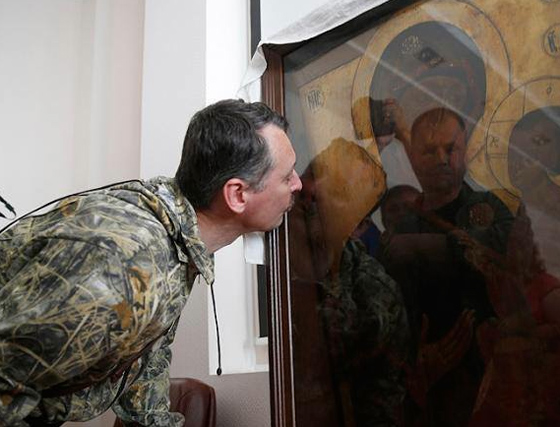
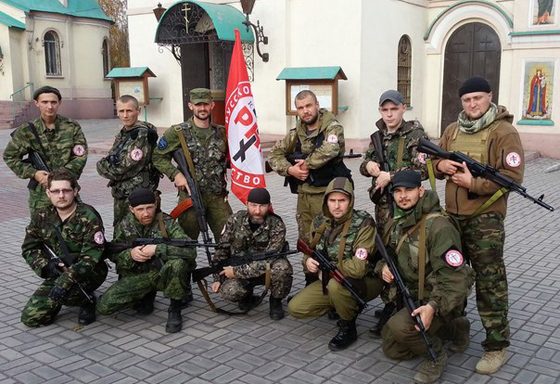
 © Stanislav Krasilnikov/TASS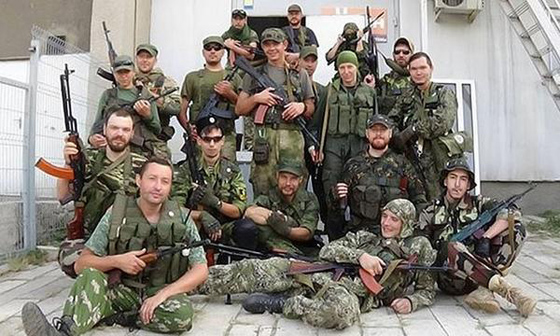
All these people are a kind of "literary republic." Many of them have read a huge number of books, they themselves write novels or poems, by education professional historians who were deeply engaged in military history. Already in the early phase of the war, Dmitry Bykov correctly drew attention to the fact that this is a "war of writers." Here we can add that a high degree of "literature" also affects the production of "visual images".
5.
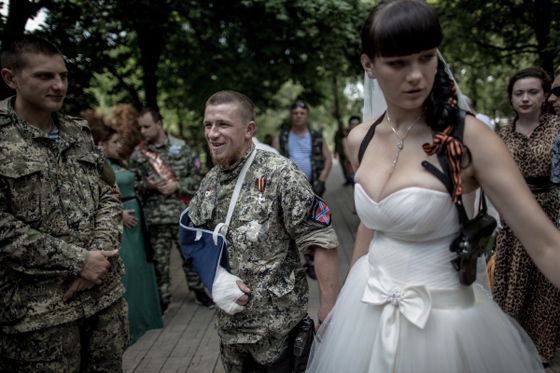
Here are three photos of the Donbass military weddings that have become extremely popular in social media. The beginning of it was laid by the so -called Motorola wedding.
 © Andrey Stenin / RIA Novosti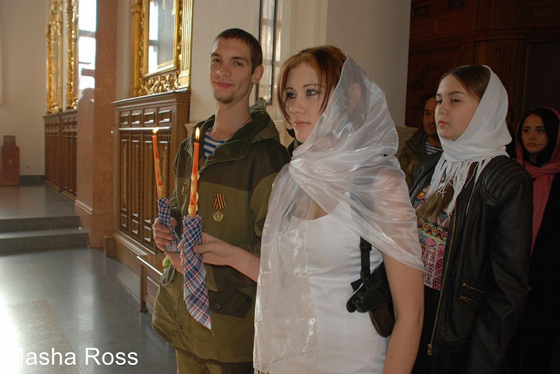
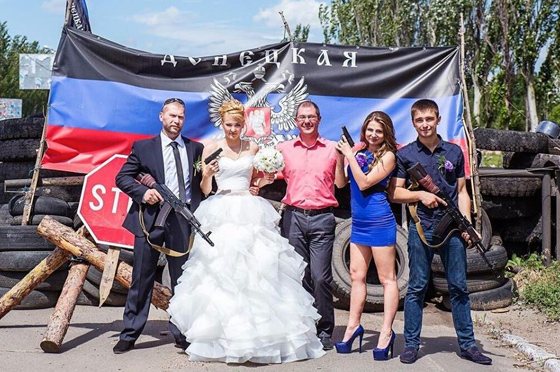
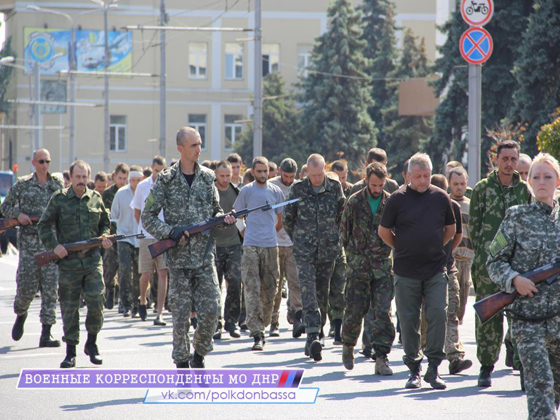
In these photographs, the “glamorous” use of weapons is noteworthy. The pistol in the holster is turned into a festive female accessory. Despite the fact that modern Orthodoxy insists on the ban on entering the temple with weapons, here we see a clear violation of this tradition, without necessity, and solely for reasons of “aesthetics”. Likewise, one of the main visual events of the Donbass war - the procession of prisoners of the Ukrainian military in the central streets of Donetsk on May 9 - is an emphasized visual quote, aesthetic gesture. Of course, all this is the aesthetics of “bad taste”, but it does not matter, because we are simply talking about a high degree of “aesthetization”.
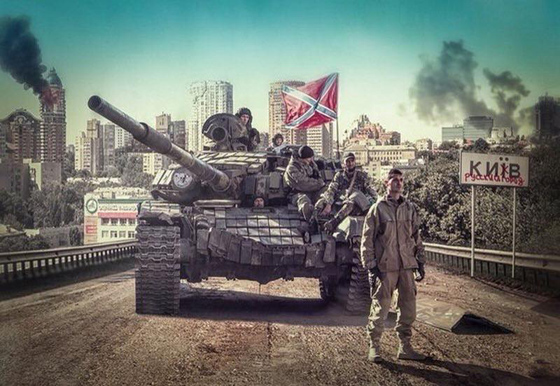
We pay attention to the production of posters and various elements of symbols. As the famous art critic Konstantin Akinsha, the posters of the planned large rally in support of the field commanders of the Donbass in Moscow, not correctly noted us stylistically referring us not to a direct political statement, but to the cinematic poster.
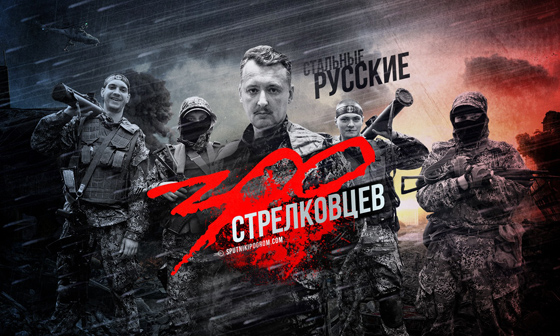
Moscow supporters of the war in the Donbass give rise to such expressive posters indicating the "glamorization" of the discourse of war.
Here I want to pay attention to several images that attract the attention of their postmodern symbols. In this photo there is a meeting at the headquarters of the Field commander of the brain. On it is an arafat, which refers to Palestinian resistance. At the same time, a flag with a quote from the Gospel of the Moscow movement of Orthodox bonuses - a small, but extremely aesthetized group, was posted on the wall.
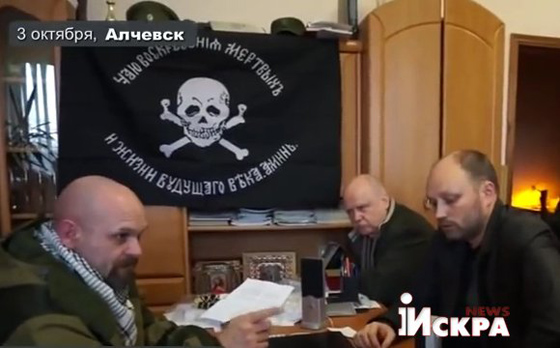
At the same time, in the array of Donbass photos, you can easily find the canonical images of Che Guevara.
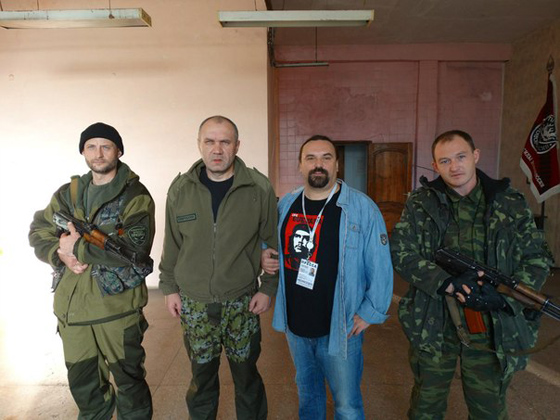
This Mikst has recently been analyzed by the famous Russian political analyst Sergei Medvedev in his article in Russian Forbes . But, in my opinion, Medvedev understands him too bluntly. He compares the DPR and the LPR with ISIS, with the Partisan Republics of Latin America such as drug -Garyls Fark in Colombia, the Maoist "Senero Luminoso" and "Tupac Amaru" in Peru, the Bolivian "Army of Catari" and the Ecuadorian "Red Sun". “They have the same love for the left rhetoric,“ popular justice ”, a racket under the guise of“ revolutionary justice ”and a passion for black masks-balconies. And it is no coincidence that one of the heroes of the “Russian Spring” the field commander Motorol wears a bracelet with a portrait of Che Guevara ... First of all, these are pronounced traditionalist anti -globalist projects. Their ideologists are inspired by samples from the past, whether Islamic theocracy in the Middle East, a bizarre mixture of Maoism, Trotskyism and Bolivarism in Latin America or a crazy cocktail of monarchism, Stalinism and “Orthodox civilization” in the heads of separatists in eastern Ukraine. Their enemy is not government, but modern society as such ... "
This is true, but with a great adjustment. We see that in the war in the Donbass there is much more distinct self -irony than in the foci of anti -Modernist resistance in Muslim countries or in Latin America. For eight months of hostilities, there are much fewer outbreaks of mass violence, attempts to build an “alternative social life” based on archaic religious or political doctrines. And, on the contrary, a lot of rhetoric and literature.
6.
Here I want to approach the conclusion. The visual picture of the war in the Donbass shows that it is not at all socially disadvantaged by the “residents of Donbass” or the men-losers recruited from Russia from among the declared former military, and the new generation of the Russian middle class. Writers, historians, military-historical reconstructors, PR people, middle-level managers-people quite successful in pre-war life-do not fight at all because of the restoration, not because of the injury, not because of the money, not because of money, as it was with Russian officers during the Chechen wars (not by chance there are so few messages about mercenaries and about the amounts that pay volunteers).
The lack of partisan funeral in social media, the crowding out of death, victims speak of the game character of this war for its participants.
The war in the Donbass, in my opinion, realizes a pure desire to add an additional “glamor with risk” over the “glamor”. This is not just “reconstruction”, but a kind of “extreme tourism”. It is no accident that the visual material of the Donbass partisans gives so few ritual photographs of the funeral and veneration of the dead combat comrades. They are hidden not because the Kremlin conceals its participation. The Kremlin does not disclose only the facts of the death of the Russian military personnel. But the lack of partisan funerals in social media, the crowding out of death, victims speak of the game character of this war for its participants. This is a kind of "safari" of the Russian middle class. However, this Safari does not happen in Africa, but in Eastern Europe. And the meaning of the situation is not that the popular uprising in the depressed region happened, but that the Russian middle class, which has risen on the oil of the zero, challenges the European middle class. This challenge is not a dominant, but postmodern. Supporters of this war in Russia are convinced that they are not waged at all a partisan war in a single territory of Donbass, but by a ultra -modern global, “hybrid”, total war (= game) along the entire surface of the globe.
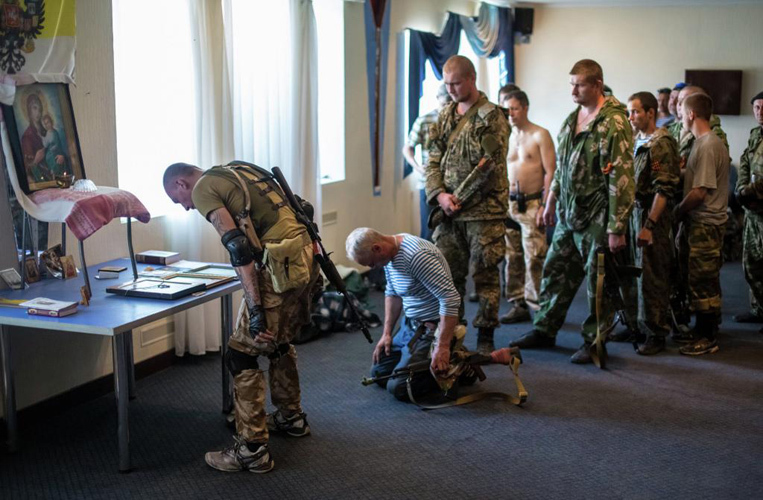
And here I want to remind you of the famous photograph of the photojournalist, who died in the Donbass, Andrei Stenin.
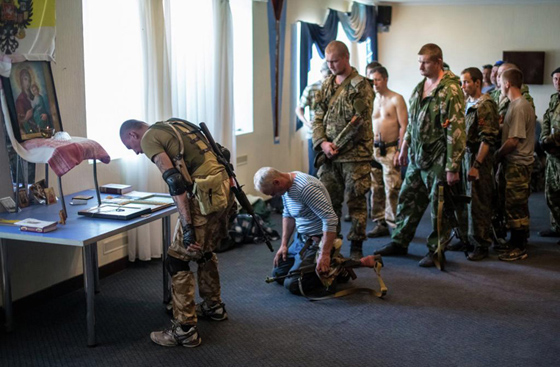 © Andrey Stenin / RIA Novosti
On the one hand, this is an expressive example of the extreme “literature” photo. Before us is a prayer room. The militias came to it, as it were, directly with the advanced, from the battle with a weapon in their hands, half -naked, disheveled. The figure of a fighter who prayedly falling to his knees is noteworthy. Only thanks to this figure is a composition built in the frame. At the same time, this is a visual quote from Russian realistic painting of the XIX century. Wanderers often seated one of the characters in their multi -figure compositions in the foreground. What does this “prayer on the knees” mean here? Removing "mortal sin"? Murders?
Despite the fact that this is a highly aesthetic war, a new type of “extreme tourism”, about 800 thousand refugees left the territory of Eastern Ukraine since the beginning of military operations. And in this "glamorous" war there are already 4,000 killed.