
Translated material
"Manifesto" after St. Petersburg
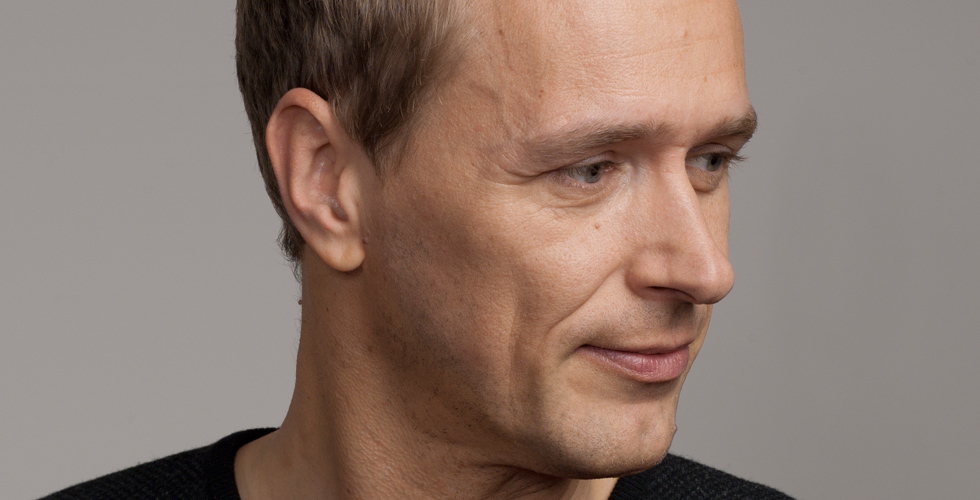
The curator of Manifesto-11, which will be held in 2016 in Zurich, was chosen by the famous German artist Christian Yankovsky . Ekaterina Krupennikova found out what to expect from him.
It so happened that I ended up at the right time in the right place - on a discussion with Christian Yankovsky during Amsterdam Art Weekend , conducted annually in November of the cultural events.
The next, eleventh in a row, "Manifesto" will be held under the motto " What PEOPLE do for Money : SOME Joint Ventures ” (“ What people do for money: joint enterprises ”). This time it will take place in the financial center of world significance - Zurich. At the same time, both Zurich and St. Petersburg, where the tenth "manifesto" took place, is officially outside the European Union.
- Is this a conscious decision?
- Not at all. Manifesto does not associate itself with the European Union. We don’t even get money from them, ”the director of the Manifesto Foundation Hedwig Feyen answered my question.
Yankovsky approaches the conceptualization of the project from a formal point of view: sets the structure, providing invited artists freely fill it. As the curator of "manifestos", it draws inspiration in projects such as Chambres D ' Amis (1986 exhibition of one of the pillars of curators, Jan Huta ( 1 , 2 ). - Ed .): “The structure that I design is revealed many opportunities. Since I suggest that the artists do not have to work as they are used to, I hope that they can make an exception for me as an artist, not a curator. For example, the artist will create a packaging for the “Manifesto” catalog, and then, perhaps, you will need to buy two catalogs (that is, in order to leave the untouched one package-production, you will have to buy a second catalog.- Ed .). Or Gerhard Richter could conduct tours along the “manifesto”. Of course, a very subtle line is, as far as the artistic work of the artist Yankovsky and how much it is an exhibition. ”
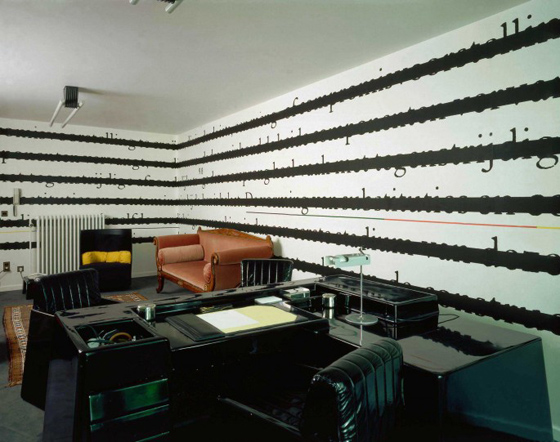 Chambres d'Amis
The frame that Yankovsky offers is opposed to the approach that is usual for the curator, which would first develop the theoretical context and used Biennale as a platform for political criticism or social transformation. “I will not have to push on politics, creating art,” the artist said, “and I will not insist that political topics be raised by participants. But, of course, those artists whom I think will certainly think in this direction. However, I do not put this in my concept. Maybe one of the artists will cooperate with the migration service, they will begin a dialogue, and we will see that it can come out of this. This is not the curatorial concept that will illustrate this or that problem of Zurich. I have many questions to such approaches. ” That is why Yankovsky is invited to work on the next “manifesto” as a “artist-bucket”, and not a professional curator like Casper König .
The exhibition will consist of three parts. The main subsection will be located in the so -called corporate spaces. Artists will work in tandem with businessmen and other professionals from different fields. The second subsection is historical; It will include museum exhibits located in the institutional environment (however, of course, this environment will not be the main thing in the structure of the project). Yankovsky believes that it is important to use institutions, since this is already familiar to the audience and developed infrastructure, the initial points of the movement of the audience, where you can get the most complete information about a holistic project. The third part will be a video documentation of the events of the main subsection. This archive will be located in a specially built pavilion, which will be erected somewhere far from the city.
Manifesto does not associate itself with the European Union. We do not even get money from them.
Here is how Yankovsky himself tells about this: “In the main subsection of the exhibition“ owners ”from a certain business sphere, they will be associated with“ guests ”artists. These professionals can bring the most diverse prospects for the vision of the city. For example, the artist is not met at the airport not a curatorial team, but a banker. He brings the artist to his office, and from here the project begins to develop. I hope that these “owners” will gradually be able to clearly identify themselves with the research of artists. Each profession has a specific context, and the “owners” can offer a variety of opportunities for artists. This is not necessarily financial support - they can simply provide “corporate spaces”. Some will indicate the angle in which there is a bag of garbage, others can open palaces for us. This part needs to be very carefully formed, it will be one of the key for “manifestos” -2016. Sometimes work with corporations is considered as an art of low level, but, I think, there is a place for development, while artistic institutions in Zurich are already quite developed, and public art has become a traditional phenomenon. ”
When asked whether the attitude of corporations to art as an instrument of advertising was embarrassed, Yankovsky replied that “in this case, the corporations will not be able to stop this or that project, as is usually the case. For example, to say the usual "our audience will not understand this." “Manifesto” is organized at the city level, therefore, if the project is refused in the press, a scandal may rise. Corporations will have to explain the reasons for their resistance. ”
I will not push for politics, creating art, and I will not insist that political topics be raised by participants.
In 2016, the Manifesto will open two days before the “art bazel”, the largest art fair, and this is important for attracting new spectators. According to the organizers, the format of the exhibition itself involves the inclusion of a usually the least active group of the audience. Yankovsky counts on “several types of spectators: firstly,“ owners ”, as well as their families and friends, who themselves will become a new audience of“ manifestos ”. Secondly, there will be such an audience that will not even know that they have become eyewitnesses of art. Suppose the artist works with a fireman, they use the possibilities of this profession. And, of course, his family and friends will come with this professional. That is, these participants will be able to gain the experience of “manifestos” before it opened. We will record an archive that will reflect all these microcosm of social and artistic activity in Zurich. ”
Yankovsky does not plan to form a curatorial team. He is interested in his own role as an artist invited by Biennale: “I am already interested in this project that I switch from the profession of the artist to the profession of a curator. I like that I do not have to follow all these rules. Of course, I have experience working with many different curators, and I can use it, knowing, for example, that I love or do not like the artist in working with curators. But, I hope, after this experiment, I will have more friends than enemies. ”
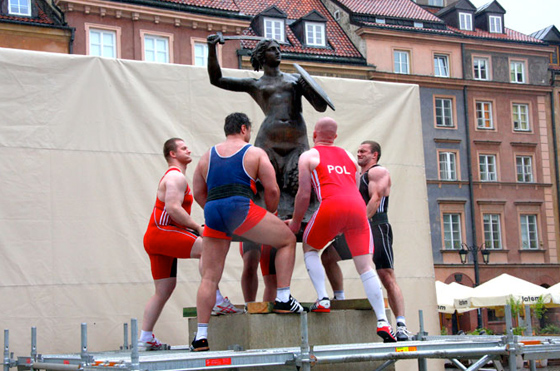 © The Center for Contemporary Art Ujazdowski Castle "The Heavy-Sweight History"
Last summer, Christian Yankovsky opened a personal exhibition in the Center for Modern Art “Uteazdovsky Castle” in Warsaw. He brought his students there, offering them to make a project in a public space. They had to choose a historical monument and work with it. The idea was excellent, but the resulting work turned out to be far from the most expressive, but often divorced from context. Therefore, I could not help but ask if the artist plans to attract his students to work on the "manifesto". “They are already invited,” he answered, “but not as participants. At first I wanted to stop teaching students, and then I felt guilty. I can't just leave them. I talked with the school principal that I would take students with me. Maybe they can make some kind of parallel project. For them, this is also a unique opportunity to see Biennale from the inside. But I can always change my decision. It is important for me that this collaboration works. ”
Yankovsky hopes that the next “manifesto” will be able to give the way to young talents: “I know about what to expect from my generation of artists: who is right, who is left, etc. However, I am not at all familiar with the young generation. I think this is a huge chance for me. I am grateful to the curators that they found me at a fairly young age. And I would be glad to give the opportunity to develop new talents. ”
In recent years, the reputation of the “Manifesto” has repeatedly been questioned in question: it was presented with a corporation using artists, a financial meat grinder and a closed, conservative institution. But the invitation of Christian Yankovsky as the “artist-curator” of the next Biennale is really intriguing and gives hope for a new page in the history of “Manifesto”. The idea that Yankovsky introduced sounds very unexpected and inspiring.