
Translated material
Media meeting - rally or picket?
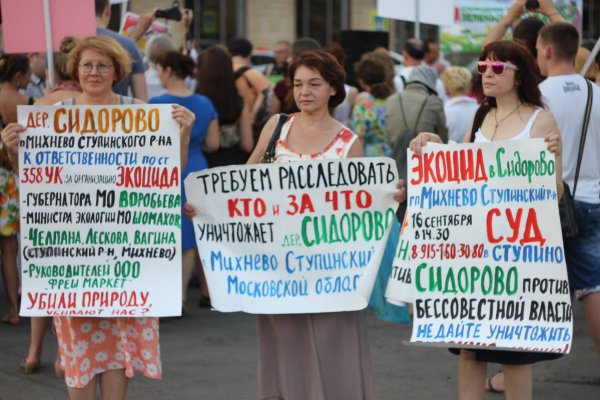
Residents of the village of Sidorovo, located in the Stupinsky district of the Moscow Region, have been fighting for more than a year with development. One of the activists was sentenced to a fine for a meeting with reporters, which the court considered an inconsistent mass event.
As Irina Ladygina said, one of the most active defenders of the village, “right in the village, literally in the gardens”, a logistics center for the O'Kay hypermarkets is built. According to Ladygina, for the sake of this construction, “ponds were buried, the forest was cut down, the water that went into artificial reservoirs was cut down in the spring, the plots are caught, at the end of the summer, some dried out the water in the well, all the last winter and spring were turned off for four, five hours for five hours without any warning, and there is no gas in the village.” In addition, as the activist claims, "on what basis they issued a building permit, it is not clear, because the general plan was rejected by the Government of the Moscow Region." Local residents could not find out the hearings officially, since the MiG newspaper (Mikhnevskaya Information newspaper), where information was published, does not apply in the village of Sidorovo. The sanitary protective strip around the enterprise of this class, according to Ladygina, should be 100 meters, but it was reduced to two meters, and somewhere to zero: “They climbed to the people in the gardens, some of the meter, some had two fences for two.” Residents wrote complaints to Rospotrebnadzor, to the Ministry of Emergencies in connection with a violation of fire safety, but from everywhere, according to Ladygin, they received unsubscribes. Stupinsky City Court refuses to satisfy claims for recognition of a building permit illegal.
Ladygina, as a result of her activist activity, was involved in litigation for many months. It began with the fact that in the MiG newspaper MiG mentioned above, an article by Vyacheslav Vagin appeared, at that time the chairman of the Council of Deputies of the city settlement of Mikhnevo, which includes Sidorovo (as well as the father of the founder and chief editor of the newspaper, at that time the deputy Andrei Vagin - the council was re -elected and the vaginas were not included in it). An article entitled “Bandera avant-garde on our land or the“ fifth column ”in action was dedicated to the rally organized by the inhabitants of the village (including Ladygina), which discussed the situation with the construction of the logistics center and sounded the requirements of the Mikhnev leadership, including the Vagin Sr. (“ Of course, they could not forgive this, ”Ladygina notes). The article stated that the rally participants on March 2 are in support of “Heroev Maidan”, “Nazis and Bendera”, and this thesis was illustrated by a photograph with the poster “Freedom to Ukraine! The security forces of Russia is not a place in a foreign country! Glory to the heroes of the Maidan! ”, Which, according to Ladygina, was not at the rally. The article also mentioned certain “odious personalities - residents of the city of Moscow, constantly not living”, who, in particular, oppose the construction of an “environmentally friendly” logistics center. Apparently, it was meant among others and Ladygin, who really lives in Moscow in winter, and comes to the village, where she has a plot, comes only in the summer. The article was given her photograph close -up. The Vagin called the “fascist Kholui” who turned out to be among those, Ladygina sued (she herself, judging by her page on social networks, in the conflict in eastern Ukraine supports the pro -Russian side). In the Stupinsky City Court, she lost, but the Moscow Regional Court decided on November 24 in her favor , collecting 5 thousand rubles from the Vagin as compensation for non-pecuniary damage and obliging the Vagin Jr. to publish a refutation in his newspaper.
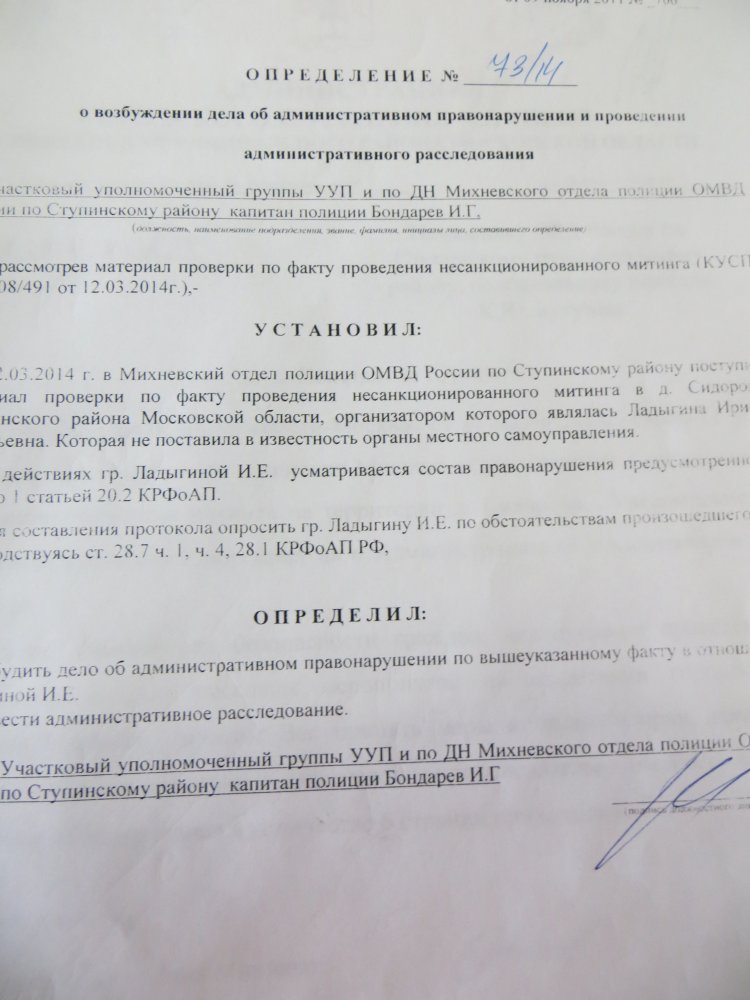
However, the “fascist-Ukrainian” topic in connection with the rally on March 2 was reflected not only in the newspaper. On April 3, according to Ladygina, she found that in Mikhnev and nearby the village of Semenovsky, leaflets were distributed under the slogan “Fascism will not pass”, which mentioned the same rally illustrated by the same photograph with a poster in support of Ukraine and Maidan. Ladygina noted that the leaflets were of good quality, clearly printed in a typographic way. The leaflets contained attacks on the local municipal deputy Sergey Testerin, who at that time supported the residents of Sidorov (the surname was also mentioned in the article of the Vagin Sr. without mentioning him). Ladygina went to the Mikhnevsky police department to write a statement on the dissemination of slanderous information regarding tutin. There they told her that they wanted to interrogate her about a certain illegal rally that she organized (it was clearly not about a rally on March 2, since he was agreed with the administration). Ladygina replied that she did not understand what she was talking about, referred to fatigue and added that if there is a need to interrogate it, then let her send her a agenda. Instead, when she was about to leave the department, she was invited to the office allegedly to talk with the boss, but two police captains (one of them, familiar to her by a village district police officer) with some two women were entered there-from what the police said, Ladygina did not understand this or witnesses-and began to ask her questions about a certain illegal rally. Ladygina continued to insist on observing the form, demanded that her be sent a summons. When she tried to leave the office, the district police officer began to push her away. Ladygina became ill, pressure rose, she was called an ambulance. According to her, while the arrived doctor made her injections, she saw how one of the witnesses, or witnesses freely went to the police officers in the duty unit and asked: "Where are my things, guys?" In less than a week, Ladygina got to the hospital due to strong pressure jumps. Only later, when Ladygin was summoned to court, she found out that she was instructed to be instructive under Article 20.2 as the organizer of a certain unauthorized rally, which allegedly took place on March 10.
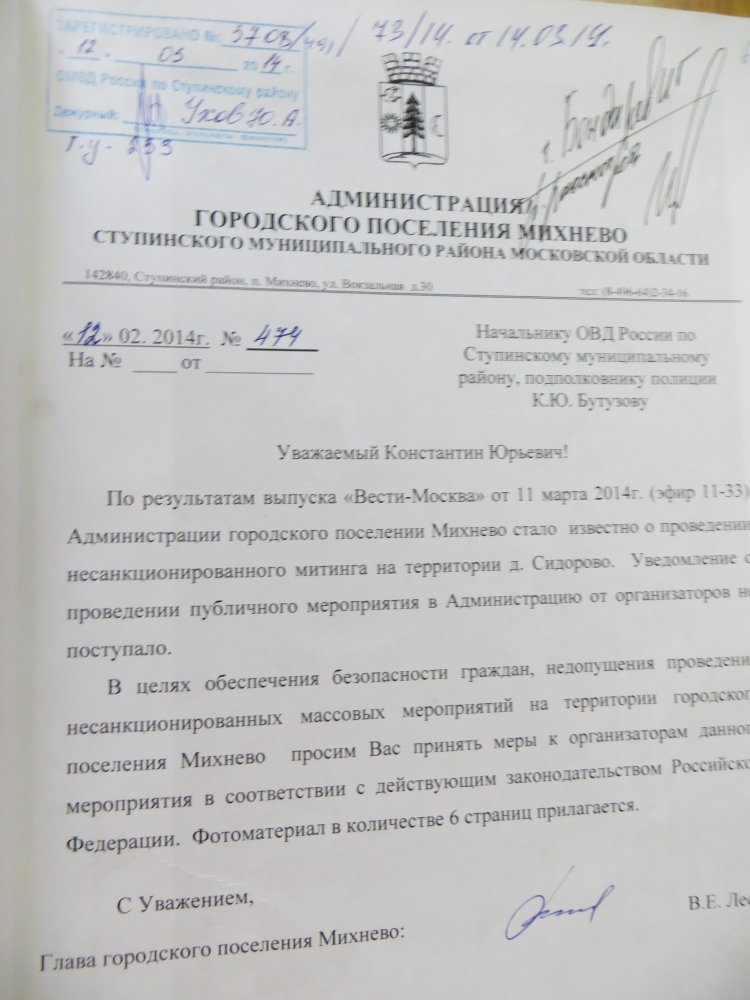
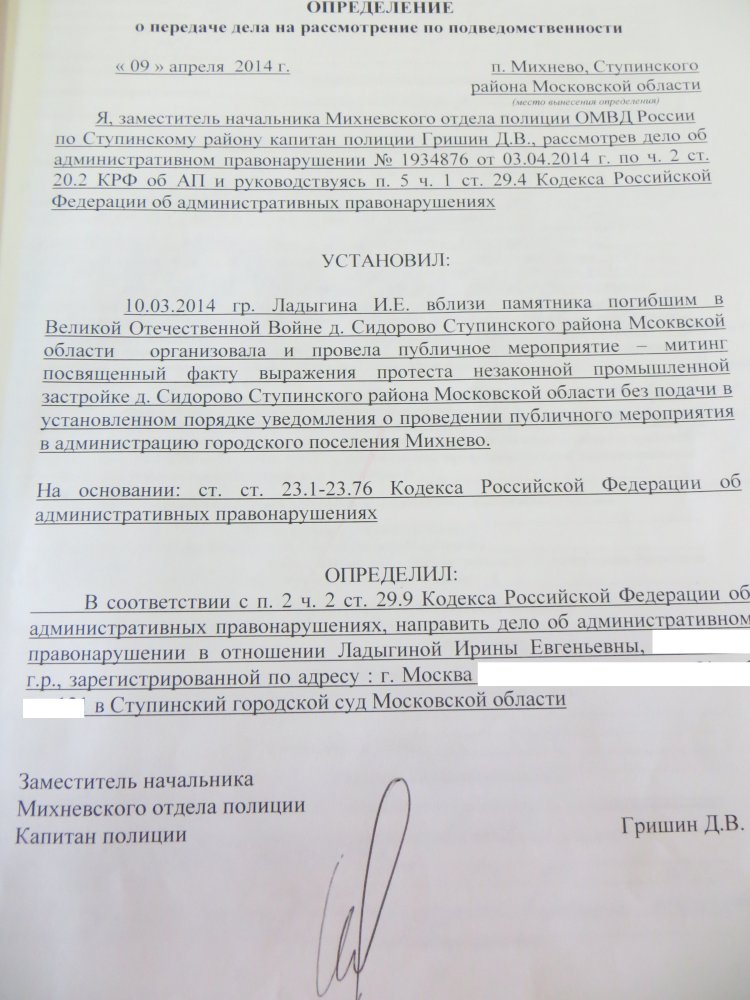 Ladygina herself and the witnesses attracted to the court claim that there was no rally on this day-it was simply to the village at the invitation of Ladygina by journalists from the Vesti-Moscow television program, who were talking with local residents. The meeting took place on the street, near the monument to the heroes of the Great Patriotic War - according to Ladygina, this is the only place in the village where meetings are held. Ladygina does not believe that she can be called the organizer of this meeting - she did not convene anyone on her and talked about what she called journalists, only to two people. She came to the meeting itself directly from Moscow, gave reporters an interview and went back, having managed to see that local residents literally “tear journalists to pieces” - everyone wanted to call them to their house. Later, from the video shown in the transmission of the video and, according to the conversations of the inhabitants of Ladygin, I realized that the journalists walked around the yards. All this is the head of Mikhnev Valentin Leskov, who was not present at the meeting, but judged, as it appears from his statement to the police, he regarded the release of the Vesti-Moscow transfer as a rally.
 At the same time, the protocol on the offense in the police, as Ladygina notes from the words of his representative, who went to the meeting with her, was drawn up without indicating the number and place.
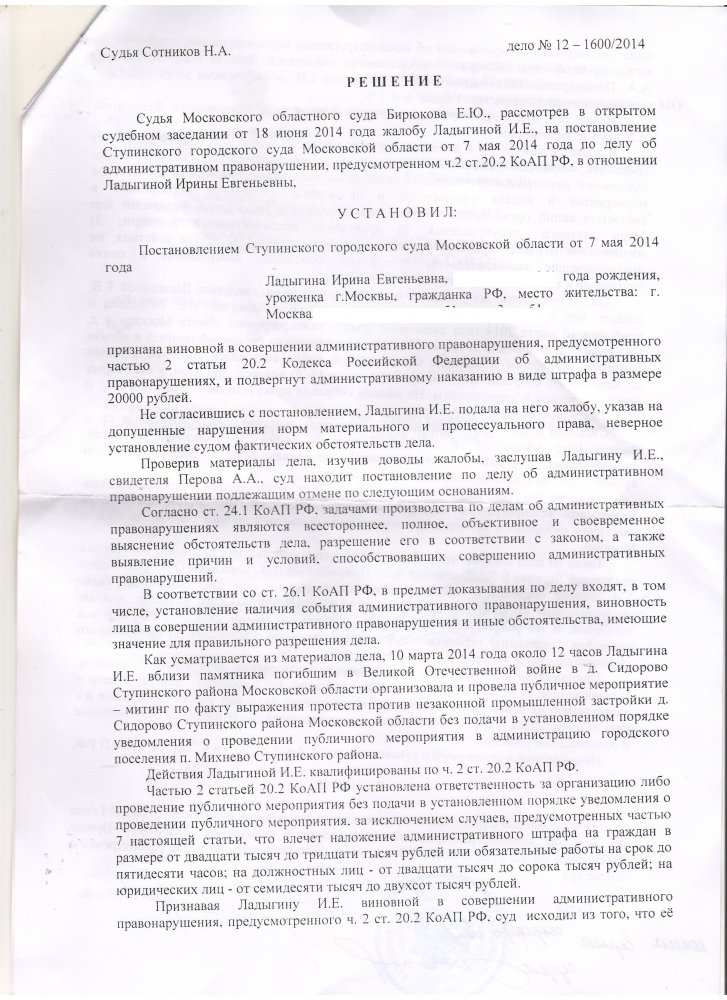
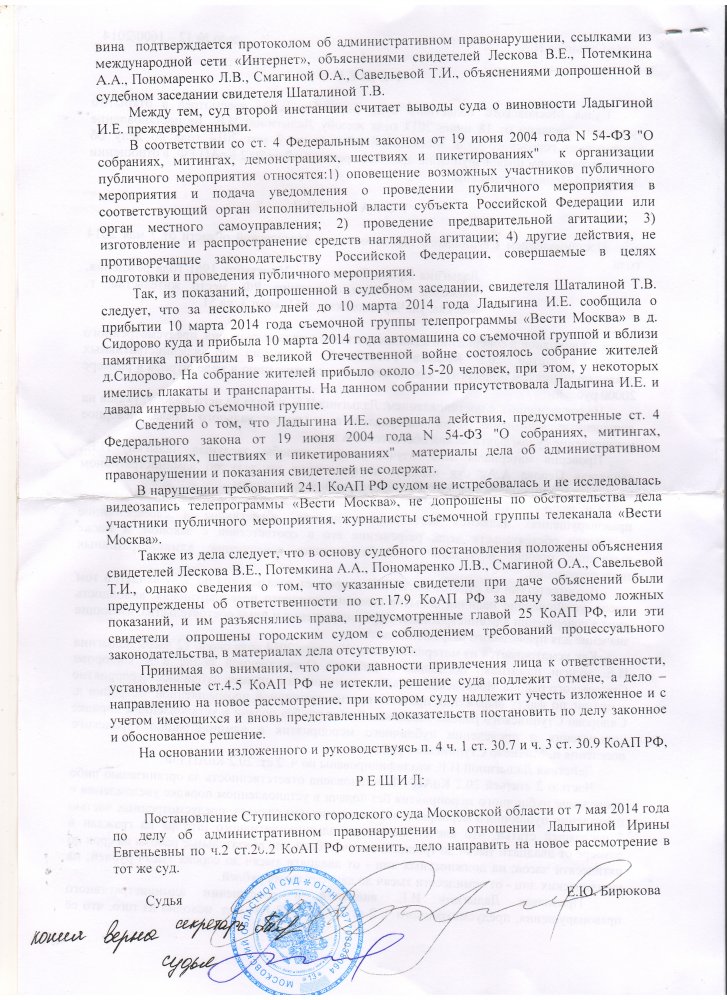
 The trial in this case began in May and is still not completed. According to Ladygina, seven meetings dedicated to this case took place in total, during the consideration of the case, three judges of the Stupinsky court were replaced by each other. The first judge, Nikolai Sotnikov, according to the activist, did not listen to anything, ignored her arguments that no one should notify anyone of the intention to communicate with the media, and on May 7 sentenced Ladygin to 20 thousand fine. Ladygina appealed to the Moscow Regional Court, who abolished the decision of the judge of Sotnikov on June 18 and returned the case to the Stupino court, and in the decision of the Moscow Regional Council it was indicated that the court of first instance did not demand and did not investigate the video recording of the very television program, did not interrogate the participants in the meeting and the journalists' own. In addition, it was noted that although the explanations of Leskov himself and his assistants were based on the basis of the court decision, there was no information that these people were warned of liability for giving false testimony or that they were interrogated in court.
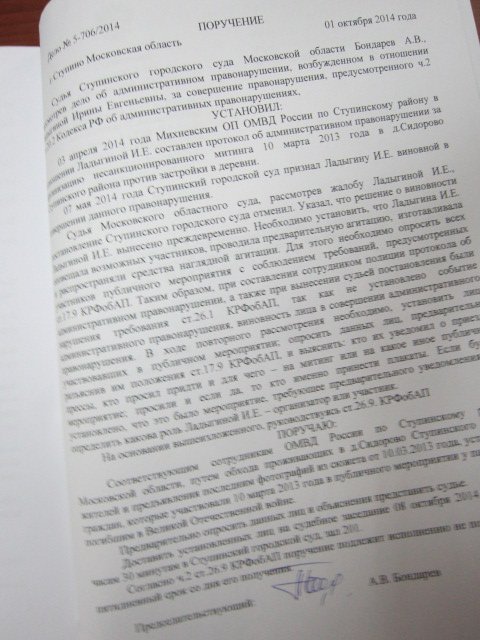
 After that, the chairman of the Stupinsky court, Alexei Bondarev, took the case. According to Ladygina, he held three meetings. He listened in detail to the side of protection and made it clear that he was ready to consider the case for a long time. However, he did not call the representatives of the other side to the court despite all the petitions Ladygina. At one of the meetings, according to the activist, the judge, in response to her next request to call the witnesses of the prosecution, said: “What can they tell us?” On the contrary, he was ready to listen and listen to the witnesses of the defense - his goal was to interview all participants in the meeting, despite the fact that Ladygina said that she did not remember who was at the meeting, especially since by that time six months had already passed - the journalists arrived on March 10, and Bondarev examined the case in the fall. To this, the judge stated that he would give an instruction that the police bring to the court “who is necessary” (the corresponding document is in the case file). Ladigina later learned from a friend of the village that police actually came to her on September 30 and asked about the details of the March meeting with reporters.
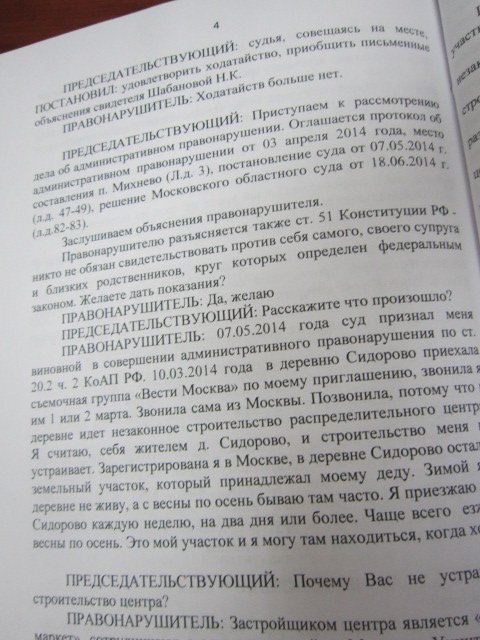
 After one of the meetings, when the those present had not yet managed to leave the hall, and Ladygina was to turn off the microphone, her friend asked the judge how much more the consideration of the case would last and what to do Ladygina - after all, the judge, they say, understands that she did not conduct any rally. To this, Bondarev replied that he could re -qualify the prosecution and sentenced Ladygin to a lesser fine, not as an organizer, but as a participant. But with the condition that she admits that the rally was (the audio recording of the conversation is at the disposal of the ATS-Info). At the next meeting, Ladygina told the judge a discharge due to the fact that he was a biased case, to bias, offers her a deal, and in addition, in Ladygin’s protocol it was called the offender, although her guilt is not proven, and the previous court decision was canceled. In addition, Ladygina submitted an application to the prosecutor’s office due to the fact that the police conducted a survey of residents not within the framework of operational-search measures, as the law requires, but on behalf of the judge, although the task of the court is to objectively evaluate the evidence presented, and not to search for evidence for one of the parties to the process.
 Judge Bondarev took a challenge, he was replaced by judge Evgeny Yesin, who also did not call any of the police or local administration. He asked Ladygin whether she walked with reporters in the village. “Then I understood,” the activist remarks, “if it turned out that I went with the crew, he would have soldered the procession to me.” The judge was also interested in the fact that someone brought a poster to the meeting. To this, Ladygina replied that she had nothing to do with this, the poster itself did not bring and did not hold, and in any law it is not said that a poster cannot be taken to meet with the press. As a result, Esin already without the proposals of the transaction re -qualified the charge from part 2 of article 20.2 to Part 5, that is, he recognized Ladygin not by the organizer, but by the participant, but the event himself did not consider a rally, but by the picket - and on November 14 sentenced the activist to a fine of 10 thousand.
On November 24, Ladygina appealed to the Moscow Regional Court. Consideration of the complaint is scheduled for December 25. According to the activist, the purpose of the administration with which she fights is “exhaust in the courts, scare to distract from the main court” regarding construction. During this time, the inhabitants of Sidorov had another reason for indignation - the construction of intercepting parking right in the village. “In general, they are being built without permits, they wrote to me from the Stupinsky administration that they did not give permission, there were no hearings either,” says Ladygina. According to her, when trying to find out on what basis, they tried to beat, knock out the camera on what basis. She sent a shot video to the president, and on November 24 filed a lawsuit to recognize the construction illegal.
According to Ladygina, while this story lasts, she received dubious calls from unknown, there were attempts to bribe (in her opinion, the “judicial pressure” began after she and the other residents rejected the proposal for the possibility of agreeing and a certain “financial assistance” in exchange for refusing to protest). “People support me, but they are still a village, people there are simple, who cannot figure it out on the Internet, not like legal intricacies. I am a locomotive, here I am so contrary to them (local authorities-ATS-info). It just becomes dangerous, I am like a bone in the throat, ”says Ladygina. Nevertheless, the activist intends to continue to defend his rights in court, including in connection with the “picket”: “I will not calm down. And it’s not at all about money - I spent more money on the road during this time than these ten thousand. ”