
Translated material
Shtl: instead of epitaph
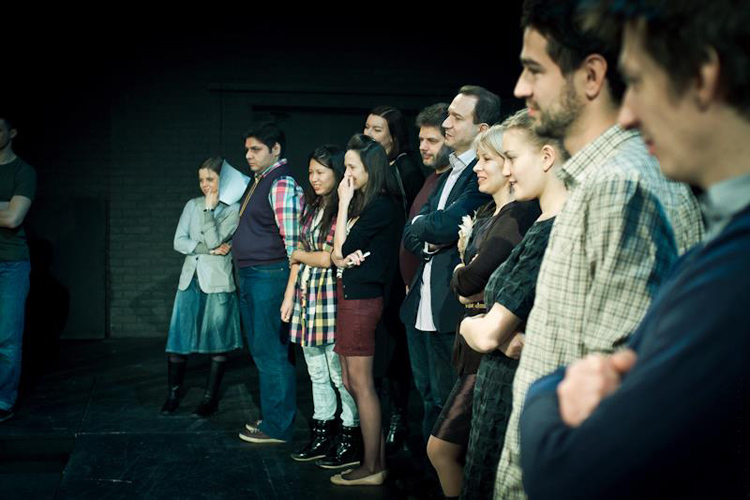
I released the third - and the last - the course of the school leader . For three years, this project of the Meyerhold Center for the training of personnel for the State Theater was supported by the Moscow Department of Culture. One of the leaders Shtl Elena Kovalskaya sums up and makes plans.
First of all, Shtl is almost one and a half hundred young people of different theatrical professions. Among them are directors and producers, playwrights and choreographers, designers, sceneds, multimedia artists, critics. Some of them work in the State Theater, others lead independent troupes and sites. The professions and experience of these people are different - and the performances about the theater are common. These people are well acquainted with each other's competencies, business qualities and beliefs. We figured it out well of how the state cultural machine is arranged, and have ideas about its modernization. There is no hierarchy among them - only horizontal ties. He pulls them to call them a “secret society”, but in fact there are no secrets.
Their beliefs are as briefly.
Theater is an art that expresses the views of contemporary artists on reality and creating the heritage of the future. This is time.
To a large extent, the theater is the art of communication. Therefore, it should be considered as an institution that forms in society meanings, values and social capital, that is, trust between people and social groups.
The theater is also the industry. And this industry, like a bird, should have two wings - state support and support of the company: private individuals, companies, funds.
Finally, the theater is an enterprise; Like any enterprise, it needs strategic planning. And, as in any other business, strategies should compete with each other, and leaders should be selected on the basis of the competition.
Such ideas sounded in the time of the 306th audience of Qima who managed to become the legendary and, so to speak, fell into the audience. The importance of the theater in creating confidence was formulated at lectures in Stol Alexander Auzan. Professor Gennady Dadamyan spoke about two wings of culture poultry. About the competitions, which should be transparent, - Professor Lev Sundstrom and Alexander Rubinstein. Oleg Tabakov spoke about the social responsibility of the theater to employees, and the doctor of the new Sorbonna Tatyana Mogilevskaya - about responsibility to society. The fact that the theater and the state should be told by the Moscow Minister of Culture Kapkov and other leaders of the department. And about how a public agreement sounds in other European countries is British Simon Mandi. There was something about the experience of theatrical reforms in Russia to tell the ex-Minister of Culture Mikhail Shvydkom, Valery Fokin, Kirill Serebrennikov, Mindaugasa Karbauskis, Andrei Moglyny, Evgeny Pisarev. About how theatrical reforms were held in Eastern Europe - Andrea Top Hungarian criticism. Well, and so on, everyone here cannot be listed.
The plug opened in 2012, after Bolotnaya-with faith in civil society, public progress and the ability to restore the mechanism of generations destroyed in twenty years in the theater. And it closes on the eve of 2015: eight months as war, Russia is in isolation, the bottom is not visible.
But cultural policy and economics are only part of the course. Another part is lectures on the organization of theatrical affairs: strategic planning, financial management, marketing, taxes, laws, law. The third, main part is the work in the group. In the final of the course, the group created strategies for specific Moscow theaters - “Modern” and “Same”, the theater under the leadership of Armen Dzhigarkhanyan and the Ruben Simonov Theater, the Taganka Theater, the theater on Perovskaya; Only two dozen. Between the sessions, we organized educational modules, involving the plug of new people in the circle. They made institutional proposals: they created a regulation on the competition to replace the vacancy of the head of the theater, created the charter of the Russian repertoire theater, where they prescribed high -quality criteria for evaluating the theater; In the end, they discussed the foundations of cultural policy by the figures of the theater in the presence of one of the authors of this document Vladimir Tolstoy. A variety of theatrical leaders performed - Mark Zakharov and Kirill Serebrennikov, the director of the Bolshoi Vladimir Urin and the director of the Little Tomsk Youth Theater. In a word, they worked as an educational project and as a trade union.
The curriculum was the same for each year. The mood is new every year. The point, as you know, is not at all that over three years the 93rd federal law was replaced by the notorious 44th, cultural financing has decreased, the state task has been tightened and an “effective contract” looted. In the end, we are also for effectiveness, although we define it four times wider - as the French, we are talking about the artistic, professional, social and territorial responsibility of the theater. But the plug opened in 2012, after Bolotnaya-with faith in civil society, public progress and the ability to restore the mechanism of generations destroyed in twenty years in the theater. And it closes on the eve of 2015: eight months as war, Russia is in isolation, the bottom is not visible. The state headed for traditional values. In the new cultural policy, graduates Stol with their secular-stagnantic values are not expected. This is speaking in science. And speaking emotionally, to continue the school in the new conditions is the same as to heat space.
The question is, why are the graduates Shtl, so smart, talented and one, not to get out of the influence of the state and not to create an alternative to the state theater? Yes, because our culture, in the categories of birds, a single wing: state support. There are no laws that would contribute to the support of culture by society. And it is not expected - today the state prefers to keep the culture on a hard leash. The State Theater remains the main resource. Fair access to professionals and artists to this resource is a goal that today is even more distant than three years ago. It remains to rely on what, in fact, the garden was fed up: on horizontal ties inside the young community. And for a while. After all, nothing is forever under the moon. And no one is eternal.
So, the school in Tsim closes. But the "Institute of theater" opens. Rather, it will be said that Zim in partnership with the Golden Mask festival will develop a program that was launched two years ago. The Institute of Theater was an applied section of Stol, a series of programs to configure communication between theater and society; We will call it for brevity as Boris Yukhananov our program for the Stanislavsky electric power engineer - a school of theater viewer. In two years we have our own methods. We learned something. Horizontal ties inside the theater are a good thing. But the theater is able to build horizontal ties among other people. Combine, enlighten, humanize - that is, change their values. Acting in their walls and even beyond. What, what, and this Steelovites know how to do better than many. And such work today, of course, no edge.