
Translated material
The borders of the Russian
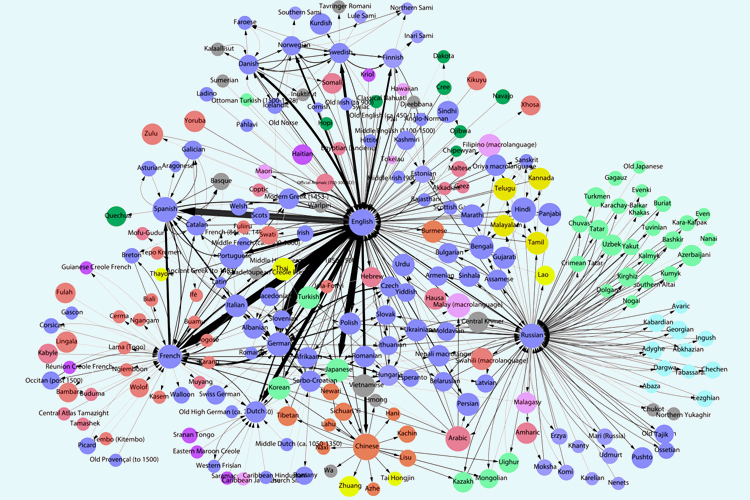
Ask at any parent forum what foreign children to teach. Someone will surely advise Chinese: both carriers for a billion and the economy of the wow-an influential language in all respects. The error in this logic is opened by an article printed this week in the American magazine ProChedings of The National Academy of Sciences .
Shahar Runen from the MIT media laboratory with co -authors (including, for example, Harvard professor Steten Pinker, classic linguistics and cognitiveness) suggests looking at languages as transport nodes on a network where knowledge of various varieties spread. Suppose someone formulated an important thought in German and set it out in the book. How soon will this idea discuss Bengali in the Indian states Assam, Bihar and Odisha? And what languages will play the role of intermediate stops? And are there great chances that the essay from the Bengal magazine will eventually transfer to German?
With this analysis, it is suddenly found that Arabic with its 530 million carriers and all of Saudi Arabia oil is inferior in influence to the Dutch, which speaks modest 27 million people. Chinese, the language of the second world economy, is also not in the leaders.
How do scientists know this? They generated three visual cards based on three portions of “big data”. Firstly, open statistics of the right to Wikipedia. They searched for cases when the same editor simultaneously updates articles in different languages. In Ethiopia, a celebrity dies or a meteorite falls - and a person who renews an article in his native Ambar, considers it necessary to ask for several cultures about this, when he followed by the paragraph into encyclopedic texts in Russian or Italian.
Arabic with its 530 million carriers and all of Saudi Arabia is inferior in influence to the Dutch, on which the modest 27 million people are talking.
Secondly, Twitter . Here, researchers were interested in bilingual users who make notes in one language or another. The more such bilinguals, the more the fat line connects a couple of languages on the map.
Finally, the most informative source is the results of the UNESCO project Index Translationum : The public database contains 2.2 million books per thousand more languages. This time we can say not only that the X language is connected with the language of Igrek, but also who has influenced whom. If the book was first published in English, and then translated into Russian - the arrow on the map leaves the mug tagged and sticks into the circle with the Russian label. The arrow in the opposite direction - to English - for almost all languages is much less fat.
Russian, if you look at the translation card, literally the following in importance for English. In the field of its influence (except for the understandable languages of the former USSR)-sudden Uyghur (north-west China), Tamil (South India), Gujarati (Western India), Suakhili (Africa) and Khmersky (Cambodia). This can be accepted for evidence of the vastness of the Russian world and the effectiveness of the work of the RUSSIA TV channel Today - but rather, in Soviet cultural policy.
When the influence ends, books remain, even if no one else reads them. If you find in the UNESCO database all 204 transfers from Russian to Khmersky, six Lenin’s work, two Brezhnev, the Soviet Constitution and the “main directions of social development of the USSR for 1981” will be on the first page of issuing. The “elephant” of Kuprin and “How Dunno composed poems” by Nosov will be found a little deeper.
In the field of influence of the Russian language - sudden Uyghursky, Tamil, Gujarati, Suakhili and Khmersky.
The living zone of influence is reflected by Twitter and Wikipedia. There are quite a lot of those who write in Russian and the Macedonian or Russian and Novo part. And even in Russian and Japanese. In the latter case, according to raw data, it is impossible to say a guaranteed way to talk about who are the Japanese who are in love with Russian culture, or Russian schoolchildren who write down the names of the heroes of anime by hieroglyphs. However, the transfer of information from culture to culture in large portions is unlikely to occur on Twitter. The Wikipedia format is better suited for this, and here the influence zone is compressed-thin lines connect Russian Wikipedia with the Tatar, Yakut, Chuvash and Kyrgyz, and the only truly thick-from the English. With Wikipedia on Tamil, Suahili, Mongolian and Nepalsky there are no more ties.
Ronen with Pinker and their co -authors are divided by observation: the influence of the language, counted in this way, greatly correlates with the number of “world celebrities” among native speakers. How to identify real celebrities? To begin with, we go to any district book and pull out the encyclopedia from the shelf in the gilded binding “Great times and peoples”, where there is some duty list-Aristotle, Shakespeare, Leonardo da Vinci, etc. (In the case of the authors, the book Human was at hand Accomplishment : the Pursuit of Excellence in The Arts And Sciences , 800 b . C. to 1950 with four thousand names). The composition of the list in the encyclopedia to some extent depends on the continent and the country where the great ones were considered, so the authors complement it another, formed by a more universal principle. All those who are dedicated to the articles in Wikipedia are at least 26 languages.
In Armenia, with its three million inhabitants of celebrities corresponding to this definition, there were 15. In all of India - 136. 95 in Australia and 100 in Ukraine. In the 175-millionth Nigeria-23. In Russia-369. In the UK-1140. This is hardly a story about the “innate talents” of different peoples. Just an influential language makes it possible to tell more about the achievements of those who are well aware of its native speakers. The increase in oil prices and new missiles help this little, but new books and articles on Wikipedia are very even.