
Translated material
"There was no sensation of the bottom"
Personal experience: how Belarusians survived their currency crisis
In less than a year, the dollar and euros in Russia has doubled in less than a year, the fall of the ruble has already turned out to be much more serious than during the 2008 crisis, and has not yet slowed down. The active actions of the Central Bank, which increased the key rate to 17%, do not help the ruble and the active actions of the Central Bank. A similar scale of devaluation in recent years in the post -Soviet space took place only in Belarus. In 2011-2012, during a currency crisis, the dollar in Belarus has risen three times. "Medusa" asked Belarusians to share experience: what is it like to live in conditions of constantly cheaper currency.
Anna, former employee of the Belarusian state -owned enterprise
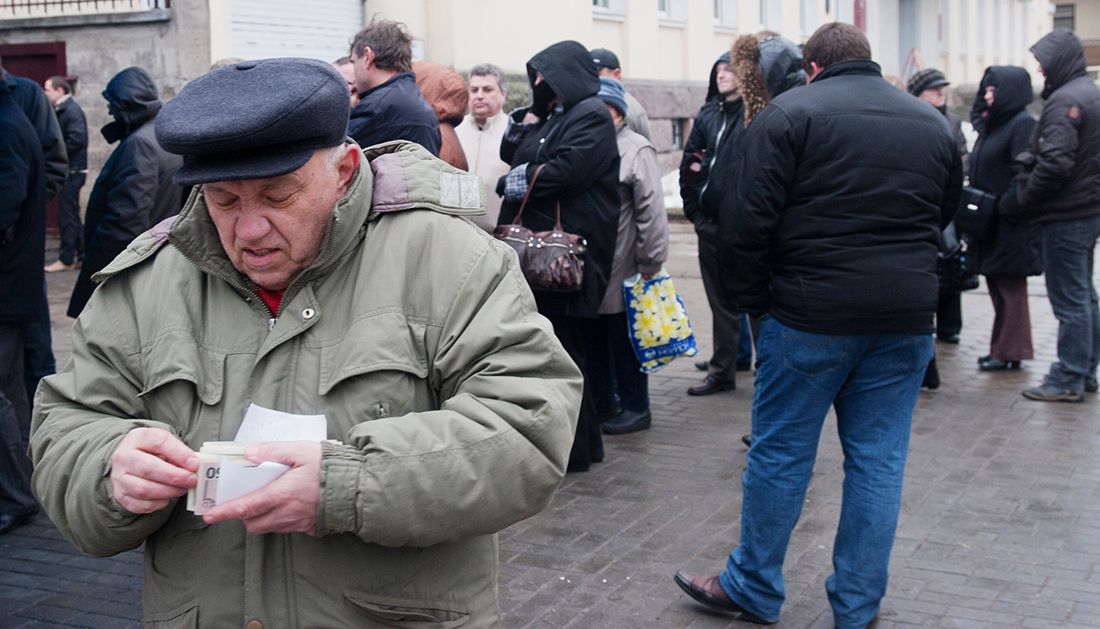
I can’t say that it was scary. Maybe Belarusians are just used to this. In Belarus, permanent ass. It came just a little large. There was no money before the crisis, just all this was artificially restrained. Then everything exploded, one might say. The dollar was gone - in Minsk there was no currency at all, there was definitely no six months. Speculators sold only. People occupied the queues, stood for days, on duty ate this currency near the exchangers.
And then it slowly leveled everything. The Belarusian economy quickly came to itself. Prices in Minsk are now in Moscow. Salaries are also comparable, although less, of course, than in Moscow. But I have many friends who work in Minsk in foreign companies, and they get no worse than in Moscow.
We did not have to significantly limit ourselves, here, they say, we will not buy sausage - this was not. Everyone lived and lived. Prices are constantly rising. Everyone is used to it. In Belarus, this is normal - that everything is bad. They did not relate to Lukashenko worse, because they always treated him badly, throughout history.
I can’t say that Belarusians experienced the 2011 crisis as acute as Russians now, because they were accustomed to this already. Belarusians are taught by the fact that the Belarusian ruble is constantly depreciated - and earlier, and now they store savings in the currency. And the Russians are in rubles.
I worked in a crisis at a factory that was engaged in import substitution. There was such a laptop - a “colleague”. It was they who bought HP computers, pasted the colleague stickers and sold three times more. Buyers are different state institutions that were ordered to buy laptops. That's all import substitution. According to the documents, everything passed, as if we had made a “colleague”, supposedly bought spare parts and so on. In fact, even the boxes were original. I had enough salaries only for small pocket expenses. Due to the situation in the economy, the salary was not raised.
Dmitry Smirnov, site editor 42.tut.by
In 2011, we tried until the last to keep the official rate of the Belarusian ruble to the dollar, saying that everything is fine. I recall the photo of Alexander Lukashenko, his son Nikolai and Peter Petrovich Prokopovich (chairman of the board of the National Bank of Belarus from 1998 to 2011; now the assistant Lukashenko - approx. "Medusa" ) sitting on gold ingots.
We had a course before the crisis at the level of 3100 rubles per dollar. The ass began around mid-March 2011, when the people realized that there were not enough bucks in exchangers, and ran to buy them in all possible ways. The fact is that Belarusians are generally familiar with currency jumps.
It was possible to buy dollars, euro, and so on, either by a miracle, or from the currencies. It was they, by the way, could be recognized as a real course. Then a wonderful Prokopovich site appeared, on which people exchanged currency with each other, and the site received a commission-a sort of online exchanger. The site instantly became superpopular, as it allowed to see the real ruble course. An interesting moment-then we joined the Customs Union, and the Russians massively came to buy a used car with us, which, due to lower duties, were ultra-deesh for them. We also did not value fuel for a long time, and truckers made a hook to drive through Belarus, and the Belarusians themselves began to be exported in tanks and cans of fuel to neighboring countries. Then, this began to fight for a ban on crossing the border more than once a week except for special cases.
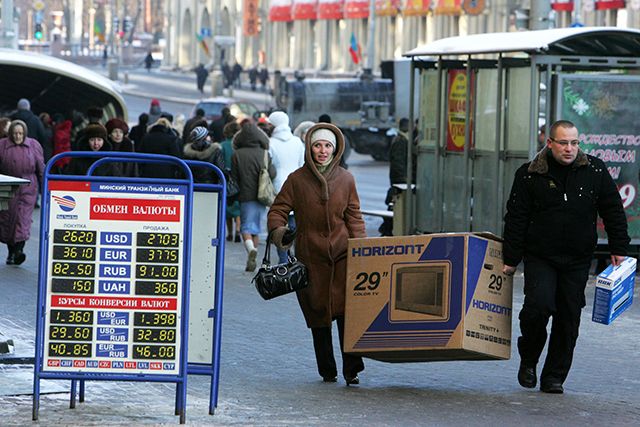
The actions of our National Bank were something like the work of your Central Bank, as I see it from here-the guys simply did not know what to do. At first they stubbornly kept a rate at the mark of 3100 rubles per dollar, giving rise to currencymen. Then they decided to establish another correct, in their opinion, the course-about 4,500 rubles, while 4600-4800 were already traded on the market. By this, they only spurred the people to a more active currency buying. As a result, it ended at the end of September 2011 approximately when the National Bank allowed the free sale and purchase of currency on the exchange. The equilibrium course was at the level of 8800 rubles.
The rise in prices was not noticeable immediately. What was produced with us (products, clothes, some industrial goods) did not value the longest time, but here the prices in the end caught up with. The people, realizing that the currency is depreciated, began to buy everything in state stores - Tsum and Gum. Basically, they took a technique that they wanted to buy, but spared money earlier.
Then I worked in MTS (state -owned company, 51% - at the National Beltelecom Communications Operator), and we did not raise salaries for quite some time. As a result, a lot of techies left for Russia.
I also did not want to put up with a sharp fall in income, so I got a job for another job (on one of the Russian Internet resources). As a result, in two works, I began to receive as much as before the crisis on one. There was never a “bottom” feeling, there was constant irritation - until the moment a part -time job appeared, for which they paid a stable Russian ruble then.
Elena Sysoy, translator
In 2011, as now, my salary was tied to the dollar. Therefore, I did not notice any serious changes in personal finances. Most of my friends had the same situation. Parents who work at state-owned enterprises have indexed and even raised their salaries.
Of course, we noticed that prices are rising, and we notice it now, but there was no feeling of some disaster. The most noticeable manifestation of the growth of the course was that banks did not sell currency. People stood in lines, some currencies appeared, a “gray course”, stories about how bank employees buy dollars “from under the counter”, trunk vehicles with dollars (currencies from them traded currency). The panic was around the purchase of currency: everyone began to try to get it somehow.
I can only speak for those people whom I know, but nobody rallied around the opposition [against the background of the crisis]. December 19, 2010 - after the presidential election - the opposition showed all its inadequacy and helplessness, although even then ordinary people were unlikely to go beyond the opposition. In April 2011, the metro was blown up, and at some moments it seemed that one of the goals, albeit indirect, could have distracted attention from the exchange rate. But this did not help.
Lukashenko, too, did not unite people around him, in any case, young people. After all, prices were not released, although the [Prime Minister of the Republic Mikhail] Myasnikovich and [Chairman of the Board of the Bank of the Development of Belarus Sergey] Rumas tried to promote something more “market”. But Lukashenko scolded them and said that, of course, he would not allow the poor people to raise prices and tear it off. Perhaps someone believed that it was better, and that the president, of course, will not give us a grudge to these private traders and the “fifth column”. Many were, rather, all the same - they were all used to it. Those who are not used to just left.
I don’t remember any specific moment when the dollar stopped growing and everything fell into place. We constantly have a slightly growing course, prices are constantly rising. But with the binding of salaries to the dollar, this is not so noticeable. There are some things that I could not afford from one salary, but it was not possible to postpone it. But I did not have to radically change habits in lifestyle, I just started to treat my budget more carefully and prioritize. There was no desire to leave either-in any case, not because of money.
Evgeny, Minsk entrepreneur
In the spring of 2011, many Belarusians were waiting for a crisis. The presidential election in December 2010 and the artificial growth of salaries in the budget sphere preceding this was pressed on the national currency course. An additional load on the course was provided by the fact that many updated their fleet before increasing import duties on cars and actively exported the currency abroad for the purchase of cars. It was this factor that the state set the cause of the crisis - but, of course, this is not so. The most important reason for that crisis, in my opinion, is preferential housing lending. The state spent more money than earned, the “printing press” actively covered this imbalance.
The spring of 2011, I, a student-student and the head of the sales department for the sale of equipment, met fully: I expected a used car from the United States, and spent Belarusian "bunnies" on all nonsense like outstanding appliances.
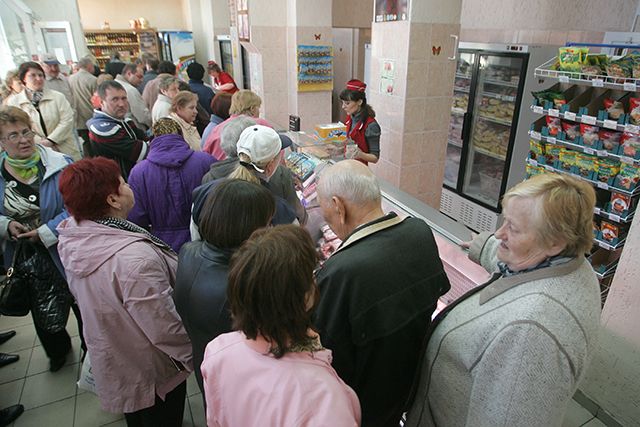
Cash currency from exchangers disappeared around March 2011, since the state could no longer spend gold and foreign exchange reserves. People began to look for alternative "sources" of currency. The state rate of approximately 3100 Belarusian rubles per dollar, but the real exchange rate on the market reached 5,000 rubles. From the TV at that time it sounded that everything was fine, no panic, but most Belarusians reacted adequately: they swept everything from the shelves.
The Belarusian society, quite calm and intimidated by the acceleration of the rally after the presidential election at the end of 2010, surprisingly actively at first expressed its discontent. There was a large action after a simultaneous increase in fuel prices, the youth actively clapped her hands on the squares in protest, organized on social networks. However, the special services did their job well, and by July 2011, all protest activities were under control.
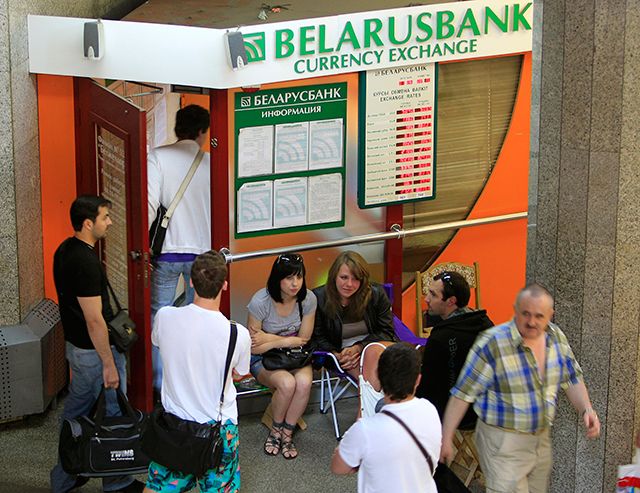
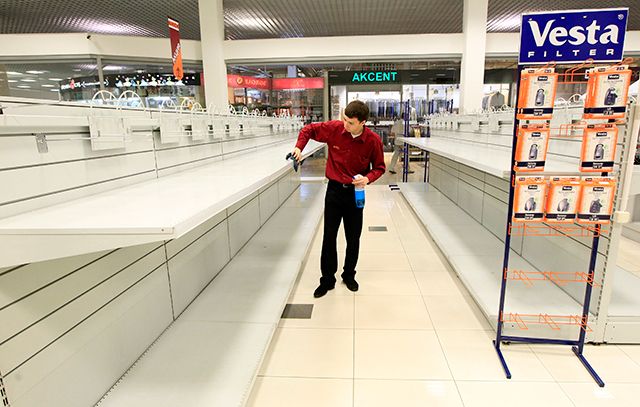
The real dollar exchange rate in the summer was already 8.5-9 thousand rubles. The state was raised only to 5 thousand rubles, and on TV they constantly called it fair. The price increase was most noticeable in the trade in imported goods. Technique, products, household chemicals and medicines immediately increased in the price in proportion to the real market rate. For example, the laptop in the winter of 2011 cost 3 million rubles, in the summer it costs 9 million. Most of all, the devaluation influenced the budget sector - we have a very large percentage of the population. The purchasing power of the population has fallen sharply. Many barely made ends meet.
At the end of the summer of 2011, the government, thanks to its most adequate part, finally managed to develop a course of course formation. The National Bank of Belarus also drove the refinancing rate to heaven. Since September 1, 2011 it became 27 percent. Until the end of the year, it was lifted up to 45 percent, which made loans very expensive for business and the population, but it allowed to attract a “printed” money ruble mass in deposits.
In October, money began to appear in exchangers gradually, the course was formed by a way that was understandable to the market. Companies and entrepreneurs learned to survive in high interest rates. This, of course, restrains the development of small and medium -sized enterprises, but we were not given other conditions
In general, it seems to me that the Belarusians managed to survive the crisis time with dignity. Many finally gained financial literacy. Someone lost business or went bankrupt, but received invaluable experience. And most importantly, a certain part of the population, previously inert, finally realized that she should only rely on herself, and not on the state.
Andrey Kozenko
Vladimir Tsybulsky