
Translated material
The return of the king in the heads
"Olympia" in the "Workshop of Peter Fomenko"
"Olympia" in the "Workshop of Peter Fomenko"
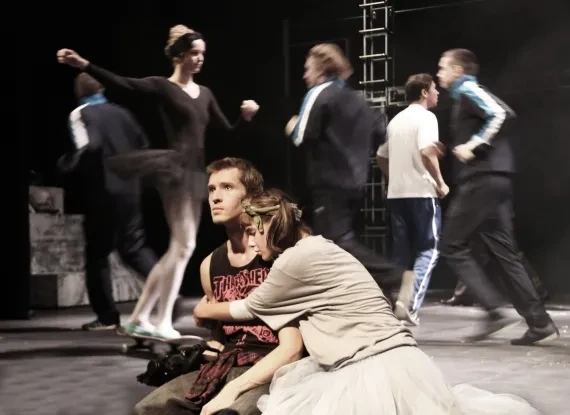
Olga Mukhina’s play “Olympia” has two initiations: “Those who rolled on the rollers in the Alexander Garden in 1991–92” - and Leni Rifenshtal, the author of the film “Olympia” (1936), the formidable ode of the Berlin Olympiad and the knees of Germany. The genre of the play is “The Tale of Tales”. And the plot is extremely simple: the life of one Moscow family from the Olympics to the Olympics. From 1980 to 2014.
The play of 25-year-old Olya Mukhina “Tanya-Tanya” Pyotr Fomenko set in the winter of 1996. "Workshop ..." was still homeless. Neither the new building of the theater opposite Moscow City (Olympia is there), nor even about the “old”, about the cozy cave of the converted cinema “Pioneer”, there was still no question. (I remember: “Tanya-Yanu” play in the hall of the Polivanovsky gymnasium on the Prechistenka. School chairs are shifted, the hall is clogged, its columns shine from darkness, the young sisters of the Kutepovs are fascinated in the ray of light ... In some places they shoot at night. At Mokhova, at the gates of the Moscow State University, they trade in vibrators and all this and all this Founded in Moscow-1996).
In 2001, Evgeny Kamenkovich staged the play Olya Mukhina “Yu” in the Moscow Art Theater. A.P. Chekhov. Then they thundered, the other names of the “new drama” established (or left the stage). Mukhina was silent for a long time. Olympia was written by it in 2013 specifically for the "Workshop ...". Kamenkovich (as you know, headed the theater after the death of Pyotr Naumovich Fomenko), said in an interview when Olympia was still rehearsed: “My first act as the boss was the order of the play by Ole Mukhina. ... At the same time, half of the troupe still does not perceive this work of her. ”
The performance was staged by Evgeny Tsyganov, an actor not only “thaw” Valery Todorovsky, but also “a“ workshop ... ”. This is his directorial debut. In the role of the grandmother of Vera Ivanovna - Ekaterina Vasilieva. Her heroine is very different, say, from the state of Emilia in the "Ordinary Miracle." Elegance, extravagance, thoroughbred nervous plastic are dropped by the actress, as a beautiful, but worried cloak of the 1970-1980s. The essence remained and become. Not the hardness of the character: but its insignificant softness. The softness of fluid water, which sharpens the stone and thereby pierces the road in the rocks. For this, in the water, centuries are spent on the water.
This flowing water, the “eternal Moscow River”, running past the windows of the Stechkin family, is the main symbol of Olympia. Everyone passed: Tokhtamysh, Bonaparte, Beria, chain mail, leather jackets, raspberry jackets. And the river flows.
There is no enchanted honing of the Misansen to Tanya-Tani in Olympia. It begins almost like a nostalgic series: dad-champion, a banner from the Olympiad-1980, proud of dad mom, Sofia Rotaru sings on TV: “I! You! He! She! Together - a whole country! ”, Vysotsky buried, five -year -old Alyosha (Ivan Vakulenko) and grandmother sharpen tears while our affectionate Misha flies from the Luzhniki.
The house of the champion is like everyone else: a variety of chairs and chests of drawers, a trepidable tablecloth, an imported calendar with a beauty ... Perestroika, a hoarse cry of Tsoi in a tape recorder, the withdrawal of troops from Afghanistan, August 19 - the transformation of the Lord. Alyosha’s dad and mother in the ring near the White House. The rod of the btrov and through it the clutching throat of the melody: the girl Katya plays on the violin "Get up, the country is huge ...".
In the play by Olga Mukhina, the peaceful inhabitants of the surname is purely weapons: Stechkin, Makarov, Tokarev. (And how many still unprecedented designers are left!). Rollers on the rollers General’s daughter Larisa Tokarev (Serafima Ogarev), the great love of Alyosha. The first bags with heroin are being taken to Moscow: the dad of Larisa, in fact, is lucky. And the sharply impoverished dad Alyosha, the Soviet Olympic and the hero of the White House protection, unloads these bags in 100 bucks. The total frustration of 1992-1993, dark Moscow, illuminated by the headlights of “boomers”, ruin and defeat are shown clearly - physically and plastic.
The tougher and crazy the time in the play, the stronger the performance of Olympia. The most thunderous scene is the 1994 restaurant, where it serves, who will have to, the whole family, and the “security forces” are walking (those who rebuilt in time) and bandits. The “Early Russian Glamur” blazes black and red, mother (Galina Kashkovskaya) found herself in the role of a meter and steamed a tavern with the cheerful rapture-burning, which then covered Moscow.
And Larisa in a golden dress, wriggling like a stripper in the ladies club “Red Red Riding Hood”, sings: “In Afghanistan, in Black Tulip, with vodka in a glass we will silently float above the ground ...”.
At the ramp, the grandmother’s mop in the mole is measured: she was taken in a beautiful life in a breakdown. Mother cheerfully shouts: “Fish cut, meat assorted, tangerines ... Alyosha, ice is bartender bread!”
Stechkin’s house survived European repair: a fashionable black “wall” seems to be a columbarium in which the urns of the Olympic cups of his father shine. Grandmother-almost against the will-admires the washing machine as an automatic machine (an excellent scene where the “consumerists” of the 1990s-and of course, is a pity, as wretched: to tears). Larisa and Alyosha are twisting in the black, acidic, rumbling carnival of Millennium, in diamond dust of drug trafficking, in feathers and psychedelic waxes, in a dance by the fire, where everything that was worshiped with sparks: “Peerka and strobe -scraps flashed, monitors, lasers, and neon lights are burning, cars, blue, blue Jaguars-Mustangs, Black Mitsubishi. ... Pink pacifiks, hearts, Open-Eira, warm blankets at dawn, hot tea, pepsi, whiskey, adrenaline and speed. ... the era of rhinestones. ... how beautiful they sparkle. "
It is clearly drawn here: everything is constrained by one chain-the “black tulip” of Afghan and showdowns-1993, the asceticism of Samizdat and the development of Lurex with Latex, the collapse of the Soviet righteousness of the 1980s and the dashing childless “zero” tribe. Over the Olympia, the words are like: "Not all of us will die, but everything will change ..." . And yes: they die here. And go to jail. And slowly return to the norms of peacetime.
The final is a psychedelic idyll: everyone who survived rises along the snow grief. Fathers of families, owners of businesses who have tied ... who with what, there are options. White costumes in the spirit of the Sochi Bosco. Skate. Everything shines - like Tverskaya near Christmas. Tverskaya-2014: without a “carousel” and “red hat”. With fairs, led-lips and ice fortresses. (By the way: but she really shines!).
Grandmother Vera Ivanovna, an angel of the strength of the family (she? Or her spirit?) Waiting for everyone at the top. Alyosha fascinatedly says: “It is good for us to be with you here! If you want, we will make two tents ... ". The viewer snorts: What are the tents? There they cheered up a whole resort! Then he thinks: but this is the gospel ... The long rise of the apostles on Mount Tabor on the day of the transformation and the words of the apostle Peter to Jesus.
And the “earthly transformation”, begun on August 19, 1991 at the White House ... Of course, it lasted twenty years. And it's not over: the mountain is cool, the ice slides. But according to the play in the genre of “Fairy Tale” written in 2013, we went through the dark part of the maze. And while they crawled, fell in the darkness - they changed, changed and changed.
Grandmother Vera Ivanovna was waiting for everything: according to the predictions of the elders, in 2017 the king will appear to Russia, the Romanovs family on the female line. Judging by the final of the Olympia, the king’s return begins with the resurrection of the king in the heads. From the replicas of the survivors: “I went through my helicopters on the screw ...”, “I gave birth to two boys ...”. According to the grandmother herself: "Do not sin anymore ... if you can."
Written in 2013, Olympia went on stage at the end of 2014. The ice glides underfoot again. What shocks to wait until 2017, to the "phenomenon of the king", is not entirely clear, sir. But for some reason, this gives the “fairy tale” “Peter Fomenko’s workshop” a new severity. If only because the history of this theater clearly testifies: in the Time of Troubles, it is better to be true to yourself and a firm spirit.