
Translated material
"The exhibition that they dreamed about"
In the Plane named after A.S. Pushkin hosts the exhibition “Paul Klee. Not a day without lines ”, dedicated to the 200th anniversary of the establishment of diplomatic relations between Russia and Switzerland
In the Plane named after A.S. Pushkin hosts the exhibition “Paul Klee. Not a day without lines ”, dedicated to the 200th anniversary of the establishment of diplomatic relations between Russia and Switzerland
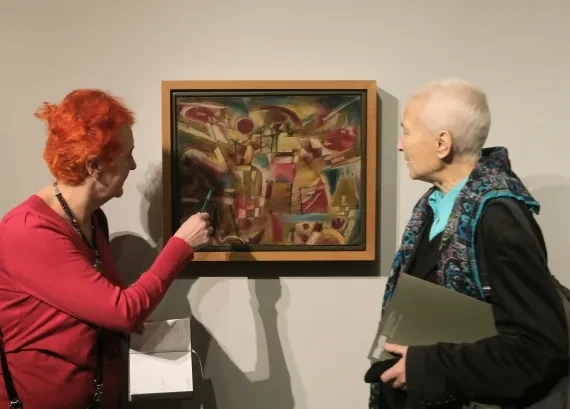
Paul Kleyan’s personality is covered with a mystical area: few people understand his brightly expressed infantility and colorful childishness, but everyone is trying to evaluate esoteric metaphors and rationalism. The curator of the exhibition Alexei Petukhov is convinced: “Although this is the first meeting of the Russian viewer with Paul Klee in the entirety of his creative personality, our public can consider itself quite prepared for it.” However, modern society is pounced on its art, inserting its archive “five kopecks”: “What kind of children's pictures are these? I can do that too. " Unfortunately, everyone can repeat, but to come up with - units. Many do not see the game of flowers, ideological combinations of lines and metaphors that are closely intertwined with an esoteric principle. The XX century gave rise to the mystifier Paul Klee, whose joking transparency goes against realism, and the childhood shunes academicism. Stubborn conservatives turn their nose: “This is not an art. He simply did not know how to draw. " Questions immediately beg for: that is why Klee taught at the Bauhaus school and his recognized heritage has about 9,000 works?
Someone can say that the artist is a child of the era (the 20th century passed under the auspices of industrialization and an increase in production pace), after all, 9,000 works are not jokes. It is worth assuming that Klee wanted to have time to show the society his inner world, where the devil got along with the heavenly (paintings “Doll”, “Puppet” and “Obsessed), and figurative art with a grotesque (“ Woman in a traditional outfit ”).
The first hall of the exposition will appeal to the ossified skeptics that are used to admiring naturalism: next to naive children's patterns of Klee, his anatomical images of a person are located, and a little further away the “wind” of the lyrical landscape. “Naturalistic studies” for klee are the first steps on the long way of searching for a creative “I”, and for skeptics - this is an opportunity to make sure that the “artist from God” is a “artist”. The self -identification of Klee debuts when the music becomes a “charming mistress” (the artist often played the violin in front of creative work), and his paintings begin to balance on the lines (“Channel Manager”, “Miserable Circus”) and play “Nonth” games with color (“step”, “bust of the child”). It is not for nothing that the motto of Klee is “not a day without lines”.
The seven halls of the exposition are the abstract rooms of the artist’s life, where Klee's versatility (150 works are presented at the exhibition) fit into the chronological framework. The artist should be perceived not only as a detached romance from the "other world", but also as a rationalist (he had a catalog of his work). Contempt for the philistine conventions pushes him to create glove dolls, whose faces and costumes “distort” the philistine idea of beauty. Confidence that “a man is hiding behind a mask” and “it will be good to live among the dead”, pours into a series of gloomy images (“Demonitsa Girl” and “Masks in the Meadow”). Klee looked at reality “the eyes of the child”: his “pure” look did not get dirty about growing up, which throws the dirty shadow of maturity into the inner world. The artist is not afraid to fantasize: he came up with
The metaphorical language that symbolic signs (the painting “VAZ”) deduced and juggling with the grotesque (“blind and wheels”).
Paul Klee believed: "Art does not convey only the visible, it makes the visible secretly comprehended." It remains only that the “prepared viewer” will be able to abstract from naturalism and swim along with the gap along the river of his work, the source of which is childhood, and the mouth is eternal peace.
Ksenia Kulyasova