
Translated material
“Euromaidan. Black installation. " Online Prime Minister
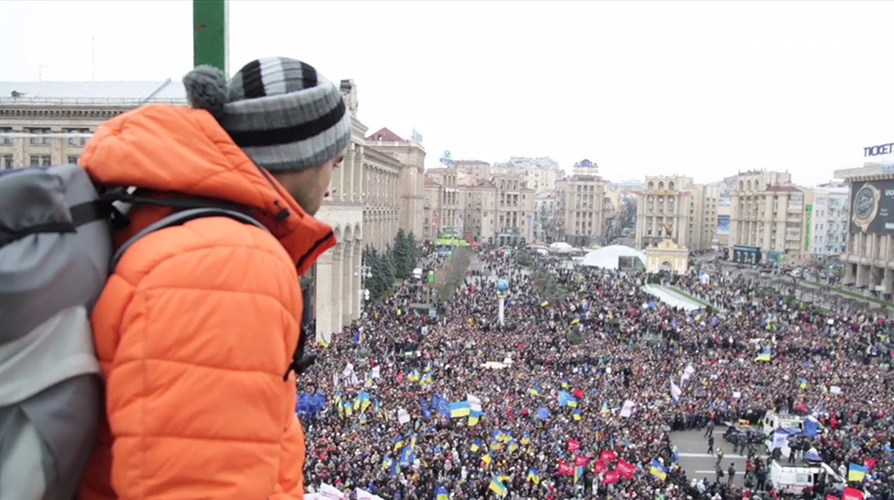
As stated in such cases, we proudly present today the world online prime minister of the Ukrainian film “Euromaidan. Black installation ” -a almanac film made by a large group of authors. Here are their names: Vladimir Tikhiy, Andrei Litvinenko, Roman Bondarchuk, Katerina Gornostai, Julia Gontruk, Roman Lyut, Andrey Kiselev, Alexander Tekhinsky, Alexei Solodunov, Dmitry Sorukov.
The film is shown as part of the Sinma Belief project, which has existed for a year. On the occasion of this modest anniversary, we made an electronic book about documentary cinema in the turning point of 2014 with the texts of Marina Razbuzhkina, Vitaly Mansky, Alisher Khamidzdzhaev, Alexander Rastorguev, Sergey Paratsovoy and Alena Polunina, as well as with a discussion of six films, including the film Euromaidan. Black installation. "
You can download the book in digital form for free here or got paper forms with autographs of directors here - and on paper the book is printed only in 120 copies, of which we have only 5 left.
You can watch the movie from 11:00 to 23:00 in Moscow.
Do not miss, this is an important movie!
Nice viewing!
And read his discussion, which took place during the special order of the film in Moscow as part of Sinma Belief and in partnership with the Artdocfest festival on December 14. The discussion of the film was attended by one of his authors Katerina Ekhnostai, as well as Vitaly Mansky, Marina Razkhkin, Elena Fanailova, Andrei Arkhangelsky and Gleb Morev.
Mikhail Ratgauz: At first I would like to ask Katya Ekhnostai: how is it cleanly technically that such a large company of people gathered this almanac film, how did it glide in history?
Katerina Ermine: Everything is very simple. We met on the Maidan. For example, with our main editor, we can say that the collector of the whole Roma Bondarchuk we met there, and we shot the same episode - in the subway (we are talking about the stage in the Kiev metro, which is blocked by the rebels awaiting the exit from the Berkut. - Ed. ). The film got what was shot by Roma, and not me, he had better. Roma is one of the organizers of the Docudays festival, and this film was the idea of the festival. We collected everyone we know, asked who managed to remove what on the Maidan. And then the most successful of everything that was sent was selected for the film.
Ratgauz: That is, there were no specific tasks? Who was the brain of the project?
Ermine: Everything was decentralized. We did not coordinate with each other in any way. People shot what they wanted. This is the main problem of the material, and therefore such a structure is suitable for it - almanac. Because this material is very fragmented.
Vitaly Mansky: I can say that, it seems to me, this film is assembled in the same way as Maidan himself was assembled. There is some kind of invisible, but tenacious connection between the Maidan and the film. Because the Maidan, by and large, did not collect - well, except for the State Department, it is clear that he ordered and paid for him. And so, if you really, everything somehow formed by itself. There was food, and garbage was taken out. The Maidan turned into a city, into a certain country that functioned according to its laws. It seems to me that this film was formed according to the same laws, and in this, perhaps, its main dignity. These are such honeycombs. It can be seen that these short stories could become separate films. But perhaps they would have lost something from this.
Marina Razbuzhkina: when the events that are important for all occur-and the events in Ukraine make sense for the whole world-when there are many questions to them, the document always has a choice: what he should give out at the exit-a film-concept, where there is already an idea of how the director understands the event, or chronicle. Here in the Ukrainian program of Artdokfest there are both films-concepts (these are the "Maidan" of the Loznitsa) and the chronicle. For me, the chronicle is more valuable, although I in no case deteriorate the meaning of the film of the Loznitsa. Because this proximity to the human person and human behavior, it seems to me, will be extremely interesting for future fat in cinema, which will begin to comprehend these events after 20, 30, 40 years. Although now time is faster than in the 19th century, and probably this understanding will happen a little earlier.
Andrei Arkhangelsky: You know, there is a leitmotif in this film. From time to time, some person appears who asks: “What is the point? Why all this? " This is a very important point, maybe one of the most important. There is no concept in world -class events. Their meaning is formed by pieces, by itself, precisely in these matters: “What are we doing here? Why are we here? " And the film itself answers this task. The plan is formed before our eyes. And he is only that at first no one knows how it will end. This is the naturalness of the film - it is that he does not have a plan. And the story too. This is a sense of meanings, consisting of nonsense and chaos, this is a very important point for me.
Gleb Morev: I think we are in a difficult situation, because immediately after such a film it is quite difficult to formulate anything rationally. The impression is very strong, first of all - emotional. And I think that what kind of film we have seen about the Maidan, whoever made this film, emotionally it will be a shock. It is very difficult for an artist to work with such strong material. But in a series of these episodes, shot, as I understand it, in different groups, I was most struck by the seemingly household plot, shot in the Kyiv city hall: this peaceful dream of people. Because we still look at him from our time, we know everything that will happen. And in this peaceful dream we see the future rhyme to the last scene, when corpses are already lying at this place, with the same shoes that peeps out from under the blanket. But in general, I think that the cinematography of the Maidan is a separate topic, of course it will be a whole chapter in the history of modern documentary cinema.
Elena Fanailova: Also because there was no more serious historical period over the past 15 years in the post -Soviet space. We witnessed such an event in modern political history, which is not often in life, a person manages to survive and test. Maybe I can only compare this with what happened in 1989-1991. Andrei said that in this film and in the actions of the Maidan there were a lot of unpredictable, and I just remembered the short stories that speak of self -organization. Novels about doctors, a short story about a man who puts himself on to the role of the leader of the "hundreds" in the barricades on Grushevsky. It can be seen there how Ukraine differs from Russia. And it is distinguished by the structure of civil society, and is distinguished by a great care of people about others, private care. And this, apparently, is one of the reasons why their revolution was a success, but ours failed. Although people who began this revolution, began, said: "We envied Moscow in 2011." And one more thing - that's exactly about this movie, about the work of filmmakers. In my opinion, in the penultimate chapter-and these are the most tragic days of February and the most terrible events on the institute-operators show us how they shoot people from one and the other. And this, of course, is the huge professional success of this team - that people were able to work with the “golden eagle”, go to the side of the “Golden Eagle” and see how things were there, see their human and inhuman reactions, create this mirror.
Ermine: The last passage in the film, it is called “Everything is burning”, now has become a large full -length film, it is already finished and shown, so this is a small fragment of huge material.
Fanailova: Yes, and another important point. Of course, you did not know what would happen when the film was shot, but his most important plot is a trip to Yanukovych’s homeland when we see people from the east of Ukraine. Here, at this point, that the conflict zone is now. Kyiv, who had experienced what we saw, could not fully understand the tragedy of Eastern Ukraine Rivne because Eastern Ukraine, which did not survive the tragedy of Kyiv and experiencing its only now, was not able to understand that, took place in Kyiv in winter. I work as a journalist of Radio Liberty, and for six months I am quite regularly traveling to Kyiv and talk to people there. So, only now or two months ago, the Kyiv intelligentsia began to seriously think about the problems of the people of the East. And humanitarian, and public, and linguistic.
The first viewer: you know, I did not watch the “Maidan” of the Loznitsa, but some reproach him that he was removed too on top, as if from a bird's eye view. About the height from which we watched direct streams every night, starting from December, ending with a terrible night from February 18 to 19, when Golden Eagle was 10 meters from the stage. But in this film there is a different extreme - we are all the time in a crowd of people. Backs, heads, people, people, people, people ... And I personally did not have enough, maybe a little look at it from above. We know that the center of the Maidan is always a working scene. Who remembers these streams on the Maidan, the center there. And she is not here. And one more thing: by the way, I didn’t even pay attention - there were shootings at the institute, right?
Ermine: Of course!
The first viewer: in YouTube “Gromadska TV” laid out absolutely amazing shootings when people try to protect themselves from bullets, they shoot, shields break through, people fall and pull them. I saw stronger shots shot by Kiev journalists in YouTube than here. So I still did not have enough, maybe this very night from the 18th to the 19th. Everyone was already running there, three or four thousand people remained. And everyone understood that if they last until 6 in the morning - everything, the revolution won, Yanukovych would run away. And they survived. Here is the center, the emotional point of what was on the Maidan is the night from the 18th to the 19th. The 20th was just a meat grinder, murders, and on the 22nd they were already buried.
Mansky: You know, in the minds of the viewer the picture of the Loznitsa and the Euromaidan are already one cinematic work. Because they complement each other, fill. You absorb YouTube that you watched, and even the Russia channel, which excited you, all this created the energy field of the Maidan. But here I want, maybe not to argue, but to briefly express my doubt ... Here Gleb said that the Maidan is such a powerful event, that whatever you take off, this is already a movie. As a festival, I, of course, watched, maybe twenty films about the Maidan, and this is not true. There are films that create this emotion, and a loser, of course, among them. There are films that pass along the tangent and not exciting the emotional component, which is the essence of the cinema. At the same time, in my first replica, I hinted that, perhaps, separate fragments from which the “draft installation” was woven, and there would be such films, that is, not the fact that they would be an emotional and cinematic event. And together they work in the way that they, I believe, worked for this hall. Another question. In a sense, I am not so envious ... But Lena recalled about 1991, when we also had a revolution that released us and, in fact, did not leave a single picture. The present is not a single one. And the Maidan remained in history thanks to the powerful, coordinated and very soulful work of documentary, Ukrainian and not only. And this really causes envy.
Razbizhkina: Yes, I want to support Vitaly. I also saw several films that are completely cold, who are trying to explain the situation on the Maidan, and not only do not connect to them, but you resist them. And here it is amazing that you connect even to those microistories that you do not sympathize with as a real person. Here, for example, I still remember this grandfather crying at the broken monument to Lenin, and I understand that I am connecting to his individual fate, regardless of whether I like it or do not like that they destroyed the monument to Lenin. But he is so alive and he really suffers, this cannot be portrayed that we, of course, connect. And it is very important that we begin to sympathize with just people, not political ambitions. It is always very valuable in documentary cinema. Now everyone has been divided into groups, someone on the side of Ukraine, someone on the side of this Donetsk formed republic, but when you see specific people, you understand that you are not on someone’s side, but you are on the side of this person. Each time in a new way-each time a new person. Because he is a suffering person. And this is the height of this film, and in general such a cinema. (Applause.)
Ermine (turning to the viewer): I tried to understand what you meant about the scene. I don’t know, personally, for example, I never felt the scene with the center of the Maidan. She caused me even more negative emotions than positive, only in recent days she played an important role when she was warned about the events that took place nearby. For me, other shots taken in the last short stories are much stronger. For example, a woman who wears tangerines on the front line. These are things ... They will never leave memory. And about the fact that you did not have enough battle ... Indeed, the guys who mounted this short story did not have such material. Because everyone took only what they personally shot. And such material is really important for the investigation to find out who shot. But, it seems to me, it is so strong in emotional influence that it might even prevent it from connecting to it. Because I see a lot of such material and its deliberate manipulation use.
Fanailova: I think that, indeed, there are already twenty films, there is already some film text about the Maidan, and each film adds something to him. By the way, I completely disagree that the shredder has a cool, detached film. This is a fresco. This is just the only film among those that I watched, which claims to be chronological presentation of reality in large blocks. It is almost all shot in medium, so it is right to watch it on the big screen. And if you want to get a chronological idea of the Maidan, then it is probably better to start with a luster. If you want details, then this film seems to me extremely good with his close plans, with his approach to people, with these small things that you understand about them. Well, again, I can only say with great respect to the guys “thank you”, especially for combat shootings. Because it does not fit in my head how it happened, how the operators endanated themselves. You understand that people go to death for the idea, and you can hardly imagine this psychology. And only the fact that you see the work of these persons, the work of this psyche, returns you at this time, makes him empathize, think that everything was not in vain. By the way, one of the authors of the second short story is the son of my friends who worked there almost this winter.
Second spectator: I do not agree with our documentaries who were talking now about 1989-1991. This film caused me parallels with another event of our history. By the degree of participation of the people and in tragedy, the year 1993 was closer to what was happening on the Maidan. And by the way, 1993 is also not reflected in the chronicle. At least I do not know such films. And the fact that this really does not reflect that we did not realize the tragedy of 1993 leads to what we now have-indifference in society, its split and passivity.
Fanailova: I can't disagree with this. By the way, many psychologists said that the city passivity of Moscow is associated with the injury of 1993 and with subsequent injuries associated with terrorist attacks. This is to the question of human anthropology in urban space.
Vybizhkina: and for a minute: why are the events of 1993 or 1989-1991 practically no understanding in the cinema. If you remember, it was a technological transition from a film to heavy betami, very imperfect, with a small number of cassettes. And very many events removed were erased in order to then use the same cassettes for another. And this is the horror that, due to the technological revolution, we lost almost somewhere in the chronicle. Because the cinema was practically no longer filmed, and the video was imperfect, and everything was erased, because it was necessary to record another sowing or something else on the same cassette. These are technological dramas. Not only the fall of aircraft, but also how and when we lose the chronicle.
The third spectator: Katya mentioned already about the film "Everything is burning." Literally just in Leipzig he received three prizes at once, and the political non -aggression of the authors was especially noted. Is it so?
Ermine: In fact, no one has seen him yet. He was in Leipzig and will probably be at the opening of the new Docudays in March. We are looking forward to him.