
Translated material
Secret mediator
How foreign firms participate in Russian corruption schemes: Reuters investigation
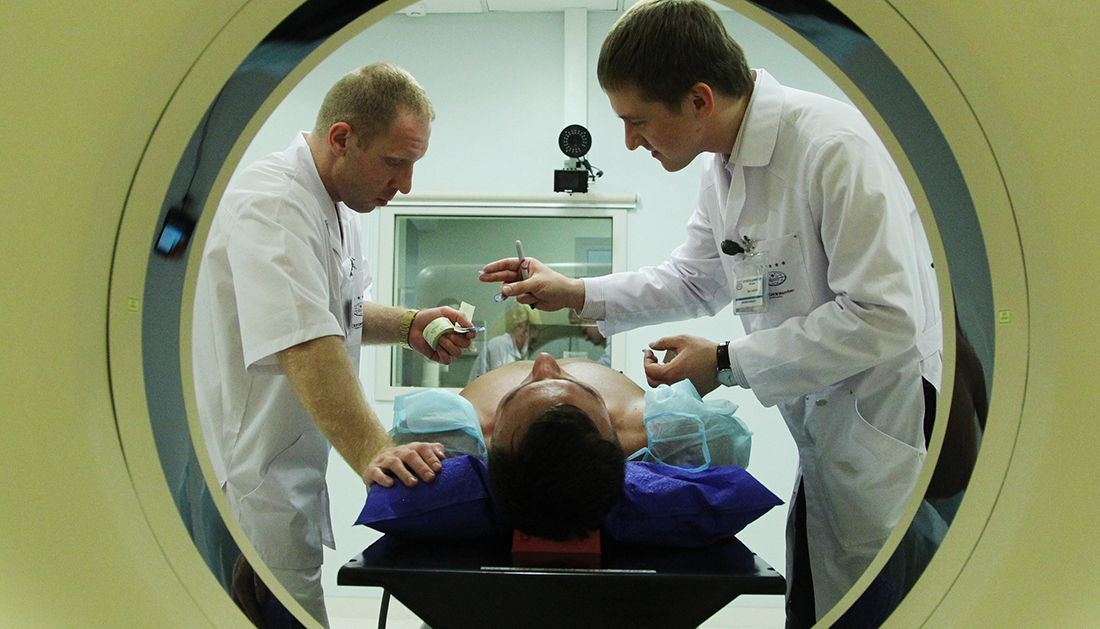
The Russian authorities buy foreign medical equipment at high prices, and suppliers do not pay attention to participating in the transactions of dubious intermediary firms. It is because of them that Russian hospitals spend four to five times more of its real value on expensive equipment, the Reuters investigation is approved.
Reuters journalists analyzed about 20 thousand transactions in the field of purchase of medical equipment from January 2006 to July 2013 for a total of $ 2.8 billion with more than 150 suspicious companies. In most cases, there is no information about the owners of these companies. In 2010, the Russian government already paid attention to corruption and fraud in the purchase of medical equipment. After that, some large foreign companies stopped working with suspicious intermediaries - but not all.
As follows from the Reuters investigation, Toshiba and General Electric really abandoned intermediary schemes for the supply of medical equipment to Russia, and Siemens and Philips continued to use their services. Formally, there is nothing illegal in such schemes, however, American and European legislation requires firms to check all partners and avoid cooperation with suspicious companies.
In May 2011, the Center for Cardiac surgery in Astrakhan acquired an ultrasound scanner of Philips IE33 for about $ 580 thousand. In December of the same year, the medical center in St. Petersburg bought the same device for $ 490 thousand. At the same time, American and European hospitals bought IE33 in 2011 for $ 145 thousand. According to Reuters, on average for the average for the average for the average for the average for the average for the average for the average for the average behind From 2011 to 2013, Russian hospitals paid twice as much as Western medical institutions for scanners and tomographs. A decisive role in a significant increase in prices for the Russian market played intermediary companies-as Reuters journalists found out, when scanner manufacturers sold them directly, the cost of equipment was not very different from the price that Western clinics paid for it.
For example, in December 2012, Philips sold the IU22 UZI22 apparatus for $ 106 thousand to the Russian distributor. The exactly the same scanner was sold to the distributor in 2012 with the participation of Rainham LLP-its cost amounted to $ 360 thousand. In total, eight scanners were delivered to Russia, which significantly exceeds significantly exceeding. Markets. Siemens and Philips for the period from 2011 to 2013 concluded contracts totaling more than $ 120 million with the participation of suspicious intermediary firms, Reuters writes. Neither Philips, nor Siemens, nor representatives of intermediaries began to answer journalists' questions.
Reuters did not have evidence that manufacturers of medical equipment received any money from intermediary firms. One of the sources of the publication says that such firms existed, first of all, so that Russian businessmen could move away from taxes, and to pay “commissions” to the leadership of hospitals.
The appearance of opaque intermediaries suggests that their owners can overstate profit, wash money or engage in bribery. Agreeing to such a scheme of work, Western firms help to support the system that has developed under Putin (English.).