
Translated material
RUBLE on military course
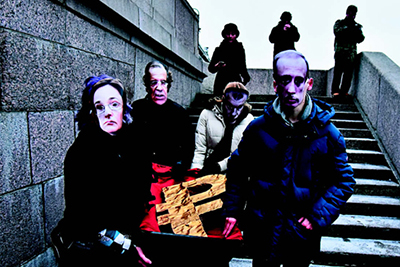
Activists of the Vesna Public Movement at the Run of the Rule, St. Petersburg, December 6, 2014
It turns out that there is nothing easier than waking up in another country - it is enough for a drop in oil prices from mid -November to mid -December to give the euro to the ruble once, December 16, to exceed 100, and the dollar on the same day to touch the plank of 80 rubles. for $ 1. It would seem that an episode-nevertheless, although on December 18, Vladimir Putin spoke at his press conference about dozens of various objects, in essence, nothing but currency panic in the country was not said. The point is not so much aware of the ruble to the dollar as in the rapid of falling: acceleration of free fall in national currency can only be given by obvious institutional failure.
A year of ruble surprises
The most unusual in what is happening in December 2014 in Russia is close to absolute predictability and banality of events and at the same time the exclusivity of the form that the Russian currency crisis is now taking. By the end of November of this year, our national currency was not particularly interested in anyone: VSHE Vice -Rector Konstantin Sonin, who was quite zealously following the “Russian” publications in foreign media, noted only brief notes on the topic of Grind Circuman Times. Recall that the course of the economic crisis in Latvia two years ago caused a completely unforgettable polemic with the participation of the same Crucoster, Anders Oslund and similar to the radiance of the economists.
Even about the prospects of the Ukrainian economy, completely uncertain for tens of various reasons, they wrote more than about the “soft landing” of the Russian economy in the first three quarters of the year (with extremely low unemployment) and the devaluation of the currency of the largest trading partner of the EU, which in addition to the military conflict on the eastern border of Europe.
Nothing explanations with the ruble occurred. Even in August, the weakening of the ruble looked completely adequate to a decreasing price of oil, and the actions of the Bank of Russia, which not too aggressively increasing the key rate, that is, the price of money, is unlikely to demand someone’s applause. At the same time, at the same time, however, it was already realized that things were not so predictable: the Elvira Nabiullina team had already survived by that time and the strange crisis of January 2014, when the banks that had come out of the holidays unexpectedly fell into the likeness of currency panic, and the first round of real currency panic in late February - early March, when the ruble was first devalued, by 30 %, with 30 %, with 30 %, subsequent correction. In the first approximation of the ruble, the currency of the country-exporter of hydrocarbons can indeed be considered a derivative of oil prices: this is a rather typical Commodity Currency, “product currency” in the classic description of the famous professor of Harvard Kennet Rogoff, given to him back in 2003.
And now, in the second half of December, at the price of a barrel of Brent is about $ 60 (that is, almost double the decreasing from the beginning of the year) and double a devaluation ruble, many put on the fact that nothing out of the ordinary is happening. Yes, Norway is also a hydrocarbons monoxporter, the Norwegian crown has depreciated from the beginning of the year by 23 %. But Norway did not annexed the neighbors of the peninsulas, is not under the sanctions of most OECD countries, did not arrange the propaganda ribs heard all over the world that repel any investments, and generally belonged to the concept of “political risks” with balanced and accurately.
Russia is generally quite atypical "Petrocracy".
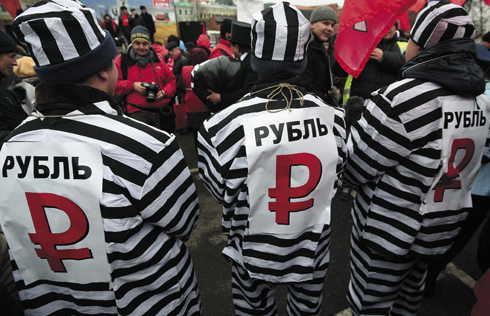
For protest organized by the Communist Party, Moscow, December 6, 2014
Battles under the carpet
On October 31, the Bank of Russia Board of Directors quite calmly raised the key rate from 8 % to 9.5 %, assuming that further everything may be worse, but without surprises. On November 10, reacting to a slightly faster than previously assumed oil prices and slightly more nervous than previously observed, the reaction of the markets to this decrease, the Central Bank announced the abandonment of the policy of the “floating course corridor” and the early (two months earlier than the plan) transition to free ruble swimming. The idea 50 days earlier than it was written in the schedule approved back in 2009, officially responsible for numbers in exchangers, but for prices in retail trade, was unobviable, but simple. The Bank of Russia fairly reasoned that the inevitable turbulence of the course, accompanying the restructuring of the model of monetary policy, would be justified in the eyes of the public precisely the drop in oil prices, and the inflationary pressure in the I quarter of 2015 would still decrease much, regardless of whether the transmissive mechanism of the Central Bank or bad would work well. By that time, both the Minister of Economy Alexei Ulyukaev, and Elvira Nabiullina, and the Ministry of Finance and the Presidential Administration were well aware: partly due to falling oil prices, partly due to structural reasons in the stop of economic growth in 2015, it was essentially inevitable. The country's entry into the "trap of medium incomes" Alexei Ulyukaev predicted when he appointed the Minister of Economics two years ago. Attempts by the Assistant of President Andrei Belousov, security officials from the Security Council and the Union Academy of Sciences to convince Vladimir Putin to immediately launch the “Economic Miracle”, based on the issuing lending to the military -industrial complex, Russian Railways and energy by the Bank of Russia, were repulsed so easily that the scenario of January 2015 caused a pleasant yawn in the White House. Inflation of 5-6 %, GDP growth of 0.2-0.5 %, conditional liberals in the Government, led by First Deputy Prime Minister Igor Shuvalov, are engaged in leisurely and cautious deregulation of the markets and slow improvement of the social sphere, conventional conservatives on the still considerable budgetary funds forge the homeland and prepare the suffering for the main event After Sochi - the World Cup. Actually, this idyll is easily imagined when reading the text of the message of Vladimir Putin to the Federal Assembly read on December 4-since the message itself was written in the atmosphere of some incomplete but rather comfortable relaxation of September-October.
That is why the message looked so empty: it was prepared for another context.
From the crisis of financial - to economic
The idea that the devaluation of the ruble (so far stopped at 60-65 rubles/$) and there is a reckoning of the economy of the Russian Federation for the military-patriotic efforts of the spring-summer of this year in the east of Ukraine, on December 14, when the Bank of Russia had to urgently extinguish the currency panic by raising a key rate from 10.5 % to 17 % (and the main mass of refinancing of banks-up to 18 %) became almost a total. Applications of Alexei Ulyukaev, and finance Minister Anton Siluanov, and Prime Minister Dmitry Medvedev about the “fundamental underestimation” of the ruble can be quite deciphered as support for this version. The ruble “lost” by 55-60 %, at least half - the result of the distrust of the market for Russian national currency. True, to calculate that in these 10-15 additional rubles per dollar to the “equilibrium” price of 45-50 rubles for $ 1, it should be attributed to the sanctions against the Rotenberg family, that the Donetsk exploits of Strelkov, and what is the result of Vladimir Putin’s “counter-sanctions”, which were not compromised by fellow citizens of milk and meat.
However, there is reason to believe that the currency crisis of this December will still interest economists - so far the fact that we know about it suggests that in the coming weeks the contribution to the exchange rate of the most diverse problems of the Russian economy accumulated over 15 years will be realized brighter and more unusual than it could be assumed. And even more so, their influence on how the currency crisis will develop into an already, apparently inevitable economic one.
Firstly, it is in the next two weeks that it will become obvious that the instant reaction of all markets of the Russian Federation to a significant, but not at all catastrophic impairment of the ruble much more than it could have imagined. In essence, the Bank of Russia is no longer able to quickly reduce the key rate from the current 17 % to (probably) adequate 12-13 % adequate when stabilizing the course-a single-month collapse of lending in the economy and investment is highly reduced at any loan rates, since the main risk is paralysis of the payment system and the banking crisis. Even a short -term shock of this scale is forced by the vast majority of players in the economy to change their strategy for ultra -conservative or, on the contrary, to accept unlimited risks. Given the almost inevitable decrease in the sovereign rating of Russia Standard & Poor's, Moody's, and Fitch (this would happen without currency panic-the Russian budget, due to the fall of oil prices, has become much less solvent even taking into account the extremely low state debt of Russia), the completion of urgent business operations and the rejection of any risk now is the most intelligible strategy. The only problem is that the implementation of this strategy, namely, the converting of all assets into foreign exchange deposits, market agents prefer to do outside the Russian banking system - which the Bank of Russia is trying to resist.
The result of the December devaluation can be a variety of events. For example-destabilization of the government due to the exacerbation of disagreements in the power corporation. So, on December 18, the head of the Ministry of Finance Anton Siluanov and the Ministry of Economy Alexei Ulyukaev sent a letter similar to the ultimatum to the head of the Central Bank (quite obviously interfering with the independence of the Central Bank), in which they insisted on weakening the regulatory course of the Bank of Russia.
Yes, the reserves of the Bank of Russia are still first-class-but are they comparable to the scale of the future depression of the entrepreneurial class in Russia, which has lost faith in stability? And if at $ 110 for a barrel, a tranquilizer for many was the expectation of social changes caused by the fabulous wealth of Russia, then at $ 60 per barrel, this tablet simply ceases to act.
Yes, Norway is also a hydrocarbons monoxporter, the Norwegian crown has depreciated from the beginning of the year by 23 %. But Norway did not annex among the neighbors of the peninsulas, is not under the sanctions of most OECD countries, did not arrange the propaganda rods heard all over the world that scare away any investment