
Translated material
Elusive rent
One ideologist-uniform somehow came up with the name of the Russian Federation of “Energy Super-Sold” and even tried to consolidate his authorship in an article about his own person in Wikipedia. But with the filling of the term, a bummer came out with a specific content. The last third of 2014 was for the leaders of the oil industry the moment of awareness of the bitter truth - alas, alas, it will not work.
Dear pleasure
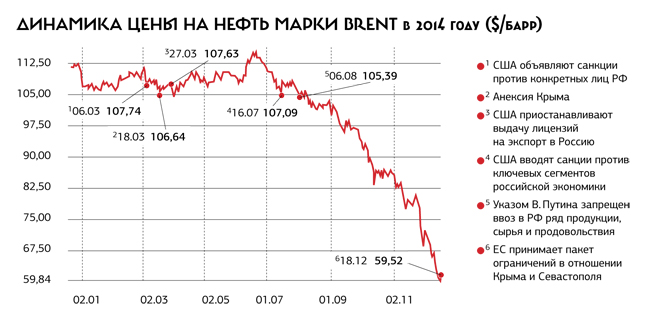
Oil prices have remained surprisingly stable for the years- above $ 100 per barrel of the Brent reference grade, but in September with acceleration rolled down and by mid-December collapsed below $ 60. The period of low prices threatens to get to be drawn- and this puts a fat cross on the hopes of the government, if not to be found, then at least stabilize the prey at the annual level above 500 million tons. These hopes were based on plans to master the hard -to -recover oil reserves - primarily from the so -called Bazhenov retinue, which lies at a depth of more than 4 km throughout Western Siberia. Other means to stop the decline in prey in Russia, if you do not resort to radical restructuring of the industry, you could not. To stimulate such projects, tax benefits were conceived, and the entire Bazhenov retinue, and other same geological oil horizons, were recorded in commercially extracted resources. But then an embarrassment came out: in Lukoil, which was closely engaged in experimental oil production from Bazhen, they calculated that one barrel removed from the bowels there is at least $ 85. There is also little hopes for oil of the Arctic shelf: the barrel obtained in the ice seas will cost more than $ 150.
When oil ends
Last year, BP experts, making up the annual overview of the world energy industry, calculated: the oil reserves of Russia at the current production rate of production will be enough for only 22 with a bold year. The Minister of Natural Surses of the Russian Federation Sergey Donskoy hastened to correct the Anglo-American company, saying that it was enough to explore the resource base in the country to produce 600 million tons of oil annually. The audit showed, however, that the minister included in this base those resources, the extraction of which could not be commercially profitable even with planned tax benefits. And even in conditions of a long period of low prices, no profitability can be stuttering at all.
In the current conditions, the fall of Russian oil will begin next year and, according to Rusenergy, its annual volumes will be reduced by 2020 by about 15 %, and by 2030- by 30-40 %. After this, oil for export is no longer left for export, and providing internal demand will be in question. If you take into account only easily recovered oil, which is produced by classical methods, and not technologies for stimulating deposits, then the country is 6-7 years old. In addition, it is worth remembering: these technologies are strongly dependent on imported materials and equipment, and Western sanctions against Russia make a truly critical situation. The trouble is that over the past 15 years, the oil industry was deliberately and proudly turned into a “free ridge” and “locomotive” of the national economy. In 2000, less than 9 % of the federal budget of Russia provided for oil and gas revenues, and this year more than 52 %. The naive belief that it is possible to infinity to the extraction of natural rents, which brings tremendous profits and makes unnecessary efforts to develop other sectors of the economy, brought state strategists.Parasites - forever?
The simplicity of the parasitic approach of the raw material economy was struck by a serious ailment of inefficiency and the most important industry of the country. Creeping deprivatization gave the state officials private companies and enterprises. Instead of “Yukos”, “Iterers”, “Udmurtneft”, “TNK-BR”, an inconspicuous and poorly controlled “Rosneft” arose, which was mired in debt, laid the Chinese a significant part of their future oil production and now requires assistance from the state- at the end of October, Rosneft asked for 2.4 trillion rubles. From the National Welfare Fund (FNB), and on December 11 placed exchange ruble bonds worth 625 billion rubles, and the buyer of bonds is unknown. At the same time, according to Interfax with reference to sources in bank circles, the record Rosneft's loan is actually a similarity of Bridge from state-owned banks for future receipts of funds from the Federal Tax Service.

The monopoly position of state -owned companies does not allow to develop, and often to work for private operators in oil production, who are ready to invest in reconnaissance and development of reserves, considered small or tile, go to the risks in the introduction of innovative technologies, minimize costs and achieve success where giants simply do not take work. What will the authorities do when she finally understands that her main feeding trough brought to the decline? Will the Rosneft will continue to absorb the remaining private companies that have begun and allow? Will increase the tax burden on the industry to squeeze the last juices out of it?
It is naive to wait for the officials that control government agencies in the oil industry, of their own free will, will refuse to control cash flows, kickbacks from “friendly” contractors and to write off losses and debts at the expense of the state budget. Unfortunately, the country is not visible to a leading force capable of going against bureaucous interests and changing the situation through radical structural reform.