
Translated material
Sergey Stratanovsky: "Completely crossing Soviet poetry is wrong"
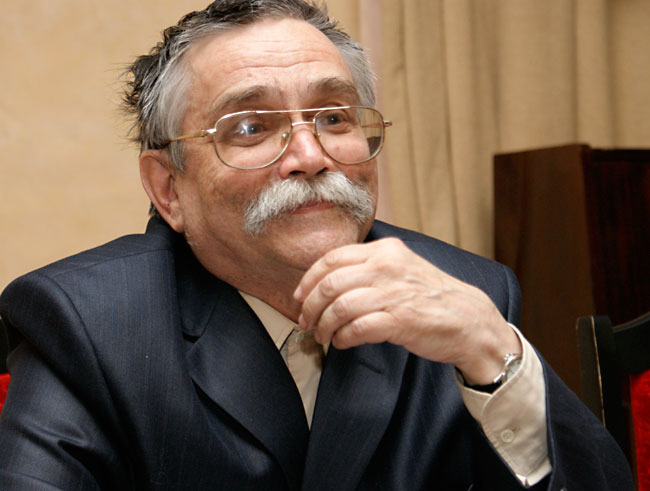
On December 5, Sergey Georgievich Stratanovsky, one of the classics of the Leningrad ignorant literature, turned 70 years old. Just in the Pushkin Fund publishing house, his new book “Hammer Nekrasov” has been published.
- Your family was connected with science, while you chose poetic creativity. How do the language of science and the language of poetry coexist for you (or, on the contrary, mutually repel)?
- I really come from an academic family. My parents at different times - and my mother until the end of life - were teachers of the University of Leningrad. My father became famous as a translator from ancient Greek and Latin, he owns the fundamental translations of Herodotus, Fukidid, Strabo. I was not very capable of scientific work ... In any case, I did not go along this path, although I graduated from the Faculty of Philology of Leningrad University (Russian branch), where I was engaged in outstanding scientists, Vladimir Yakovlevich Proppa and Dmitry Evgenievich Maksimov . I must say that I have a certain complex in connection with this, and literary science is still pulling me: I have four articles about Mandelstam, there is an article about the “twelve” of the block, there is an article about Bagritsky. In these articles, I see the realization of my scientific potentials, although in the strict sense they are not scientific and gravitated to the genre of essential thoughts. I lacked many qualities necessary for a person science: perseverance, meticulism. In addition, poetry fascinated me early enough. I began to write poetry after graduating from the university, and the need was more likely psychotherapeutic, associated with the ability to overcome internal uncertainty and psychological discomfort.
I have been listing my work since 1968, then I had a relationship with unofficial St. Petersburg poets who were in the same position as I (since I had no hopes for the publication of poems). And from the scientific path - the desire to enter graduate school, write a dissertation - I resolutely refused. My parents, for which I am grateful to them, understood me and did not insist on anything.
It is quite difficult for me to answer the question of how scientific and poetic creativity correlates. I have the feeling that there is no sharp border between them and the poet may well be a scientist. Like, for example, Olga Sedakova, who is generally universal and realizes himself in different hypostles. I think that poetic intuition helps her write serious scientific articles.
- Could you tell us more about training in the seminars of Proppa and Maximov?
- At the Proppa seminar I was engaged in only a year, but this year was quite fruitful for me. At that time, I seriously thought to become a folklorist and listened to his course on the Russian fairy tale. I was in a folklore expedition: I and Anya Nekrylova , who is now a professor, was attached to a dialectological expedition in Pudozhia (eastern coast of Lake Onega). These are rather deaf places, an administrative border with the Arkhangelsk region: there is completely preserved a wooden temple on one of the islands of Vodlozer (Ilyinsky Pogost), which is not valid, but supported in good condition. It was such a collective farm on the islands and on the shores of Vodlozer: there we recorded folklore. Unlike those who studied dialects, we had a more or less free schedule, and we freely moved along the settlements. The then classes of folklorism also influenced my poetic work: I mean the book “The Revolution of the Bubn”, built on the folklore of the peoples of Russia.
Propp assigned certain hopes on me. In one of his letters recently published (to Anna Nekrylova), he writes that he hopes for me as a future folklorist. But I soon realized that I was more interested in poetry, especially the poetry of the Silver Age, and went to the seminar of Dmitry Evgenievich Maksimov, whom I consider as his main teacher. In general, the Blokovsky Seminar led by him was a wonderful phenomenon, which literally unique. Moreover, at this seminar they were engaged not only in a block, but also by a silver age (as far as possible at that time). We established ties with Tartu, where we came to Blokov conferences: I personally were at two of them. I must say that I met many future friends and acquaintances precisely at the Blok Seminar: my close friend Kirill Mikhailovich Butyrin , whom we met and became close later, is also a graduate of this seminar.
- So, you started with lyrical verses and moved towards the expansion of the range. Could you briefly, even dashingly, describe this path?
- I wrote poetry from the school bench, went to the Daring club, where I met Vitya Krivulin. But everything that I wrote in early youth, I forgot, crossed out my, sublimely speaking, I have been counting the creative path since 1968. At first it was a lyrics associated with attempts to understand yourself, to comprehend something. Then all this expanded, other topics came, in particular, historical: the transitional here was very fruitful for me 1973. Then a large poem (or mini-poem) “Suvorov” , the poem “Herostrates” , “Sociological treatise in poetry about the phenomenon of alcoholism” appeared. In general, the theme has expanded, and something like a “lyrical epic” appeared.
- In your new book “Hammer Nekrasov” - but in fact, “the lyrical epic” is replaced by a “social grotesque” (as you said in one of the interviews). Moreover, unlike previous books, her heroes are no longer going to the general communal mass, but are left to themselves.
-It cannot be said that this is something new for me: such characters appeared before. There were quite a few texts that I called “poems in the mask”: there I speak not on my own behalf, but on the face of some kind of character unlike me. In my opinion, this was built on this poetry of Prigov, which speaks on behalf of a conditional Soviet man, Soviet candidate. He was carried out sequentially, I used the mask of a “simple Soviet man” only sometimes. As for the last book, in it I try to speak both from myself and from others. I strive to bring someone else's consciousness to the point of absurdity. There is nothing new in this, this is already present at Prigov, whose poems I always treated with great interest.
Another thing - it happened like this: a poem like “in a mask”, the hero is clearly not me ... Nevertheless, a strange voice begins to get down into my voice, a kind of removal of a “mask” occurs.
-In the already mentioned book “Hammer Nekrasov”, you seem to catch the epoch-making moment in history when the world is tilted, and its potential subjects are powerless to change anything.
- Yes, you have noticed correctly. Here, for example, a poem about Plekhanov. I was struck by the fate of a man who, all his conscious life, dreamed of a revolution, actively prepared it, and when it occurred, it was not at all the way he expected ... In fact, he turned out to be thrown out of life.
Indeed, my last book is a reflection on history and modernity. But I do not really share this, since all the problems that the people of previous eras turned out to be relevant for today's person. This is due to the problem of the repeatability of Russian history: at one time there was such a theory of sociologist and historian Yanov, according to which in Russia a return occurs periodically to what has already happened. Not complete, of course, but at every new round of the historical spiral, what, as it seemed, had long been overcome.
If we talk about the last book, then the topic of violence that always interested me is very important in it: I wrote about violence on behalf of the state (this is reflected in my mini-poem “Suvorov”) and the spontaneous, folk violence (about this, based on the “Gaidamaks” Shevchenko). Moreover, I turn to the topic of violence not only in verses: this year I wrote a small historical story “Notes of the Decembrist” , where this topic is also actively present.
Krivulin was one of the most remarkable people that I met in my life. I was always amazed at the scale of his personality: he sought to realize himself not only in the field of literature, but also in the field of public.
“How do you correlate yourself with the authors whose letter was a kind of reaction to the“ anthropological catastrophe ”of the middle of the last century, - whether Boris Slutsky, Jan Satunovsky or Paul Tselan, Nelly Zaks, Gunter Aich and others?
- Indeed, a certain sense of disaster was reflected primarily in German -speaking poetry - in particular, Paul Tselan, which attracts me very much. Slutsky is also interesting to me, especially since in Soviet times, most of his heritage (the most important thing for him, perhaps) was unknown, and after his death it turned out that this was a significant, large poet. His analogue in unofficial poetry is, of course, Yan Satunovsky, the big volume of the works of which was recently collected and published by Ivan Akhmetyev. Slutsky and Satunovsky have a lot in common - both in origin and in the life path, but at the same time Slutsky managed to penetrate the official sphere of literature, and Satunovsky did not even make such attempts (as far as I know).
The feeling of disaster is reflected in art throughout the twentieth century. For example, poetry, painting, drama and cinema of German expressionism were imbued with him before the First World War. Catastrophism penetrates the very texture of painting, which is made confused, feverish - the same thing happens in poetry. For our authors, I find this feeling, for example, in the poetry of Viktor Krivulin. Krivulin was one of the most remarkable people that I met in my life. I was always amazed at the scale of his personality: he sought to realize himself not only in the field of literature, but also in the field of public. We are almost peers (both 1944), and nevertheless I always felt that he was the eldest . He has always been an authority for me.
- I can not help but ask about the border between official and unofficial cultures by the representative of the latter.
- Today, as you know, there is no longer such a division, and in the times of my youth this border was quite strong, and it was created artificially and not by us.
A few years ago, I read a special course dedicated to the Leningrad poetry of the fifties and eighties at the philological faculty, and often faced the students: why could not this or that poem published? What is so anti -Soviet in poetry about love or landscape lyrics? The fact is that in addition to censorship, there was disinterest in the natural process of renewing literature among the authors who occupied a certain niche in the official literature: they seemed to bought a ticket for this ship, but for others there was no place there. It was because of this impossibility that the Leningrad Samizdat appeared, unofficial movements appeared, including a religious and philosophical seminar on Courland Street (organized by Krivulin and Tatyana Goricheva). It was in the seventies and the first half of the eighties that the unofficial culture in Leningrad crystallized: a single environment formed from a certain “Brownian movement of molecules”. Poets, artists, photographers were a single environment: we talked quite closely and were interested in each other's work. I must say that several rock musicians were several on the outskirts, there were much less contacts with them. However, I was far from them.
- You said that poets and artists united in one community, experiencing interest in each other's work. And how did the visual culture influence - painting, cinema - on your poetics?
- I had quite a lot of acquaintances in the artistic environment: for example, with Mitki, primarily with Dmitry Shagin, whose work I really appreciate. Of the large artists of the 20th century, I always loved Filonov very much. Now I am attracted to Malevich, a particularly strong impression is made by his paintings of the 1930s, when he again turned to figurative painting. And here the paradox is found: perhaps he solved purely picturesque tasks, but his paintings of that time are some artistic formulas of the era (remember, he has a picture where a peasant woman with a black face is depicted? After all, the tragedy of the Russian peasantry is expressed here). Apparently, Malevich was more interested in the ratio of picturesque masses, but the paintings that had a socio-psychological dimension involuntarily turned out. Perhaps he did it unconsciously, although who knows ...
In addition, I am of great interest in the art of photography. For example, I am close to the work of Vladimir Ioselson, many things of the now deceased Boris Kudryakov and Boris Smelov. All that they did is echoing with poetry. For example, depressive, desert landscapes and Leningrad slums at Boris Kudryakov. Boris Smelov was more lyrical, but he knew how to find something alarming in the obviously beautiful. It would seem that it could be more romantic, beautiful than Pavlovsk, but due to the fact that the pictures are made in a negative, some anxious mood arises. Familiar, open landscapes acquire an amazing, dreaming image.
As for the cinema ... Of course, I have a number of favorite films: I loved Waida, great Italian directors. One of my favorite films is General della Rover Rossellini. I love two paintings by Istwan Sabo: “Mephisto” and especially “Colonel Redl”. Of the Russian, for me, in visual terms, Tarkovsky’s “stalker” with his aesthetics of destruction, decay, decay, and attention to abandoned places mean. As a matter of fact, the whole “stalker” was built on this - in this I see a great visual discovery of Tarkovsky. His paintings generally feel the strong effect of painting: for example, winter shots in the “mirror” - a clear association with Bruegel. Of our modern directors, I really love Sokurov, I consider his trilogy an absolute masterpiece. I love Zvyagintsev. But Herman is pretty far from me.
- We touched on non -certificate literature, and now I would like to ask: does official Soviet poetry (“identifying itself with the ideologems of the regime”, as Sergei Zavyalov wrote), from the heroic twenties to the very late time?
- This is a rather complicated question. I believe that the position that completely crosses out Soviet poetry is the wrong position. In the twenties, she was on the rise: for example, the early Nikolai Tikhonov was a very interesting poet. On the other hand, on the fate of the same Tikhonov, one can also trace the limitations of this poetry: if there was a certain vital energy in the early texts, then later it runs out and no evolution occurs. Rather, it happens, but not creative. From the poet, he gradually turned into a writer's official. I must say that Selvinsky tried to preserve and preserve the “living beginning”, moving away into some exotic or the world of nature. I have an article about Bagritsky, which I will not retell, I will only say that he, of course, was a vivid phenomenon, which expressed in his work the feeling of the so -called early Stalinism.
As for the poets who have passed the war, how strange it is, the war for them was a kind of psychological output. They faced the terrible reality of the repression, from which they sought to escape: the famous "brigantine" Pavel Kogan was written in 1937 and expresses a desire to hide in some very cheap romance, and this is with a complete awareness and understanding of the events. That is why the war turned out to be such a psychological relief: the enemy is clear, it is clear what to do, it is clear how to live. The so -called peaceful life was worse and more unbearable, and the fact that Kogan, Kulchitsky and others with such joy went to the front was psychologically explainable. From that generation, I saw David Samoilov, with whom my parents were familiar. He even has some kind of record about me in his diary, but, frankly, I did not have contact with him. He impressed a person who was in a very ambiguous position: on the one hand, he was recognized, he was a member of the Writers' Union, he had money, a cottage in Pyarn, and on the other hand, what was happening in the country, he took painfully and knew that the authorities were poorly treated. There was a case when a guest ticket was given to him at some congress; He sent him with the words "Samoilov in literature is not a guest." It was felt that he was seriously experiencing what was happening, but he could not and did not want to become a dissident ... In general, a dramatic fate, perhaps, is less dramatic than that of Slutsky, who generally broke after the episode with the condemnation of Pasternak, but not to judge ...
In the sixties, many printed poets began to come out of what can be called the "Soviet literary standard." Sosnora already in the 80s ceased to fit into the framework of Soviet poetry, and it naturally ceased to be published. Кушнер как-то существовал в этих рамках, но насколько его творчество можно считать советской поэзией… здесь возникает трудность в определениях: можно трактовать советскую поэзию как банально-пропагандистскую, но в то же время мы сталкиваемся с тем фактом, что был, например, Слуцкий — который по своему мировоззрению был человеком вполне советским.