
Translated material
Christmas in Nineveh

When we speak of sociolinguistic problems and how certain languages disappear from the linguistic map of the world as a result of deportation or extermination of various ethnic groups, we rarely think about how it looks “from the inside”. But behind any social, demographic and linguistic changes are living stories of ordinary people who themselves are not happy that they ended up at the epicenter of historical events. Christmas is approaching, and Christians of many faiths are preparing to meet him on the night of December 24 to 25. For some, this is primarily a family holiday, a delicious table and gifts, for others - a church festival, and for the Christians of Iraq the current Christmas was not so much a joy as a test of strength. In the summer of this year, we already wrote about the position of the Assyrians of Iraq, whose physical survival as a result of another war was in jeopardy [1] . Since then, alas, little has changed for the better.
On August 7, when the Assyrian diasporas around the world were remembered by the martyrs who suffered during the 1915 genocide, the militants of the Islamic state of Iraq and Levant (ISIS) occupied Bachdid, a city that was previously considered one of the strongholds of Christianity in Northern Iraq. Kurdish troops retreated and handed over the city to the enemy. Fortunately, most residents managed to escape: they were waiting for the attacks from a minute for a minute and were ready for emergency evacuation. At the time of delivery of the city, it was mainly armed men: women, children and elderly people were sent to Erbil, Dokhuk, Alkosh and other safe cities in the north of Iraq in July. Alas, several families for unknown reasons did not listen to anxiety signals and remained in Bachdid. Nothing is known about their future fate. The men could not protect the city on their own: although they were armed, a handful of volunteers with machine guns could not withstand a well -trained army equipped with the latest military equipment.
In the same way, neighboring Assyrian cities and villages were empty and were occupied by Islamists. Ezids and other representatives of religious and ethnic minorities fled from nearby villages.
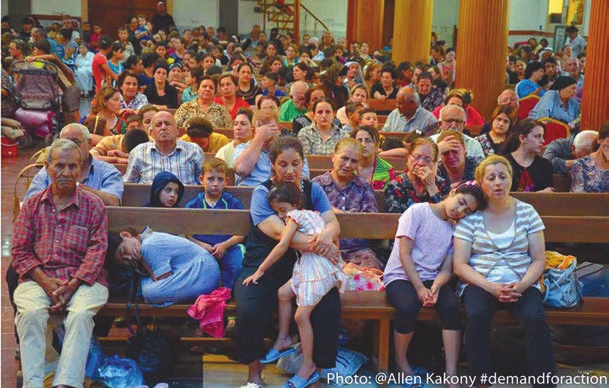
Assyrian refugees were accommodated where: in removable dwellings, in the homes of relatives, churches, school classes. In the summer, many spent the night in the open air or in tents, but already in the fall such nights became dangerous to health: abundant cold rains turned the tent towns into swamps, many tents were flooded. Living in such conditions the further, the more difficult, the more children. Winter in the north of Iraq, although short, but rather harsh. Snow often falls in the mountains, and the air temperature sometimes reaches minus ten degrees. It is clear that in such conditions it is impossible to winter in a tent.
 Of course, many, especially young people, would be happy to leave the country and go to work in Western Europe or New Worlds. However, for leaving the country, a passport is needed, and not all Iraq citizens have it. The queues for receiving a passport have to wait months. In addition, there is a chance to catch on in another country, first of all, those whose relatives have already settled and have taken root abroad. So, France accepted a limited number of Assyrian refugees. But only those whose relatives already have French citizenship.
Against the background of a global crisis, nobody needs rootless refugees. Despite the fact that the Assyrians are mostly qualified specialists in many fields, including medicine, and speak at least English, and sometimes another or two European ones are added to it, the further they have the opportunity to get work in Western Europe. The level of unemployment is growing, their citizens do not always have enough jobs, and keeping a crowd of unemployed is becoming more and more difficult. So, after the Iraqi war of 2003, Sweden not only hosted refugees, including Assyrian ones, but also identified such generous manuals that they could live without working. Now there is no such opportunity to maintain foreigners at the expense of taxes of their citizens, and it is almost impossible to leave for Sweden and live comfortably, as before.
 At the same time, many political and religious leaders advocate that the Assyrians, despite all the difficulties, remain in Iraq: mass emigration can lead to the fact that over time the Assyrians are assimilated and gradually dissolve in other peoples, the language and the ethnos itself will disappear. At the same time, many former residents of the Ninevian plain share this point of view and very painfully perceive the prospect of assimilation.
The author of these lines happened this summer to chat with the Assyrians who suffered as a result of ISIS. Happy passport owners were able to come to Tbilisi at the invitation of the Assyrian diaspora there. However, it was not easy to find a job in Georgia, and for some, staying in a calm and safe country was only a respite before returning to their homeland. According to them, not everyone, leaving their homes, found themselves in a distress: some were sheltered by relatives, many wealthy families were able to rent a good housing.
“Our main problem is not poverty, but unemployment. Now we can provide ourselves, but if we do not start earning, we will simply spend all the money and find ourselves in poverty , - this is how Bachdida, who are now in Ankawa, suburb, is evaluated by the suburbs of Erbil. - Most of all we would like to return to our hometown. But even if we manage to knock out the militants from there, we will have to restore it from the ruins. It will take at least a year, and will we have funds for recovery? "
 It is difficult to build forecasts: the situation can change in any direction. Now the militants under the pressure of the troops of the international coalition began to retreat, but before the liberation of the Nineveh Plain, where the Assyrians lived compactly six months ago, far away. However, only the retreat of troops does not make the liberated territories suitable for housing: they may be mined, and in this case it is impossible to immediately return to their home from evacuation. Yes, and houses are not always intact ... Nevertheless, in the last months of refugees, refugees are no longer called refugees, for them there is a new definition: “temporarily displaced faces”. This temporality inspires some hope, but the “displaced” do not build any illusions: “After all these events, we do not trust anyone. Who benefits from protecting us and deal with our problems? No matter how sad it is, we can only hope for ourselves and our strength. ”
The world community, on the one hand, is shocked by ISIS crimes, on the other hand, it is too busy with many more important social problems for itself: the economic crisis affected the interests of many European countries, and the tragedy of brothers by faith somewhere far in the East fades in comparison with their own drama. Of course, religious figures provide moral support as far as possible. The Pope has repeatedly encouraged Iraqi Catholics. The delegation of the French priests, led by Bishop of Lyon, arrived in Erbil in early December and arranged a festival of light. The French brought humanitarian aid and thousands of candles as a sign of solidarity and hope, as well as the comforting video message of the pope. Perhaps the holiday turned out to be beautiful, but the general situation has not changed.
 Like a hundred years ago, finding himself in a distress, the Assyrians turned to Russia's help. It was the Russian Empire that once helped many Assyrians of Turkey and Iran to escape from the genocide and provided the shelter. Since then, there is a Russian Assyrian diaspora, many inhabitants associate with the artel of shoe cleaners. Modern representatives of the diaspora, many of which are socially very successful, do everything possible to support Iraqi fellow tribesmen.
At the end of October, a delegation of the Imperial Orthodox Palestinian Society went to Erbil, which included a representative of the Assyrian diaspora Roland Bijamov. The delegation delivered humanitarian aid and met with Assyrian political leaders. One of the important consequences of this trip, except for the help of “temporarily displaced persons”, was the first to sound on the central television channels and in the central press the name of the ethnic group. If earlier in the news reports they talked about the faceless “Christians of Iraq” without a genus and a tribe, then this time the announcers spoke of Iraq's Assyrians. Maybe from the outside it turns a trifle, but the use of an ethnonym for the people, which journalists have not called their name for a long time, caused a great resonance in the diaspora.
More recently, on December 8, a delegation consisting of representatives of several Assyrian political parties visited the Russian consulate in Erbil and was adopted by the Consul of the Russian Federation Viktor Simakov and Vice-Consul Evgeny Arzantsev. The topic of discussion was the difficult situation of the Assyrians and the future of the Nineveh plain. What will be the result of these meetings, time will tell.
In the meantime, the Assyrians of Iraq are preparing for Christmas, dressing Christmas trees and putting the nativity scenes. Despite any tests, the holiday should be, as usual, magical and joyful. Children are waiting for gifts from local Santa Claus, and adults are looking for comfort in prayer, since nothing more is done so far.
We thank A demand for action for the kindly provided photos. More pictures here: www.ademandForaction.com/?page_id=156
1. Assimilation or death? // TRV-hunger No. 158, 2014.