
Translated material
"Andropov, return the book"
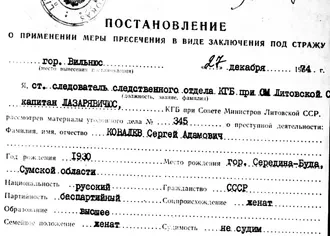
40 years ago, December 27, 1974, Sergey Kovalev was arrested. On the 80th anniversary, Lithuania gave him the scanned materials of his criminal case
40 years ago, December 27, 1974, Sergey Kovalev was arrested. On the 80th anniversary, Lithuania gave him the scanned materials of his criminal case

It is quite difficult to clearly answer the question of what exactly Kovalev was taken for. In his opinion, he accumulated a completely convincing number of sins. Back in 1956, he, a graduate student,, together with his comrades, wrote a letter to the dean of the biofacment of Moscow State University demanding an objective presentation of materials about genetics. At that time, it was taught that it was a reactionary bourgeois teaching. Kovalev demanded to give information, and he should evaluate it to the future scientist himself. The result is rigid pressure on the signatures, after which almost everyone except Kovalev and several more stubborn people removed their signatures. Then there was a Komsomol assembly at which one of the leading ladies said: “They, you see, lack the study of the Morganism-Darwinism so that they can understand themselves! And here they read the course of scientific atheism. What can you teach the Bible? " Kovalev agreed with enthusiasm.
Then there was a letter to the Presidium of the Central Committee regarding the case of Daniel and Sinyavsky, letters in defense of Ginzburg, Galanskov, Yesenin-Volpin and others ... In 1969, he took part in the creation of the first human rights organization-an initiative to protect human rights in the USSR.
Soon he was forced to leave Moscow State University. Such a requirement came from a higher party organization. He didn't want to. The elderly party organizer honestly said that Kovalev’s refusal to quit will interfere with the further activities of the entire team. He explained: if you do not leave, we need to fire you at a general meeting. “I will have to either vote for this dismissal, or put a party card on the table myself. I do not want to vote for dismissal. I am an elderly person, I still have scientific ambitions, and I can’t realize them, abandoning membership in the CPSU. Leave better yourself. " True, after dismissal, he wore money to the unemployed Kovalev ...
The activity of the initiative group was in the nature of monitoring a violation of human rights. In addition, Kovalev began to edit the Chronicle of current events, it was precisely to him that the materials of the Chronicles of the Catholic Church of Lithuania - a similar Lithuanian publication. Therefore, Vilnius.
Of the other iconic acts of Kovalev: in 1973, after the arrest of Yakir and Krasin, the KGB through Irina Yakir reported that each new issue of the Chronicle would be accompanied by arrests. After an almost one -year break, Sergei Kovalev, along with Tatyana Velikanova and Tatyana Khodorovich, announced that the mentioned three members of the initiative group were responsible for the continuation of the “chronicle”. A press conference for foreign journalists took place on this subject. And in the same 1973, Kovalev wrote a letter to Andropov.
From his friend, Vladimir Maresin, a copy of Solzhenitsyn’s book “The Gulag Archipelago” was removed. Kovalev wrote in the KGB that this is not a thing - to rummage in foreign libraries and, they say, if you please return the book to me, that is, the rightful owner ... A funny detail. Before sending a letter, he showed him Sakharov. Andrei Dmitrievich warmly supported the letter and even wanted to attach his signature to Kovalevskaya. Sergei Adamovich reasonably objected that the same “archipelago” could not belong to Sakharov and Kovalev at the same time. Then Sakharov simply attributed his words of indignation to Kovalev’s letter.
But back to December 1974. Actually, the proceedings of the criminal case of Kovalev were allocated from the case of the issue of the "Chronicle of the Catholic Church of Lithuania." The investigation group consisted of 10 people, most protocols were led by Captain Lazaryavichyus and Major Istomin. The list of grounds for the Kovalev case contains 1641 document. The essence of the prosecution: you all in your "chronicle" lied.
Kovalev formulated his position, being questioned on December 23 as a witness: “... I refuse to take part in the investigation in case 345, since the investigation and the court systematically violate the procedural norms in criminal cases under the articles of the Criminal Code of the RSFSR, which leads to unlawful sentences.” After some time, Kovalev comes to the conclusion that the investigation seems to really want to verify the veracity of the information published in the Chronicle. So, on the 77th interrogation, Sergei Kovalev writes: “Probably, as an exception, I will answer this question. But first, I ask you to present me the text of the 32nd issue of the Chronicle.
What are you talking about? Alexander Feldman lived in Kyiv, who wanted to leave for Israel. He was refused a visa to leave. Feldman read and kept samizdat, participated in the demonstrations of the refuseniks, was subjected to short -term administrative arrests for this, went to the synagogue (the warriors were on duty from the synagogue and took those who came to the pencil). He was arrested for hooliganism: he, returning from the synagogue, allegedly knocked out the cake from the hands of an unfamiliar young lady. Nearby was a police car with considerable ranks in it very successfully. The place and time of the court was hidden from relatives. Dali 3.5 years.
In the camp of Feldman, “Tremed as a Jew,” in connection with which he refused to go to work, was sent to the penalty area, where a appliances neighbor beat him, was transferred to a chamber-type premises and announced a hunger strike. "Chronicle" calls the names of the guilty. Kovalev got acquainted with the materials, as well as with the certificate of the colony administration and the protocols for the interrogation of witnesses on the camp life of Feldman. And he is ready for cooperation: “Suddenly, thoroughly and impartly checking the reports of the“ chronicles ”and making sure that they are in no way to slander (that is, obviously false fabrications invented to discredit anything), the investigation will refute unreasonable accusations?” Kovalev strongly doubts this result, but honestly ready to give investigators a chance.
The testimonies of the witnesses say that no one beat Fieldman, did not call the Jew, he himself was so conflicting and lazy ... By the way, much later, in 1979, in the court in the case of Tatyana Velikanova, Witness Kondratov, an employee of the camp in which Feldman was sitting, said that "he did not know who beat him and that he beat him very much."
And there was a strange correspondence - the head of the KGB investigation department under the Council of Ministers of the Mordovian Autonomous Soviet Socialist Republic from the head of the investigation department of the KGB of the Lithuanian SSR: please check the following facts, a list of facts.
The answer is to the chief and so on the KGB of the Lithuanian SSR: the audit established that ... the content of the materials set forth in the “chronicle of current events” ... mainly corresponds to reality. The certificate was drawn up by the senior investigator of the KGB under the Council of Ministers of the Mordovian Autonomous Soviet Socialist Republic ...
Or the story that three schoolchildren were allegedly arrested in Tbilisi, one of the parents and the school principal were removed from work ... The KGB says: doctors did not arrest anyone, did not take anyone off. In the case of Kovalev, however, there is a certificate that the director of the school Alexander Metrevel was transferred to a lower position to another school. But it is unlikely that this certificate was shown to Kovalev himself. And after 40 years I found one of these schoolchildren - he wrote a letter to me: yes, they were arrested, were under supervision for 5 and a half years ...
And, finally, the investigation was offended: “I studied two and a half episode of those that were presented to me ...” - everything was neat, correctly and accurately described in the “Chronicle”. And then Istomin said in half the third episode: “Okay, Sergey Adamovich, enough. Maybe then there will be time left, but now it's time to finish. You know, we must already close this - the deadlines are settled, well, we will strain the prosecutor general, ”says Kovalev in an interview with www.polit.ru
And then there was a court on which Kovalev, for example, present an episode with a machine. We took a printed device on the Hudas witness. In the process of removing Gudas, they beat a little. So writes the “chronicle”, and the witness Gudas himself says that no, they were polite. And then Kovalev asks: where did you find the equipment? According to Gudas himself, some carriageways asked for permission to leave heavy things that would be taken on the way back. And they found her in a heap of sand. “What kind of manner: the thing left for storage cannot be put in the hallway there so that it waits for the owners to return? Well, then he understood that something had to be hidden. So it lies. And if it lies in this, then where does it understand that he does not lie, that he was not touched by a finger? " Only now the judge immediately understood the cunning course of Kovalev and removed the question.
And then the gathering of pigs began. With these words, Kovalev was characterized by a high court, under the doors of which academician Sakharov pushed, who sent a telegram demanding to call him as a witness. And he went to Vilnius, instead of receiving his Nobel Prize in Oslo on the same day. Kovalev demanded that the witnesses declared to him to be at the trial, and the already questioned remained - in case questions arose to them. And since his requirements are not met, then, then I quote the protocol, "I can’t stay in this gathering of pigs for more than a minute and demand that I be taken to prison." Then, however, he apologized for the “gathering of pigs”, replacing it with a softer “gathering of people who do not respect the law”.
The result of “gatherings of people who do not respect the law” were 7+3: 7 years of imprisonment and 3 years of links for Kovalev. The matter itself has become a textbook for KGB officers.
The criminal case of Sergei Kovalev is stored in the archives of Lithuania, and scanned materials were donated to Sergey Adamovich for the 80th anniversary. In addition to the criminal in Vilnius, there is also an operational case.
Recently, Ivan Sergeyevich Kovalev, the son of Sergei Adamovich, the former political zek, came to Russia to get acquainted with the FSB archive - his own and his wife, member of the MHG (Moscow Helsinki group) Tatyana Osipova. According to the laws in force in Russia, a considerable part of these cases is secret. That is why the full criminal case of Kovalev Sr., with all certificates, protocols, requests and answers, can be considered not only an encyclopedia of the movement of dissidents, but also a unique document of the era. I hope that one day this document will be entirely published.