
Translated material
Memory. Daniil Harms
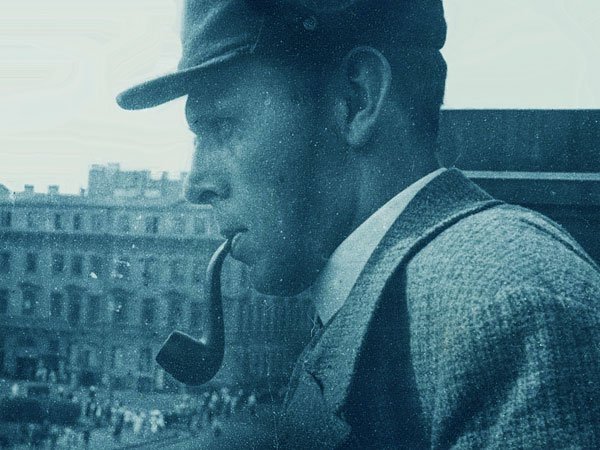
On December 30, 1905, the poet and writer Daniil Harms were born.
Personal business
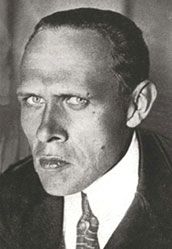 Daniil Harms
Daniil Ivanovich Yuvachev (1905–1942) was born in St. Petersburg. He studied at the Petrischule school, then in the 2nd Kchildren's United Labor School. Since 1921, he began to write poetry, then he came up with the pseudonym "Harms". In 1924 he entered the Leningrad Electrical Engineering (the application for admission was signed by the surname "Yuvachev-Harms"), from where he was expelled for "weak attendance" and "inactivity in public work" a year later.
He became part of the “Order of the Umphli” founded by the poet Alexander Tufanov , where he received the title “Vit Zaumi”. Cares with the poet Alexander Vvedensky . In 1927, Oberiu (“Association of Real Art”) was founded, which included Daniil Harms, Alexander Vvedensky, Nikolai Zabolotsky, Konstantin Vaginov, Igor Bakhterev and others. Members of the association called themselves Oerius. The memorable action of Oberiu was the evening of “three left hours”, which was held on January 24, 1928, on which the audience heard the poetry of the poets-coariuts and saw the play by Daniil Harms “Elizabeth Bam”. Like other poets of his circle, Harms collaborated with the Leningrad children's magazines “Hedgehog” and “Chizh”, and also published several children's books.
In 1931, Harms and Vvedensky were arrested by the OGPU. Harms sentenced to three years of correctional camps for the anti -Soviet children's poems. Then the conclusion was replaced by expulsion, so Harms, like Vvedensky, went to live in Kursk, where he was until October 12, 1932. In the 30s, the work of the Oberiuts caused more and more discontent of the authorities. The last public performance of the Oberiuts took place in April 1930 in the student hostel of the University of Leningrad. The newspaper “Smena” published an article “Reactionary Jonglery (about one sortie of literary hooligans)”, and “Student Pravda” called the poetry poetry “a challenge to our socialist construction and our Soviet revolutionary literature.” After that, the public performances of the Oberiuts ceased, and only children's works managed to publish. In the 1930s, he wrote a cycle of stories “Cases”, the story “Old woman”, numerous verses and stories.
In August 1941, Harms was arrested a second time. The decision on his arrest said that “Yuvachev-Harms D.I. K.-r. He is configured, spreads slanderous and amazing moods in his environment, trying to cause panic and discontent in the population. Government. " As with the arrest of 1932, he pretended to be crazy in order to avoid a harsh sentence. Experts came to the conclusion: “... Yuvachev-Harms Daniil Ivanovich suffers from a mental disorder in the form of schizophrenia. The disease is long, the prediction is unfavorable. As a mentally ill Yuvachev-Harms in the act incriminated to him is not responsible, i.e. Insane and subject to treatment in a psychiatric hospital. ” As a result, the military tribunal determined “by the severity of the crime” to contain Harms in a prison type psychiatric hospital. Harms died in the blockade Leningrad from hunger in the psychiatry department of the prison hospital “Crosses” on February 2, 1942.
What is famous
The outstanding poet and writer, the largest figure in the unofficial Soviet literature of the 1920s-1930s. His work is characterized by absurdity grotesque, black humor, absurdity, but in many works, a philosophical and mystical subtext is hidden behind the outer semantic layer. Most of Harms was not published during his lifetime. After the death of the writer, his archive was saved by the wife of Harms Marina Malich and his friend Yakov Druskin, who took the manuscripts from a bombed apartment and preserved them for many years. In the post -war years, only children's poems by Harms and those adult works that could go for humorous were known to readers for a long time.
What you need to know about
Literature was not the only way of Harms' creative action. His art could be called life -making. As the organic parts of it included everyday eccentricity, a tendency to draws and hoaxes, deliberately shocking behavior during the Obyright evenings. Harms wore an unusual suit: a checkered jacket, a tie shirt, short trousers, checkered golfs. The appearance was complemented by a cap and a tube. In the daily speech of Harms, paradoxical or shocking statements were not uncommon (“My phone is simple-32-08,” said Harms, is easily remembered: thirty-two teeth and eight fingers ”).
Direct speech
“Maybe you will say that our plots are“ non-reward ”and“ non-logical ”? And who said that the "worldly" logic is required for art? We are amazed at the beauty of a painted woman, despite the fact that, contrary to anatomical logic, the artist turned his shoulder blade with his heroine and took her aside. Art has its own logic, and it does not destroy the object, but helps to know it. ” From the declaration of Oberiu (1928)
“I did not immediately understand what kind of person it is. He was completely extraordinary, not like anyone, or a conversation, or behavior - a unique man. It seemed that he was all of the jokes. Now I understand that otherwise he did not imagine his existence. Eccentricity was characteristic and necessary for him. ” Alice torn
Like all Oeriuts, Harms painted. He painted the wall of his room, his drawings were interesting on a paper lampshade of a hanging lamp, in mascara, according to the principle of imaginary symmetry. Harms loved painting, but his love of music was infinite. Busthuda, Gandel, Bach, Mozart - these are those whom he adored. He often sang Lacrimosa with a thick and pleasant voice. Almost daily, Y. Druskin came to him, an inspired musician who played from memory playing the creation of giants of the XVIII century on the Fisharmonony. Of the contemporaries, Harms appreciated Shostakovich, especially his opera "Nose", which after several performances was "forbidden". " Nikolai Khardzhiev
“He always dressed strangely: a jacket, stitched specifically for him with some kind of tailor, the neck is an invariably pure collar, golfs, and hetras. No one wore such clothes, and he always went in this form. Be sure to with a large long pipe in the mouth. He smoked on the go. In the hand - a stick. On the finger is a large ring with a stone, the Siberian stone, in my opinion, is yellow. Tall, although he stooped a little. He had a tick. He somehow very quickly brought both hands-or rather, two index fingers folded by the house, to his nose, making such a sound as if he had rejected, and at the same time tilted slightly and trampled with his right leg, quickly and quickly, quickly. ” Marina Malich
"Harms in some of his stories was an underon-boy, who was not afraid to say:" But the king is a goal. " He saw the insignificance and emptiness of a mechanized life, which was frozen in automatism of thoughts, feelings and everyday life; The emptiness and meaninglessness of existence, determined by the words: '' like everything '', '' so customary. '' In his stories and verses there is what is called nonsense, alogism. It is not his stories that are meaningless and illogical, but the life that he describes in them. The formal meaninglessness and alogism of situations in his things, like humor, was a means of exposing life, expression of the real nonsense of an automated existence, some real states inherent in every person. Therefore, he said that in life there are two high things: humor and holiness. By holiness, he understood the true - living - life. Humor exposed a non -blessed, frozen, already dead life: not life, but only a dead lining of life, an impersonal existence. ” Yakov Druskin
11 facts about Daniil Harms
- The father of the poet Ivan Yuvachev was a revolutionary-nor-perch. In 1883, he was arrested and sentenced to death, but then the execution was replaced by 15 years of hard labor. He served his sentence in Shlisselburg and Sakhalin, in these years he survived a religious appeal and became a spiritual writer.
- The literary critics put forward many hypotheses about the origin of the Harms pseudonym: English Harms, English Charm, French Charme, Sanskrit Dharma, anagram in the name of Marx with the replacement of one letter and even from the surname of Sherlock Holmes.
- Harms had about 20 other pseudonyms: Haaarms, Haaarms, Kharms, Horms, Kolpakov, Toropyshkin, Karl Shusterling, Harmonius, Daniil Protoplast, Daniel Sharpen, Dukon-Harms and others.
- The abbreviation of Oberiu means “unification of real art”, the letter has no significance.
- The first publication of Harms in the USSR after his death was a collection of children's poems “Game” (1962). The poem “Funny Chiji”, written jointly by Marshak and Harms, was published for a long time under the name of one Marshak. The "adult" work of Harms has become available to readers only since the 1980s.
- According to Daniil Harms, not only dramatic performances were staged, but also the ballet “Drawing Old Women”. It was created in 2007 by choreographer Alexei Ratmansky to the music of Leonid Testnikov.
- The song of Alexander Galich is dedicated to Harms “The Legend of Tobacco”.
- However, the legend that Harms was arrested when he left the apartment to the store to buy tobacco, is incorrect.
- The common jokes about Pushkin do not belong to Harms (“Once Gogol changed by Pushkin ...”). They were composed in the early 1970s, journalists Natalya Dobrokhotova and Vladimir Pyatnitsky.
- According to the writer Vladimir River, Harms and Nikolai Oleinikov starred in episodic roles in the film of the Vasilyev brothers “Chapaev”. In particular, they participated in the famous scene of the mental attack of the Kappelevites.
- One employee of the Literary Institute, having learned that Anna Gerasimova writes the dissertation “The problem of the funny in the work of the Oberiuts,” said: “These interesting people are these Oeriuts ... Do they really have literature?”
Materials about Daniil Harms
Article about Daniil Harms on Russian Wikipedia
Article about Daniil Harms in the Encyclopedia "Circumspices"
Site dedicated to Daniil Harms
V.I. Glotser. “That's what Harms! The look of contemporaries "
V.I. Glotser. "Marina Durnovo: My husband Daniil Harms"
A. A. Kobrinsky "Daniil Harms"
Books N. Name as a technique. To the unraveling of the pseudonym Daniil Harms // Absurd and around: a collection of articles.