
Translated material
New political language: Results of the year
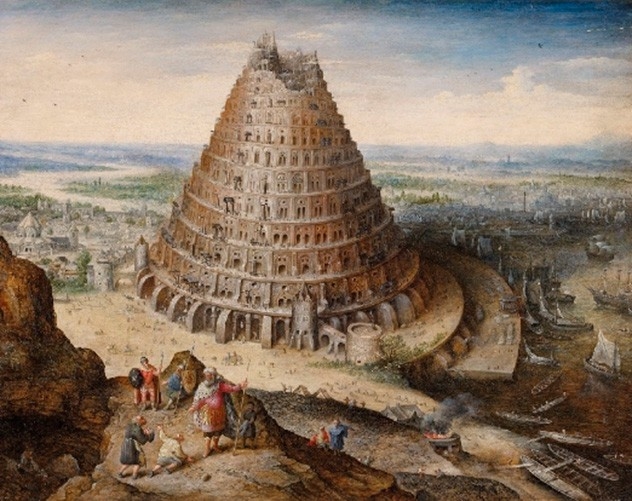
2014 was not only the year of the death of a stable ruble, but also the year of the death of most styles of the Russian language. An official, politician, diplomat, economist, top manager and layman now speak the same way: Kazenchin, Argo, the language of the Boulevard Roman, Stand-Apa and fairy tales. The Babylonian confusion was either a reward or the punishment for Crimea and attempts to build a strange “Russian world”: there are no wealth of expressions as there is no, but there has been an unprecedented unity in a language that is difficult to lend itself to the traditional rules of stylistics and is completely incomprehensible from the outside, but carriers are not necessary. Why and what to talk about with an external enemy and the “fifth column”? The main thing is that we understand each other, unlike the builders of the tower.
Let's go by lawlessness
The oddities with the language began to be discovered during the Maidan and the accession of Crimea. The Ministry of Foreign Affairs, which had not been the diplomacy of the style before, suddenly spoke the language of criminal series and prison cameras. One of the favorite words in the statements of the department was “lawlessness”. “In Russia, they are outraged by the lawlessness that now reigns in the eastern regions of Ukraine as a result of the actions of the militants of the so -called“ right -wing sector ”with the complete connivance of the new authorities, as they call themselves,” the department said in May. In June, Minister Sergei Lavrov was indignant at "a lawlessness that was arranged in front of the police, moreover, in the presence of the Minister of the Interior (Ukraine)." It was then about a rally with the pogrom of the Russian Embassy in Kyiv. In August, the Foreign Ministry was concerned about the difficulties with sending a humanitarian column to the Donbass and said that "it was impossible to tolerate such lawlessness, outright lies and inconsistency." The actions of NATO countries in Libya in September, our ministry also called the "lawlessness." It would seem, but what is there, the word has long become familiar in common jargon, indicates actions behind the facet of decency. And in the courtyard, lawlessness is dirty, and in the hospital, lawlessness is queues, and the prices are also chaos. Nevertheless, the memory of the criminal roots of the word remains, it means the action in violation of thieves' concepts - "to do not according to concepts, but by lawlessness." Therefore, often before a dubious expression arises "sorry" - "sorry, but this is lawlessness."
There is no “sorry” for the diplomatic language - it must be very accurate (almost scientific) and at the same time streamlined, to reserve a window for dialogue all the time: “Our partners”, “joint actions”, even if the relations between the countries leave much to be desired. That's what the language of diplomacy is needed: have you quarreled? Yes, never - were partners, there was and never interrupted the dialogue.
Now it’s not the case - it reads, for example, the American diplomat of the Foreign Ministry in English, then decides to read in Russian: Bespredel, What? He climbs into the dictionary and sees - "not according to thieves' concepts." What to think? Respond to the vocabulary of American prisons? However, one can still deal with the “lawlessness” - maybe one of the native speakers of the Russian language will explain that the word has deeply penetrated into ordinary speech, and the Ministry of Foreign Affairs simply “broke and freak out” several times.
Quietly himself
Another word, “Pontus” (not a sea from Greek, of course), did not become ordinary and did not lose its criminal coloring at all, but nevertheless entered the diplomatic vocabulary. “The West wanted to take Russia to Pontus,” is not a quote from Facebook by Face, which is being brought by Maria Zakharova, who had already managed to become famous, and not even an impersonal statement. These are the words of Sergey Lavrov. The answer of the Western diplomats to such an accusation is again difficult to come up with. These expressions do not allow continuing the dialogue - for example, a statement on violation of international law implies it, warning, too, but “for a pont” no. In this form, the Foreign Ministry’s statements turn into a kind of television show, there is no diplomatic meaning into them, but there are enough aesthetic: the phrases are turned not to the external (which should be done by the department), but to the internal listener. The addressee of the expression likes: “How Lavrov cut these with Merkel! Exactly everything - they wanted to take the pont, nonsense, but did not focus to the frarams. " "Rights, Bender, lawlessness."
Other statements of the Ministry without contacting the criminalism, however, were directed rather to Russians. For example, quite seriously the department calls on the Ukrainian authorities to read Gogol to find out what Novorossia is. Not documents of past years, not agreements, not agreements, but the work of the Gogol's works of Gogol. Imagine, for example, that the British Foreign Ministry will declare the need to read the cycle about Narnia or Middle -earth - this is about the same level of dialogue. But for the average viewer, everything is just right. By the way, another expression from Gogol was used in the Foreign Ministry-they compared Europe with the “non-commissioned widow”. The favorite image of propagandists and collections of school works immediately meets understanding again within the country.
Barygs in the market
If diplomats resort to criminal jargon, why not use it to economists and top managers, and they do it. For example, after the announcement of the message of Vladimir Putin to the Federal Assembly, the head of Rosneft Igor Sechin called to wait for how to react to the words of the President of the Barygs in the oil market . In this form, the quote reached ITAR-TASS, other news agencies gave the news about the “barrels in the market” and laughed at the colleagues: they say, if I look at Igor Ivanovich, he could not be expected from him, but he still spoke about barrels. ITAR-TASS journalists listened to the record and reported: Sechin said about the hucksters. “Such a good girl, and her father is a huckster, a speculator,” a quote from “gentlemen of good luck” climbs into my head.
Dmitry Medvedev also tries to be closer to people-for example, he compared Ukraine to “poor Lisa”-maybe not everyone will remember the plot, but everyone heard the name. And it sounds quite insulting.
Let them talk
The source of criminal-centralizard jargon does not need to be sought for a long time: these are the public performances of Vladimir Putin, in which the booze of the St. Petersburg courtyard kids skipping every now and then. In the last presidential message, too, there are a lot of this - for example, Mikhail Saakashvili, according to the president, drive around the world "as lousy in the bath." The national leader is sentimental, he compares the country with the “Mishka”, which loves “berries and honey”, but sometimes not averse to “drive piglets and out -of -clinks in the taiga”, regrets that this free beast can be planted “on a chain” and tear his teeth. Figuratively and quite in the spirit of demotivators in the patriotic public "VKontakte" or the new carications of RIA Novosti: with a good huge bear, which is harmful to small Western politicians. The motives of the transition to the presidential language are understandable - if unity with the leader, then in everything. All in one system - closer to the people. It is very easy to imagine the president, prime minister, Lavrov, Sechin, all deputies and senators for talk shows not even Vladimir Solovyov, but Andrei Malakhov. "Let them talk." And they say. “Well, in general, Ukraine behaved like a poor Lisa, and she was pulled out by lawlessness,” either Lavrov or Medvedev lamented. “But there is nothing to behave like a sucker when around the huckster,” objects Igor Sechin. “Yes, you have not read Gogol, blah, or something, he already had all this in the“ Captain's daughter, ”the State Duma deputy enters into the conversation. "The main thing is not to touch our bear!" - agrees the president. Do not switch the channel, we will return after short advertising.
New experts
The usual characters of the talk show also move towards politics and try themselves in the role of experts. For example, since the introduction of grocery antisanctions on Lifenuz, the “opinions” of the singer Lolita and Nadezhda Babkina began to appear about how the ban on the imported, how soon the dollar rate would fall. Someone more cunning created on YouTube channel Vipcomments, where the stars talk about everything. For example, Vladimir Permyakov, an actor who played in the videos of MMM Lenya Golubkov, assures that “Russia is on the right track,” and “we played played up” in freedom. Mikhail Muromov (there was such a singer) reports that "Obama puts pressure on Europe," and "sanctions on Russia will not be reflected in any way, the only thing that will be better for us." Again, the singer of the nineties Vlad Stashevsky argues that “citizens managed to eat the European Union, want to return national currencies, but who will give them?”, But “our country manages to rally.” “It is beneficial for America that everyone will be gnawed inside their country, and then they will come and put their American flag on the ashes,” Stashevsky warns. A little more courses of political information and jargon, and you can plant these specialists for Facebook by the Foreign Ministry or to the State Duma.
Of course, one might think that the language from such almost artistic experiments becomes only richer - officials spoke in jargon, ideology, inappropriate in the context of comparison, sentimental from the rostrum, is spraying from the singers. But this is not so. The destruction of language styles is a good example of the fact that the public administration machine has completely been divided. There is no more expert discourse, it was replaced by a kitchen. “Everything will be fine with us, the pindos will not pass, in Russia all their own, the hucksters are harmful, but nothing, read about New Russia from Gogol.” Such a simplification of the language leads to a simplification of logic: after all, according to philistine opinion, if there is not enough money in the budget, it is necessary to print it, if products are expensive, you need to fix prices. Such opinions are already sounding (though so far from quite odious personalities like Evgeny Fedorov). The philistine is already found in the statements of those who really make decisions. Several ministers, without any irony, said that the growth of the euro and the dollar will not affect ordinary people who receive and spend rubles. It is scary if they really think so.
Author - correspondent of the Kommersant Publishing House