
Translated material
From the standard to the ruler
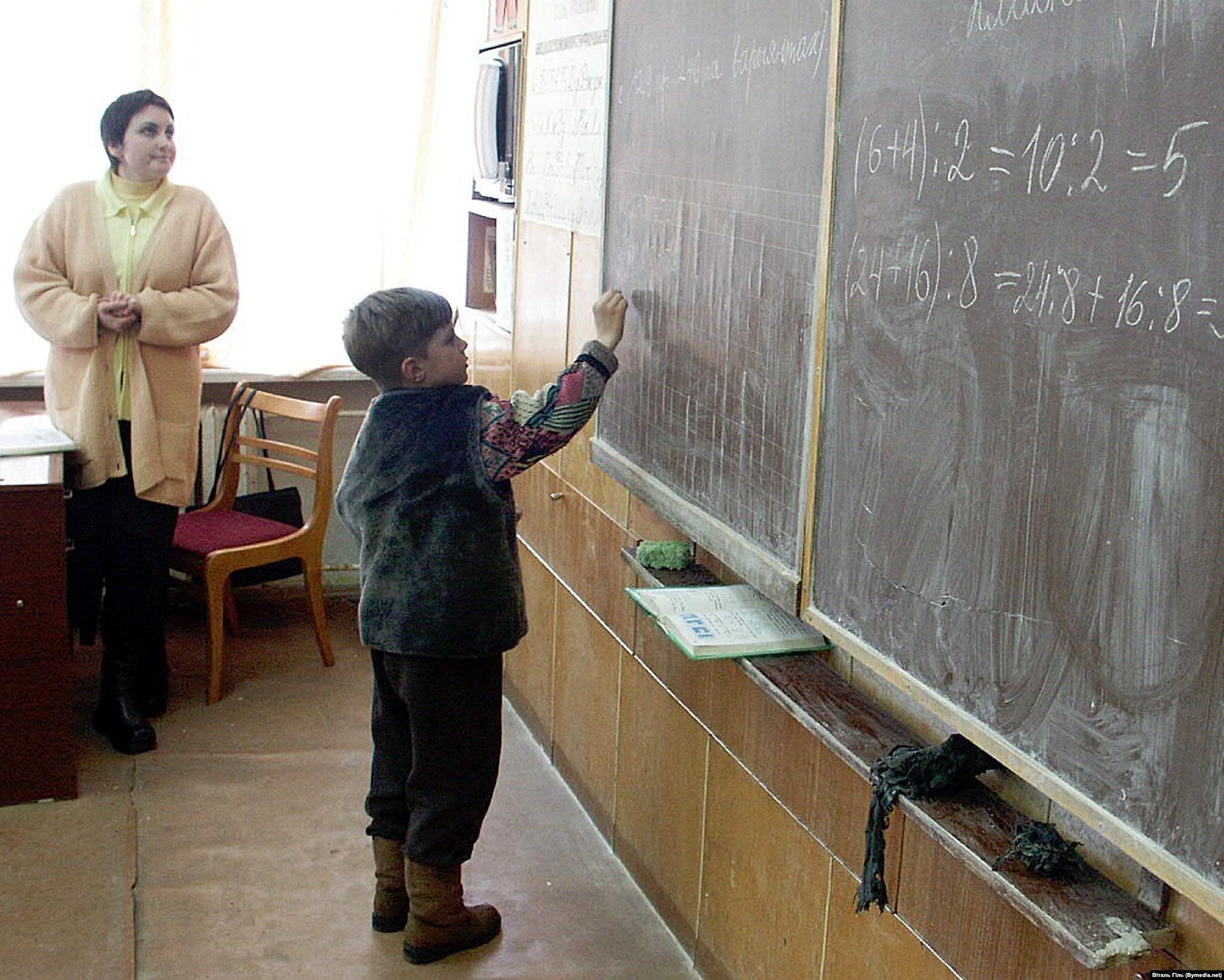
How federal intentions diverge from regional reality, and state ideology - with the moods of students and their parents
The final essay, a single historical and cultural standard, on the basis of which textbooks, a new professional standard and wages have already been written-this is a short list of school problems of the past year.
The problem of a slow action - the implementation of new GEFs (federal state educational standards) will affect the educational process for many years, mainly negatively. Firstly, the ministry is in a hurry with their implementation, although they should be introduced gradually, a step behind the step: primary school, secondary, tenth and eleventh grade. Of course, the younger school began this process a lot earlier, someone as an experiment, someone for the approval of the authorities, but a widespread transition to new Federal State Educational Standards was preceded by a lot of work with teachers. Nothing of the kind can be said about subject teachers, who, firstly, are much more, and secondly, their skills and instruments of learning vary exactly to the same extent as the disciplines themselves. So pulling everyone in a blade will not work.
So, Russian schools received an instruction to move on to new standards, for which neither schoolchildren nor teachers are ready. Any school principal, of course, will try to achieve the maximum result , even if it is registered in terms of terms such as “personal” or “meta -subject”, but he wants to be sure that his own interpretation will not seem to be a harmful or incorrect official from the local Department of Education, who will come to check at the end of the year to achieve the school.
A significant part of the teachers will turn out to be trade -detention and will be forced to leave the school
Another issue of an administrative nature that the teachers bothered this year is a new professional standard that will become mandatory after a while, but inspires fears today. Firstly, there is such a number of competencies and skills, which, continuing to work at school, will not be able to work at school. This means one thing: after a while, a significant part of the teachers will turn out to be trade and will be forced to leave the school.
It is possible that this circumstance will update the staff, but only if the salary of teachers remains at least at the level of the average in the region, and the school principals will cease to be afraid of checks and begin to trust creative teachers. This situation seems completely impossible, since much depends on the local authorities. Onaco of money comes to the regions less and less, and today it is difficult to imagine how the indicator of the teacher’s salary reached over the years will hold. It is possible that he will automatically move down after the average in the region, which, given the inflation, will return school teachers to the previous poverty line.
The school has already exhausted the internal reserves: the staff has been reduced as much as possible, the load is one and a half or two bets, and the subsidies from the federal center, as it was several years ago, is no longer expected. In the foreboding of close difficulties, teachers in some places even stopped certifying to the highest category, so as not to raise the salary. So the coming reality and the intentions laid down in federal standards diverge in the most serious way.
Technically approaching the excellence of the exam ceases to be the only objective exam, returning the position of higher education
Another part of the problems that the Russian school solved this year and the consequences of which students and teachers will encounter in 2015, concerns final tests - the future of the exam in a foreign language, the December composition, the results of which universities can add to the general entry score, as well as some others - personal portfolio , participation in the TRP . That is, the USE, so approximately approaching perfection that it reflects reality, will cease to be the only objective exam, returning the position of higher education. In addition, in 2015, universities will probably take advantage of the right to determine the exam in subjects and their number necessary for admission.
As for school exams, the teachers see the main difficulties in the change of their form and the mismatch of new federal standards. A striking example of this is the essay that high school students wrote in December. "Очевидно, – говорит учитель русского языка и литературы лицея № 1 города Камбарка в Удмуртской Республике Анна Инютина , – что те формы экзаменов, которые вводятся, никак не стыкуются ни с учебно-методическими комплексами, ни с кадрами, которые на сегодняшний день загружены настолько, что не в состоянии их самостоятельно освоить. У нас ежегодно меняются все формы экзаменов, ЕГЭ без конца – то сочинение, то изложение, then GIA, then this, this, naturally, affects the quality. "
Indeed, literature teachers this year were in a difficult situation: the final essay , which will become a admission to mandatory summer exams, had a very mediocre attitude towards literature. Actually, it was conceived as an interdisciplinary reflection on a given topic, only the entire load of training fell on teachers-explosors. It’s good that the composition was not evaluated in any way - otherwise they would have to be responsible for both the quality of training and for mistakes, both semantic and grammatical. In the meantime, it became clear that Russian students are in no hurry to reveal the soul and share their thoughts with the teacher, even if they are working in the same school. That is, the essay turned out to be an internal exam that measured the unknown knowledge, but verified literature teachers.
Preparations for the essay very incident from the discussion of the project “ The Concept of School Philological Education ”, which were developed by experts by the All -Russian Public Organization “Association of Teachers of the Russian Language and Literature”. The authors of the project, among other things, advocated "preserving the historical and methodological tradition of teaching", "aesthetic familiarization with the national picture of the world embodied in the reference texts of classical literature", a single list of compulsory works, which the best Moscow teachers actively opposed.
There is a certain cultural and historical standard, it comes from senior management, which means that it must be performed
The fact is that somewhat earlier a single historical and cultural standard was adopted, on the basis of which a new textbook textbook was written by the end of the year, more precisely, a line of textbooks. The teacher of the history of the intellectual school, Alexander Kondrashov, believes that the status of the standard still needs to be clarified: “The concept was developed by the Russian historical society - a public organization, many of its members, including the chairman Sergey Naryshkin, are not professional historians. And what is the legal role of this concept? The teachers ask: is this a mandatory document or not? He has no status.
It is difficult to resist not to recall what a strong influence on the system and content of education had party-state power in the Soviet years. Another thing is that, copying pseudopatriotism and ideological formalism of the past, it is quite difficult to achieve real changes. And not only because these lessons have already learned. The concept of a choice that you make yourself appeared. It is no coincidence that one and a half thousand people came to support the Moscow school "Intellectual", including students and their parents.