
Translated material
The results of the year. Devastation both in the toilers and in the head
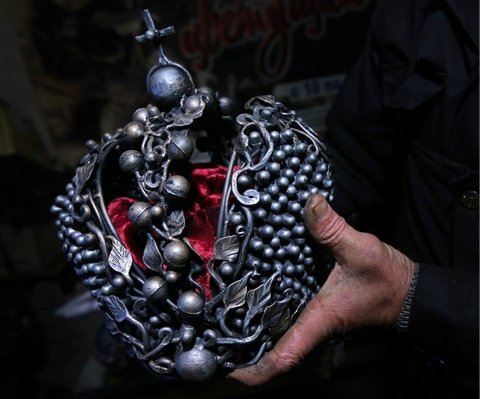
I remember that it was difficult for me to take the results of 2013 - there was a feeling that for that year there was practically nothing, well, except that at the very end Khodorkovsky was released. And for the rest of the year, some dreary haze has been accumulated, and even the elections in Moscow, Yekaterinburg, Petrozavodsk and Yaroslavl somehow went out very quickly in it, ceased to be felt, and permissible. 2014 was completely different. He was so violent that even the Sochi Olympics practically drowned in subsequent events, which were so many that there was a directly opposite difficulty - to be able to summarize at least the main in one column.
In order to try to do this, I risk placing the events of 2014 in a wide historical context, especially since I agree with the concept according to which we continue to live in a world, the main development processes of which are determined by the consequences of the First World War, which began exactly the eyelid earlier.
One of these consequences was the destruction of four empires, two of which - the Austrian and Turkish - no longer tried to revive. German tried, and mainly the same coalition, which in 1918 stopped it, forced the Germans to forget about the world and even regional domination, achieved by military means, forever. The Russian imperial project was quickly transformed and revived in the form of the USSR, but in 1991 suffered a severe defeat. It seemed to many that it was a collapse, but it turned out that there were people, there were structures and there were forces that dared to try to take revenge.
The parallels with Hitler Germany and its attempt by revenge have already become a common place. However, they are so obvious that the prominent Putin vertical theorist did not deny that Putin was reminiscent of Hitler, but began to prove that at first Hitler was quite good. In this case, it turns out that even part of the quite intellectually consisted apologists of the aggressive policy of the Putin regime admits that we are dealing with an attempt by the imperial revision, historically similar to Hitler. Moreover, this is the last possible version of a possible revenge, because over the past hundred years all empires that participated in the First World War, as well as in the second, actually ceased to exist, even those that were twice as part of victorious coalitions. The latter was deprived of the imperial illusions of Serbia, remaining in almost the same borders, which she had at the time of shots in Sarajevo.
Thus, we are dealing with an attempt to revive not just a Russian imperial project, but an imperial idea and imperial policy as a phenomenon. Does Putin have and, unfortunately, the chances of success he headed by him? Will it be possible to actually turn the story of the back, by and large, to do what no one has succeeded in? It would seem that the resources for the confrontation of the combined West are so insufficient that in this parameter of comparison with Hitler and Germany the 30s-a luxurious compliment. And there are only two factors that allow the new “great dictator” to blackmail yesterday’s partners in “eight” and “twenty” - this is a neglect of life, which is characteristic of him and his subjects, and hope for a guaranteed nuclear draw. In essence, from the upper volta with missiles the country was transformed into North Korea with hydrocarbons. But they could not work as a weapon of hydrocarbons.
Apparently, the West is not going to fight with Russia, and it is very difficult to decide the first to untie the world war, especially nuclear. I think that the mistake was precisely in this: correctly assuming that the West would not use military force, at the same time did not expect that he could go to the loss of part of profits, introducing significant and long economy sanctions. In conjunction with the sanctions on food imports imposed on Russia by its own president, it turns out even worse than it was in Saddami Iraq - not just oil in exchange for food, but oil and gas in exchange and not better quality food. Moreover, the situation with the national currency course, which turned out to be a new curtain for many Russians - is now not iron, but, in accordance with the ironic name of the ruble, wooden.
It is clear that all these circumstances, by logic, should radical and rally the opposition. When Russian revolutionaries in 1905 and 1914 wanted defeat their own government, they did this, in general, from their own purposes, trying to come to power. Then Russia was no better, but no worse than its military opponents, and the victory of Japan or Middle Empires was beneficial to him by the Russian leftist extremists. Now the situation is qualitatively different, Putin's Russia is a clear aggressor, while it attacked a peaceful country, the whole fault of which is the unwillingness to live under the rule of Putin’s accomplices and improvised. But the confrontation between aggression from a solid anti -imperial position chose, apparently, a relatively small part of the Russian opposition. Moreover, its significant part, following very noticeable leaders and with them, actually in one form or another supported Putin's annexionism. And this, it seems to me, in a great extent deprives Russia of the chances of trying again to enter the channel of civilization in any foreseeable future.
In fact, it can be argued that in Russia it simply did not find a political opposition as any noticeable and mass phenomenon. The platform on which opponents of Putin’s politics were able to somehow combine their views is not political, but pacifist and human rights. In itself, these positions are highly noble, only for the formation of the program and instruments of political action, as a rule, completely lacking.
It is a pity, of course, that many of the yesterday, more precisely, last year’s opponents of the regime in a situation of rigid demarcation joined the majority (in a political, of course, sense), but this phenomenon, perhaps, is already familiar. The number of dissatisfied can grow quickly enough, and dissatisfied will turn into disagreements even faster. It’s just very bad if the objective observer is forced to state, as Evtushenko once, “I understand what they do not need and what they need, I don’t understand.” And if a tough, radical and irreconcilab-bebest program of at least the first steps of the country's finally necessary transformation will not be formulated in the shortest time, then not only the Russian imperial project, but also Russia itself awaits the inevitable collapse. After all, the fork in which Russia stands now is highly likely to be the last. And one of the coming years will be great and terrible.