
Translated material
Article 19.3 Code of Administrative Offenses: Do I go to court?
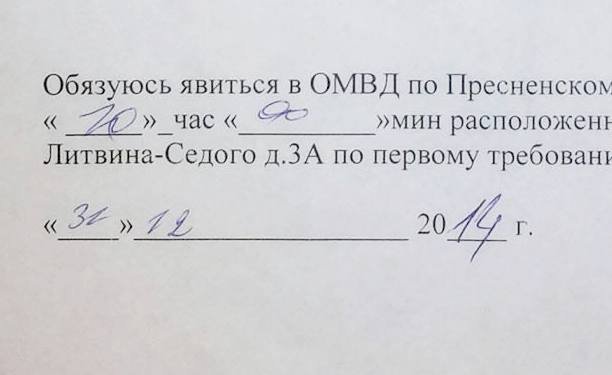
Letting go of the detainees, the police often requires them to sign the “obligation to turn out” to the police department or the court. Especially for the OTD-Info, this practice was commented by the lawyers Yuriks and the Solidarity movement.
On the evening of December 30, on the day the verdict in the Yves Rocher case, the Moscow police detained about 250 people in the vicinity of Manezhnaya Square. The detainees were delivered to 14 ATS, most of them were soon released without drawing up protocols. About 70 people were left under arrest until the morning on charges of disobedience to the legal orders of police officers.
The corresponding article, 19.3 of the Code of Administrative Offenses, involves punishment from a fine to an arrest and, therefore, allows the police to extend the detention period from the standard three hours to two days. The next day, December 31, the Tver District Court of Moscow, which was in charge of detention on Manezhnaya Square, considered only two cases. Mikhail Krieger and Roman Nevchinsky, who, according to other Meshchansky, who spent the night in the Department of Internal Affairs, were not particularly stood out, were sentenced to 15 days of arrest and celebrated the New Year in special cost No. 2 in Khoroshevo-Mnevniki.
For the rest of the detainees who were released before the court, offering them to sign the “obligation to turn out” on January 12-19, we prepared answers to several pressing questions.
If after reading this material you decide to go to court and you need a lawyer’s help, leave a request in the “Help yourself” section on our website.
1. What punishment is threatening me under Article 19.3 of the Code of Administrative Offenses?
Until recently, Article 19.3 of the Code of Administrative Offenses (disobedience to the legal order of a police officer) provided for a penalty of five hundred to one thousand rubles or an arrest for up to fifteen days. In the summer of 2014, lawmakers added a new, sixth part to her, introducing the punishment for the “repeated” disobedience to the police officer, if it occurred in a public campaign. Such an offense provides for much more severe sanctions: a fine of five thousand rubles or arrest up to thirty days. How the new law will work and how the courts will bypass the collisions created by him is still unclear.
Tatyana Glushkova , senior lawyer of the autonomous non -profit organization “Lawyers for Constitutional Rights and Freedom” (Yuriks):
The repeated commission of the offense should be understood as the commission of the offense within a year after the execution of the sentence imposed on the previous resolution (that is, from the moment the fine or end of the arrest period). If the police indicated in the protocol that the first part of Article 19.3 is charged to a person, then the court is not entitled to re -qualify his actions and to summarize part six, if the fact that a person was held accountable under this article earlier only in court. On the contrary, the court has the right to re -qualify part six per part of one. That is, he can improve, but not worsen the position of a person held accountable.
As you can see, Article 19.3 provides the courts with the possibility of a very broad discretion in the sentence. A person can be fined 500 rubles, or can be planted for 15 days. Based on my practice, I can say that the arrest under this article, as a rule, is an exceptional measure that is applied to “especially distinguished” activists. All others are prescribed fines, the sizes of which are small. As an additional indicator, one can distinguish this: if a person is released from the police department to court, then the arrests are almost never used. As a rule, they are appointed only in cases where a person is taken to court directly from the police department the day after the detention.
2. What is an obligation to turn out to be in the police department?
Alexey Gorinov , lawyer of the Solidarity movement:
Such things should never be signed. It is not clear why a citizen to be in the police department. For what? For what purpose and in what status should it appear? If it is detained, then a protocol on detention should be drawn up, if some offense is charged with it, then there must be a protocol. And that’s all. Why still be? In what case, it is incomprehensible.
Maxim Krupsky , lawyer Yuriks:
I did not encounter this in my practice. If there is an official order, by what reason the person should have called in the police department, in connection with which, and he is given some kind of agenda signed by the person who draws up this agenda, and the person himself, indicating the clear date, of a clear time when a person must arrive, in this case, the person probably has an obligation to appear at the police department. But if this document is drawn up in such a way as I usually saw as an obligation to turn to the court, when it comes to some kind of piece of paper, on which two words are written that you undertake to come to the court of such and such a number, it is not known at what time, it is, of course, it does not carry any legal consequences for yourself. Each call in the same ATS should have a clear legal basis.
Tatyana Glushkova:
The obligation of the turnout in the police department in connection with the case of an administrative offense is a document that is not provided for by any applicable legal act. I don’t know who invented it, but this was clearly done by analogy with the Code of Criminal Procedure, which provides for the opportunity to take a person’s obligation to a person to an investigator or interrogator. Regardless of how to determine the legal nature of this document, no responsibility for failure to appear on such a “obligation” is provided, and this, it seems to me, is the most important aspect in this case.
Explanation of the Foundation "Public Verdict"
3. What is an obligation to turn to the court? What call to the court is official?
Alexey Gorinov:
The obligation of the turnout does not entail any procedural consequences. Only the court itself can oblige to appear in the court. Why is it signed? This, as it were, protects both the police and the person who is held in the police department, from not holding it to trial. The police also have limited resources for the maintenance of citizens. If we are talking about Article 20.2, then I usually advise you to not sign the appeal, since it does not matter, and in general this is not provided even for the rule of law. But when it comes to restriction of freedom, part one of Article 19.3 is charged to a person, then here is already at the discretion of the detainee himself: if he wants to go to the principle, he may not be signed, but then there is no guarantee that he will be released to the court from the police department. Therefore, in this case, you can sign it.
Maxim Krupsky:
The obligation to turn into a court is a document that does not have any legal force for the court and for the detainee. It does not entail any legal consequences, moreover, if a certificate confirming the fact that the court called a person with his official agenda is absent in the case file -this can be a receipt of sending mail or telephone explorer, whatever, the person has the right to appeal the decree made by his absence as illegal and unreasonable, since the person will actually be refused access to access to access to access to access Justice and the right to access to the court session and the protection of their rights.
Tatyana Glushkova:
In accordance with Article 25.15 of the Code of Administrative Offenses, you can be called to the court with a “registered letter with a notification of delivery, an agenda with a delivery notification, a telephone or telegram, on facsimile communication or using other means of communication and delivery, ensuring the fixation of the notification or call and its delivery to the addressee.” Thus, on the one hand, the “obvion of the turnout” is still a document that is not provided for by any regulatory legal act, and on the other hand, the Code of Administrative Offenses does not contain formal requirements for the document to which the person should be called to the court. It is only important that the fact that the notification is recorded documented. Until recently, the courts did not consider the “obligation to turn out” the proper form of notice. However, after the mass detentions of February - Mart 2014, the opposite practice began to form. It cannot be ruled out that the same tactics will be applied to business in connection with the detentions that occurred on the 30th.
4. Can I judge in absentia?
Maxim Krupsky:
It depends on what article and depending on whether the court made some attempt to call a person to court. If there is evidence that the summary was sent to the person, that he was officially summoned to the court, that all the necessary conditions were created to make his right to participate in the hearing, then in this case - yes, if he is not several times, if his drive to the hearing is not executed, then, in principle, they can be considered without him. If we are talking about article 19.3, if we are talking about arrest, then the absence of a person does not allow the court to make a decision to arrest this person in this situation.
Tatyana Glushkova:
Formally - no. In accordance with the Code of Administrative Offenses, when considering the case of an administrative offense, which may entail administrative arrest, the presence of a person held accountable, is mandatory. Accordingly, the judge cannot consider the case without your presence. Instead, if you are not without a good reason, he is obliged to make a ruling about your drive to the court.
In practice, this never happens, and cases of 19.3 are very often considered in the absence of involved persons.
5. Does the punishment depend on whether I came to court?
Maxim Krupsky:
According to the law, the relationship between the sentencing, the size of this punishment and the man’s turnout is absent to the court, that is, the punishment is imposed only for the act that the person was committed at the time of the detection and fixation of the offense. Everything that concerns that, a man appeared in court, did not appear in what form he spoke in court, his attitude to the judge or anyone - everything that does not concern the offense, cannot be the basis for choosing the amount of punishment and the form of punishment.
Tatyana Glushkova:
Formally-legal-no, it does not depend. In general, in general, it also does not depend, because if you are not judged immediately after the detention, then the arrest is usually not appointed (“as a rule” in this case means that I can not guarantee cases of the appointment of arrest in such situations, but I can’t guarantee one hundred percent that there has never been a single case). Therefore, most likely, your turnout or failure to appear in court will not change anything.
6. So go to court or not?
Alexey Gorinov:
If the case is initiated and the court accepted it for consideration and sets the date of consideration, then we must walk, of course. But what about? You need to state your position in writing, in writing calmly, write everything, write, then, by submitting a petition to the judge, to introduce his written explanations to the case file.
Maxim Krupsky:
There may be a double approach. On the one hand, I know the position of lawyers who believe that it makes no sense to come to court, since the obligation to turn out, as I said, is not an official agenda. And a person who has not appeared to the court cannot be sentenced to arrest in this situation, and most likely the courts will simply take out fines. But, again, this is not known for sure, because everything is possible in our judicial system, and it is likely that a person can be sentenced to a person as arrest. Everything can be here. I do not presume to judge how the courts will act. Formally, they do not have the right in the absence of a person to impose a punishment in the form of arrest, so from this point of view it would be advisable not to come to court. If there is any iron evidence that a person stood next to the site of the action and did not participate in it in any way, there is a video, there are testimonies of witnesses, a person himself wants to come to court and defend his position there somehow and participate directly in the hearing in order to submit some petitions, for example, or somehow actively participate in the process, it is natural to be. That is, there is a choice for the person himself, for the citizen himself, for the detainee himself. The position of lawyers, which I was the first to voiced, in principle, justified, but if the speech concerned me as a detainee, then I would have appeared in court in order to somehow justify and defend my position.
7. How to prepare for the court?
If you decide to take the opportunity to get acquainted with the Russian judicial system on personal experience, carefully study the instructions for self -seated protection in court . There you will find the form of a request for free legal assistance in court. If you need it, we advise you to fill out and send a request as soon as possible.