
Translated material
Dracula bothers the Turks again
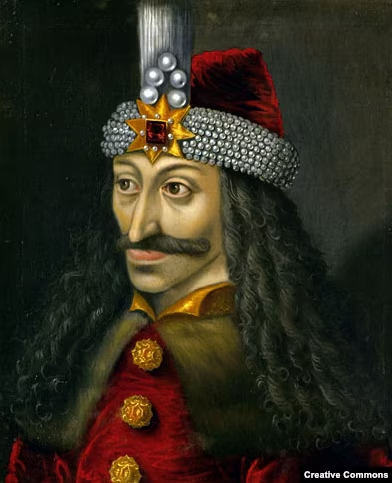
The new film about the prince of vampire caused dissatisfaction in Turkey
In Turkey, recently they started talking about Dracula - not the character of the novel by Bram Stoker , but a real historical figure, who lived in the 15th century to the prince (master) of Valachia Vlad Tepesh , who inherited his nickname Dracula (dragon) from the father, Vlad II . Excavations of Turkish archaeologists showed that Dracula may have been buried in Turkey. And the recent Hollywood film about this ominous historical character, in turn, caused a considerable discontent in the country, having religious and national reasons.
Vlad Tepes died under unclear circumstances in 1479. Where his grave is located, no one knows. According to one version, he was buried in the Orthodox Snagovsky monastery, in the vicinity of Bucharest. According to another, in Naples, where his daughter Maria allegedly lived, who, according to legend, bought her father from captivity from the Turks and brought to her. Turkish scientists, however, believe that the remains of the famous prince should be sought not in Europe, but in the north of Turkey, where he was captured for a long time.
Archaeologists argue that the burial place may be the old Tokat castle , won by seljuke Turks at the end of the 12th century and later turned into prison for the maintenance of political rivals and enemies. The researcher and traveler Evliya Celebi, who visited this castle, describes this castle as an impregnable fortress on the top of a high hill, at the foot of which a deep river flowed, to which a long stone staircase, which had about four hundred steps. The fortified building with water tanks and barns was surrounded by rocks, reaching, as a traveler prone to metaphors wrote, the Milky Way. The walls of the fortress were crowded out of mountain stones and withstood even the strongest earthquakes.
During the excavations in the castle, a long tunnel was discovered, which leads to cameras where Vlad III could be contained
Restoration work in the castle has been underway over the past five years, scientists managed to penetrate to a depth of about four hundred meters. During recent excavations, archaeologists stumbled upon a secret tunnel , which, in their opinion, leads to one of the underground prison, where Vlad III could be contained. According to archaeologist Ibrahim Kalem , scientists want to install cameras working around the clock at the site of excavations for those who want to observe the progress of work:
- During the excavations in the castle, a long tunnel was discovered, which leads to secret chambers of political prisoners, where the Valash prince Vlad III could be kept. Now it is difficult to determine in which prison they were holding this prisoner, but he certainly lived somewhere here. Vlad was captured, and then for a long time they kept in one of the dungeons. There is a version that he was devoted or poisoned by his Turkish servant who poured a potent potion in drinking in drinking. The Dracula's reputation was fixed by the vampire’s reputation thanks to the novel by Bram Stoker, written at the end of the 19th century. The writer composed a lot in it, but there were some real things. So, the chronicles say that Vlad was killed in such a way, as usually killed by those who were considered vampires. According to legend, the vampire must be pierced with a stake, and cut off the head. That is exactly what they did with Dracula, and his head was sent to the Turkish Sultan as a gift.
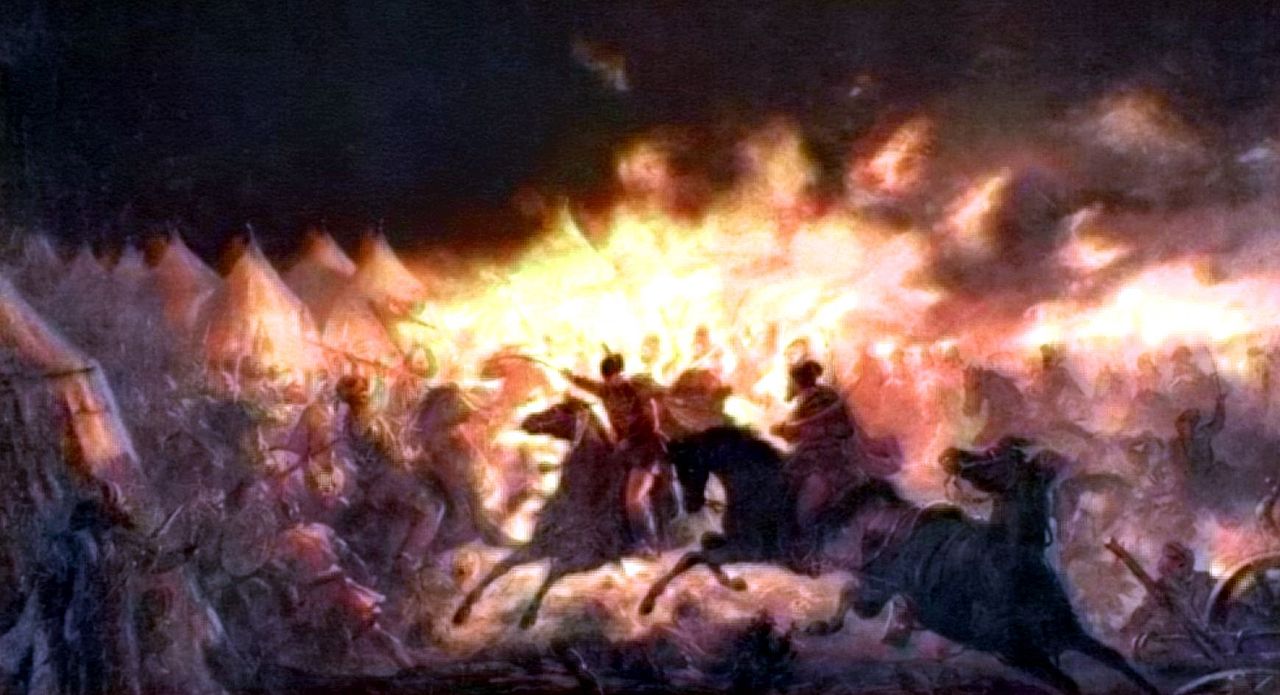
The Valashsky Prince Vlad III was the year when the Ottoman troops occupied his country. In order to preserve the world, his father was forced to support the policy of the sultans, delivered recruits to the court, regularly paid tribute and even sent his sons to Turkey - Rada and Vlad. Both spent about ten years in Edirne , where the main residence of the Sultan was then. Vlad lived along with the crown princes in a harem, the female half of the palace, studied literacy, learned Arabic, Persian, Turkish, Islamic theology, owned weapons, became unsurpassed in battle. Being medium height, he was distinguished by great physical strength. Turkish historians claim that Vlad Dracula had his own Janissaries, who guarded him in battle.
As for the Rada, his Turks were nicknamed “Yakyshykly” - “handsome”. This nickname was supposedly given by Sultan Mehmed Fatih , the future conqueror of Constantinople. According to the records of Byzantine historians, the friendship of Radu and the Sultan took on an intimate character. Mehmed considered Radu to be his “secret weapon” against the Christian world. Radu was supposed to become the governor of the Wallachia. Unlike his brother, Vlad was ugly - with bulging eyes and a long nose. The Turks already noted his unusual cruelty. During his stay at the Sultan court, he allegedly admired the smell of smoke that walked from the criminal’s body burning in the fire during a public execution. Says historian Mehmed Tarkan :
The unfortunate people writhed on the cola for many days until death stopped suffering. It was this execution that Dracula was especially fond of
- Human rumor and historical evidence did not exaggerate his cruelty. Vlad was nicknamed the Tepes, that is, the “priest”, “fangusman on the stake”. It was a medieval torture that was invented in the Ottoman Empire. The stake was driven into the body of the lying victim with the blows of the hammer or planted on a motionlessly fixed tip of the convicted person, tied to the legs to the harness of horses. The tip of the stake came out from under the shoulder blade, without piercing along the path of vital organs. The unfortunate was writhe in the cola, closed into the ground for many days, until death stopped suffering. It was this execution that Dracula especially loved. In this way, he killed tens of thousands of people - captured Turks, Christians, pilgrims, his compatriots. On the one hand, he committed heroic acts, fought for the independence of his homeland, on the other - he was a tyrant and a killer. Even in the Ottoman Empire, which was not distinguished by the softness of morals, they were amazed at how ease he destroyed people.
Among the Turkish historians there is an improper point of view that the Valash prince betrayed the Sultan, opposing him, despite the fact that he himself spent about ten years at the Turkish court, was showered with gifts and merits. In Turkey, it is believed that until some point Dracula led a double game, but then decided to follow in the footsteps of his father, who was in the Knight's Order of the Dragon (hence his nickname), which defended Christians from the Ottoman yoke. The main sobering factor for Vlad allegedly was the fall of Byzantium under the blows of the Ottomans and the realization that the Turks were increasingly moving towards Europe, threatening the existence of the Christian world.
The Istanbul historian, teacher of the Lyceum Osman Kurtuglu, says that in those distant years, the Wallachia turned out to be something like a buffer zone between the Balkans conquered by the troops of the Sultan, and the free part of Christian Europe. Most of Vlad Gloro's life took place in battles with the Ottoman conquerors and in the internecine struggle for power. During the hostilities, his family died, his father was killed, one of the brothers was burned alive at the stake, his wife died tragically. He himself, according to one version, gave the Sultan to the people of his own environment. In medieval Europe there were many cruel and brave rulers, but the posthumous reputation of Dracula in many ways does not know equal - and not only thanks to Stoker’s novel and his adaptations that followed in the twentieth century. Says a historical student Aydin :
- In Turkey, the image of Dracula is popular among young people, although in Islamic culture there is no idea of vampires. Dracula, nevertheless, is a representative of the dark world. His image in the form of a dragon is one of the tattoos popular among teenagers. However, who was Dracula - a hero, a tyrant, a traitor or an enemy - many here are still asking this question.
They also ask them in Hollywood, because the story of the Dracula, genuine or fictional, is excellent material for the blockbuster. But not all versions of this story, as it turns out, to the liking of the audience -, in any case, Turkish.
Protest shares in the country were called the new film “Dracula Untold” , shot by Hollywood director Geri Shor.
The main character, Vlad Tepes ( Luke Evans ) is trying to stop the Ottoman army and goes to the vampire for help. Getting unprecedented power, Vlad kills the Turkish Sultan Mehmed II Fatiha. A that free interpretation of historical facts outraged many in Turkey. As you know, the Sultan Mehmed, the conqueror of Constantinople, ruled for many years and died of serious illness in 1481.
Nationalist parties and youth organizations called on the Turks to boycott the film about Dracula, saying that the film not only does not correspond to reality, but also shows Islam, inciting religious hatred. Says Turkish critic Oktai Volcano :
- Vlad III and Sultan Mehmet Fatikh were the same. They knew each other well, and got a good education at that time. However, in the film, Dracula says that the name of the Sultan Mehmed will erase from the face of the earth. The Turks are presented in the picture as an evil force, and Mehmed Fatih himself is depicted by a cruel tyrant, which for the sake of gold is ready for anything. At the same time, the Sultan actually had a great mind, contributed to the development of science and military affairs.
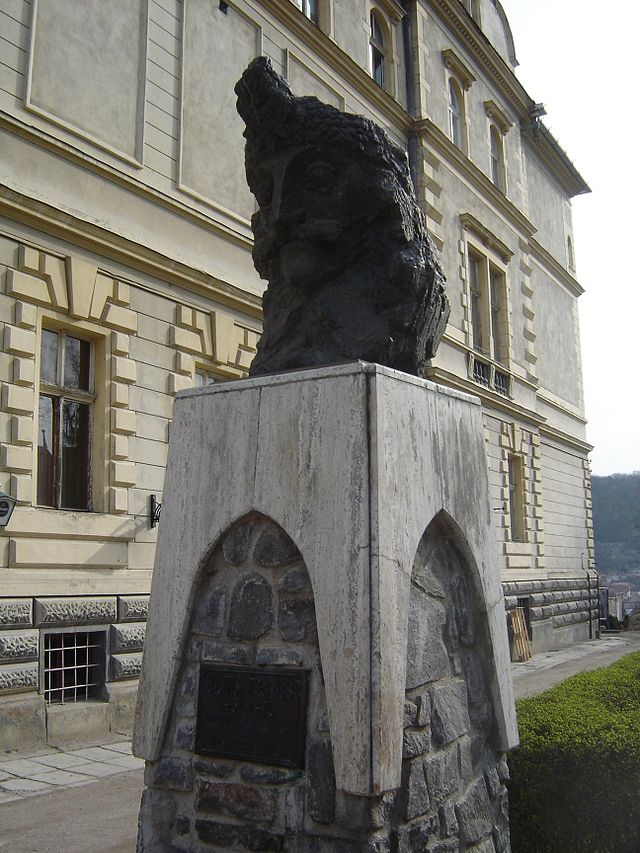
Oktay Volcano in the Radical newspaper calls on to conduct historical discussions, but not to incite hatred. In his opinion, “Europeans should admit that in those distant years the Ottoman Empire was the most developed state and carried a progressive culture to the West. Europe, however, still cannot come to terms with the fact that the Ottoman troops once won half the world, and do not want to show the events of the past in an objective light. ” The critic believes that at the same time, Dracula himself in his perception by Western culture became an outcast:
- The film is distorted by historical reality. Vlad III, on the one hand, is presented as a hero, although he was one of the greatest tyrants in history, an exceptionally cruel ruler. At the same time, Vlad turned out to be one of the few who dared to fight against the omnipotent Sultan. It turns out that he actually saved part of Europe from the Ottoman invasion, but he went down in history under the terrible nickname Tepes - “planting on a stake”. Europeans did not accept their defender, because they could not justify his cruelty and anger. So the Dracula was stuck between the Islamic and Christian worlds and became the embodiment of evil, ”says Oktai Vulcan.
Despite the calls for the boycott, last month the film "Dracula" was watched by more than a million Turks. It is approved by the UN and is demonstrated in two hundred countries of the world. And the line between Vlad Dracula as a historical figure and the character of pop culture is being erased more and more-to complete indistinguishability.