
Translated material
Colta.ru
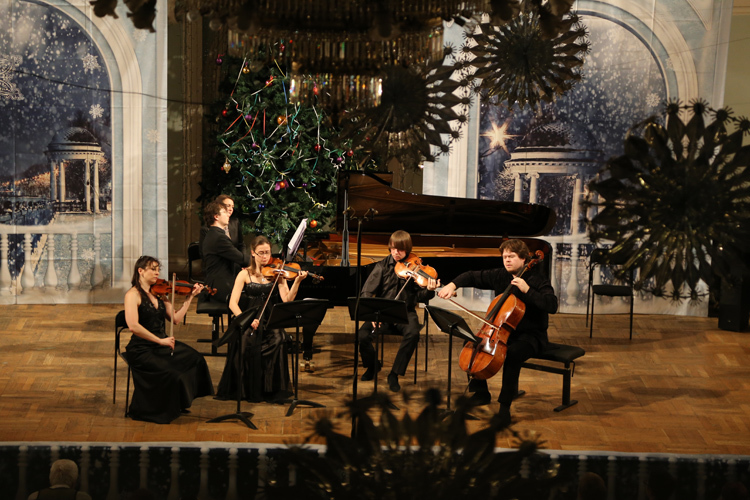
One of the strictly withstanding the rules of the Festival “Return” , held in Moscow for the 18th time under the unchanged leadership of the violinist of Roman Mintz and Goboist Dmitry Bulgakov, can not be repeated, you cannot play music that was played in the programs of previous years. You always need something new. It would seem that such a simple rule, everyone would like to take it into service. And how powerfully it works, spurks, holds in good shape.
“Return” is always not only a text, but also a context, these are steps at once in all directions from the gold repertoire of chamber music, it is air, freedom, curiosity, a disregard for the prevailing hierarchies and a complete disrespect for “only the best and tested time”. Here are the unhealthy things of textbook classics, and the compositions extracted from the non -existence of the authors of the third row, and the newly composed music, live and disheveled, neo -fraudulent with reference recordings. Delny, in human language, the written information about it is mixed in a booklet with between the "part -piece jokes, traditionally reaching the climax in the list of thanks on the last page (my favorite character of this year, who received thanks from the festival, Ya. Shandryapusel).
 © Irina Shymchak
As always, the festival took place at four in the evening, on the occasion of the repair of the Small Hall of the Conservatory, returning to Rachmaninovsky, where it began 18 years ago. The most fun program turned out to be the third, about suicide. It was called the “Werther effect”, next to its main number - Brahmsovsky third quartet (Ekaterina Apekysheva, Roman Mintz, Timur Yakubov and a young debutant, cellist Anastasia Kobekina), associated with the hero of the Gethev romance and his fashion for suicide, was a selection of Russian brutal romances on the same topic. Listening to the prosecutor, hanging over a fresh grave of his man's dried son, the hall choked with laughter. A bold jump in the most lower layers of musical art, and even with home optionally reproduced by the folk voices of the ensemble Dmitry Pokrovsky, seemed even more reckless when looking at the English participants of the same program - Counterpheries William Tauers and Soprano Anna Dannis, sophisticated sad songs of the XVII century under the accompaniment of the lurest Dmitry Illarionov, sat on the windowsill among the audience, opening their mouths.
 © Irina Shymchak
The masterpiece of intellectual programming was the first concert called Shostakovich. From Shostakovich, only the archive record of the song “Homeland hears” - the final cuckoo, which, in my opinion, was somewhat contradicted somewhat mighty shadow of the composer, which grew up against the backdrop of this evening, one way or another with him, with him, sounded. But the selection and structure of the program, where the works of Ustvulskaya, Weinberg, Shnitka, Malera, Sviridov and Denisov glorified the preludes and fugues of Bach, were outstanding.
It is no secret that the most beloved moments for the faithful festival audience-when the tops will gather in as many as possible and something like that. One of these climaxes was the piano quintet Metner on the second festival day, the works in which were grouped around the topic "Temocrats". The languid scouring from the Silver Age performed a hot ensemble consisting of Alexander Kobrin, Alena Baeva, Asi Sorshneva, Timur Yakubov and Evgeny Rumyantsev. Well, in a series of delicacies of the final, always the most English “concert at the request”, which began with the meditative play by the young Bulgarian composer of Tabakova's Dobakova “ Spinning a Yarn ” For a violin and a wheeled lyre (on both instruments he played Roman Mintz - alive and from a video screen) and ending the crowded thoughtful composition of Giya Kancheli under the actual name“ War of meaningless ”, one could still find a lot of things. And the perfumery products of Saint-Sansa-a septtee with the solo pipe of Vladislav Lavrik. And the charming sextet for the winds and piano of the half-forgotten Dutch-Jewish composer Leo Smith who died in the gas chamber. And the brutal “march” of modern American David Lang for a powerful composition with the participation of a shock installation and electric guitar.
 © Irina Shymchak
The Return festival, albeit listed as a subscription of the Moscow Philharmonic, but retaining proud independence, this year for the first time involved crowdfunding for collecting its small budget (they do not pay fees on it) and, over the years without giving up a youthful drive, is becoming an increasingly significant and unique island of real musical life. In the ingenuity of programming today, perhaps, he has only one competitor - Vladimir Yurovsky. And the niche firmly occupied by him, where intra -limit prestige, club refinement and relations with his years brought up by the public are equally important, makes us recall the legend of the “December evenings”.