
Translated material
Case from practice
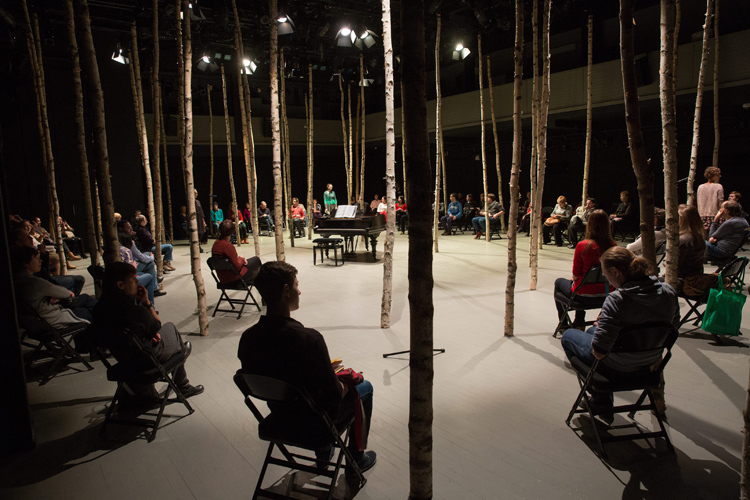
Dmitry Volkostrelov works a lot. At different sites. Or it seems so. The time has come to go to someone else, based on its previous practice, territory. Or-I heard something about this-a “Russian romance” (for some reason in a pretentious one for a minimalist) on the stage of the theater of nations was a decisive response to the ordered work “according to Russian classics”. In this case, the order in this case is deprived of evaluative connotations.
One way or another, but the contradiction, conceived in the dramaturgy of this “non -vocal evening and not a concert” (the words of the director), gave rise to his dramatic conflict and features.
The border experiment about the myth of Russian romance allowed Volkostroelova, artist Ksenia Potrukhina, composer Dmitry Vlasik, actresses (Alena Bondarchuk, Tatyana Volkova, Inna Sukhoretskaya, Maria Shashleva) to work in the field of theory/practice. But also in the transition register of subjects/object relations, which the director marks in the roles of the performers of romances and in the prologue to enter into an unusual and inviting image for them. These relations of wolfers also stimulates, representing the “non -concert” to its public, seduced by the Aphesh name. Only critics can not attend all the performances.
The reflexivity inherent in the thinking of this director entered into a dialogue with a mass cult (I omit the apology or criticism of the romance). The mass culture here was supposed to change its context. Or beat it - and in the opposite sense of the word. The notorious (for) sincerity, it is the tonality of this “non -vocal evening”, inherits not a very long trend of the “new sincerity”, which mobilized the detachments of contemporary artists - and exhausted.
“Russian romance” is a performive action of post -conceptualists, an asymmetric attempt to “return to the zone of intimacy, trust in which there were romances” (the words of the director). Thus, the process of consolidating intimacy - life and exhausting - turned out to be associated with criticism of the public, organized in space, dotted with birch. In the "Grove" with the piano.
Perhaps the study of the status of the viewer and his critical mass is the most interesting in this non -minical art of the romance. The critical message, which is indispensable in the practice of actual artists, is aimed in in this case not at the “art of the romance”, which would be stupid or vulgarity, which other snobs are charged with romances. This criticism arises simultaneously in the desire and vain precaution of the notorious intimacy, which today is not very clear what it means and how to serve it - not to mention how to excite it, initiate. Moreover, it is the property of a romantic genre, which the authors of the performance swung.
Precaution, courage and embarrassment gives the director’s text in the program for the performance, which does not need, it would seem, in the comments - unlike other opus Volkostroelov. Having abandoned the “lectures”, an accompanying speech to his non -performance (by the general standards of the theater mainstream) experiences, Volkrostradov could not restrain himself here and told about the romance compressed to several minutes of life, which is experienced in the “rich genre” .
But the matter, of course, is not in the romance. More precisely, not only in it. The excitement, as I understand it, was to try out conceptual vaccinations - and they could also concern the “art of experience” - based on the material of the mass poult. Turn or comprehend its archetypes as stereotypes. That is, something of the most essential and generic, and not just genre-and lost in his dereflexive status. A difficult task.
Wolferships approached, despite a number of removations, to the median sphere of art, which he had previously opposed.
In the new wolf -wolf stake, it continues to sort through the options for germination (post) of conceptual art in the minds of the public. He undermines the stereotypes of perception in order to palpate the very stereotypical intimacy, which - actors who are not suspected in musical skill, and the audience who looked into the theater of nations from the concert “Romance Romance”, can or cannot be capable of this risk.
Before deciding to sang actresses, the director takes them on stage in jeans, dresses, skirts. They read fragments of texts of different romances as letters from the past, from a grandmother's chest. But at the same time, from ourselves, from our time - by intonation, the plastic of speech. “Serial” on the current rumor (if it is not immersed in the context of a special visit to the “Guardian of Antiquities”), the passion characteristic of romances, in such an unexpressive reading, are alienated from themselves. Ride from a sonor context. Young actresses, set by a microphone among birch, in an imitation environment, prepare themselves and the audience precisely what for the home - and in this sense really intimate, not for the public - a performance. Then they change into historical costumes, accordingly change their hairstyles, stand with their backs to the pianist and sing, fixing their eyes to the public. They peer, as they say, in her soul, provoking - naively and frankly - "spiritual communication." Without irony, but also without salon - no matter how it relate to it - abdomen.
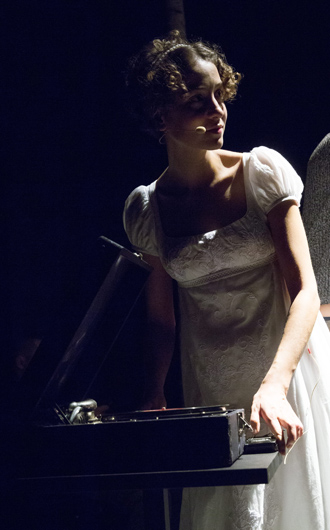 © Alexander Ivanishin
Contact with the romance and the public, as they say, is thematized, but not allowed. This is honest. Moreover, in the final, the director launches fragments of old records, connecting young actresses on a small scene to a lot of time. Volkostrokov inserts into the performance a novel about the fourth performer, whose voice we hear, but we do not see her. Thus, he straightforwardly declares the minor presence of the soul/spirit of the romance, which makes where he wants.
Another Tour de Force was committed by Dmitry Volkostrelov along with Dmitry Vlasik, who wrote a musical text, perpendicular to romance classics. The pianist extracts sounds from the strings of the piano, bypassing the keys, “transforming” this instrument into the likeness (echo) of the guitar or harp, who did not have romance performers, but to modern musical speech.
In the epilogue on the tablet of the scenes from the grates, as if from the other world, they collapse, exactly like in the Norztenovsky “fairy tale”, letters. On envelopes - an address with the name of the performance. Inside - the manuscript text of the romances "as a keepsake". Transistoric excursion ended.
The extraordinary performance of Volkostroelov-in contrast to his “NOT performances” in the texts of Pavel Pryzhko-if desired, can be built into the tradition of extraterritoriality, which Adorno wrote about: “ ... extraterritoriality in relation to the concepts of culture ... Apparently, this is based on the sympathy between the avant-garde and the Music Hall or the Varry, thanks to this, the closeness of the extremal ones occurs. manifestations of art in their confrontation between the middle sphere of art . ” But the author of the “aesthetic theory” charges the mid -art sphere of art, the image of the inner world, “ which, thanks to its similarity, its proximity with culture, discovers what the art should be, what are its tasks and responsibilities . ”
Wolferships approached, despite a number of removations, to the median sphere of art, which he had previously opposed. However, the opposition of art has been able to, developing his thought Adorno, " exclusively thanks to identification with what it is rebelled against . "
The Russian Romance is a case from the practice of the director - he recorded this unresolved and significant conflict.