
Translated material
Traces on the body
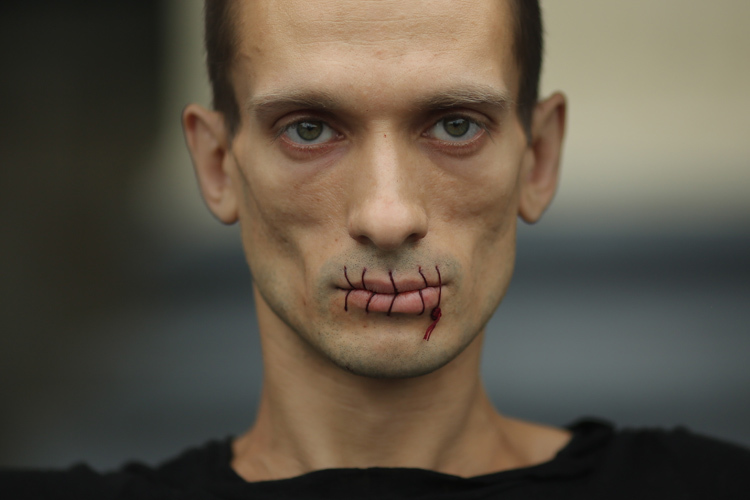
It seems that there is some general agreement regarding the shares of Peter Pavlensky . “Everything is clear here,” says Igor Gulin. “An example of the intelligibility and conciseness of political art,” says Dmitry Volchek. “We all feel like that - as if our eggs are nailed with a carnation to Red Square,” summarizes Elena Kostylev. Immediately, however, there is a desire to ask a simple question: who are these “we”? Is such a generalization true to the entire population of the country? Most likely, not: workers and housewives from depressed regions did not occur to me to complain that it was in the last three years that they took the opportunity to move and speak. Long before the establishment of the Putin autocracy, all this did Russian capitalism with them, which recorded them - with a nominal abundance of freedoms - in the position of actual serfs.
Immediately, however, there is a desire to ask a simple question: who are these “we”?
With the Message of Pavlensky, the liberal intelligentsia, the class of educated and relatively wealthy people, painfully experiencing “twisting of the nuts” and a conservative rollback to the right, is more likely. In other words, upon closer examination, the illusion of universality (“we are all”) turns into the particularity and interest of a well -defined social group. Only the liberal intellectual after 2012 really feels a lot of new restrictions, (in his opinion) metaphorically depicted by Pavlensky in the form of barbed wire on the body, a seam on the lips, a nail in a scrotum. What conclusions can be drawn from this situation? That the artist Pavlensky, being a product of the same liberal environment, does not know how to overcome the inertia of Gabitus, go beyond its framework and, therefore, remains doomed to manifest the desires and fears of only a small social group? Or, conversely, that the class of liberal intelligentsia acts as a usurper, monopolizing the right to interpret Pavlensky’s actions and using this monopoly in its own political interests? Whatever the answer, it obviously reduces the radical potential of famous actions, and therefore we need to change, say, a class context: to think about what the artist’s work may mean for a separate social stratum, but for the whole “world of hungry and slaves” of modern Russia.
The emphasis itself on the suffering flesh, which the predecessors loved so much, is perceived today without proper affect and must be left.
If we want to see a certain universal dimension behind the shares of Pavlensky, then it will probably be useful to pay attention to their fundamental democracy, which manifests itself in a conscious refusal of originality ( “there was no task to surprise someone, come up with something unusual” ), and in addressing the widely known practices of prisoners (sewing up the mouth, pinching of the scrotum), and in the use of the simplest mechanisms of exposure (identification of the viewer with the shareholder). At the same time, one should abandon the temptation to integrate Pavlensky in the old tradition of working with a body, the brightest manifestation of which was the shares of Alexander Brener, Oleg Kulik, Oleg Mavromatti in Russia. Not only is the most advantage of the existential problems of Moscow actionism is not very close to Pavlensky - the emphasis itself on the suffering flesh, which the predecessors loved so much, is perceived today without proper affect and should be left. Perhaps more productive will be the displacement of interest from a medium (body) by (also very democratic) means of production involved in shares. What is a hammer, threads, a nail, a needle, a wire, a knife? Simple utilitarian things, tools of traditional labor, technical equipment of hired workers like a seamstress, carpenter, a carpenter or butcher. The strongest rhetorical figure used by Pavlensky is the figure of silence about these things. In fact: with a very wide mass-media illumination of shares, most of the listed tools always remain in them behind the scenes. Accordingly, behind the frame, the work produced using these tools remains. Few saw how Pavlensky sews his mouth for himself, pinchs the scrotum with a nail, is wrapped in a prickly wire. On each action (with the exception of the “separation” ), the audience was presented only by the result, the final result, the finished product obtained in the process of painful exposure to instruments (hammer, needle, wire) on the material (body). No wonder the emphasized statue, the plastic expressiveness of the figure of Pavlensky was repeatedly noted; Before us is really not a action and not a performance-but, rather, a semblance of a living sculpture, which is passionate about to say something.
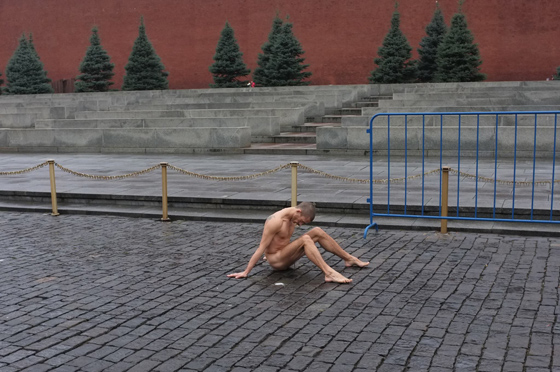
Isn't it the key to the desired universalism, clearly flickering in the artist? Hiding the process of labor for the screen, Pavlensky shows us only marks, terrible and shocking traces left by labor activity on each person. “No, the worker is no longer a person, not even a man or woman: he has his own, special floor - labor intending him for a specific purpose; It is marked with it as a woman is marked by her gender (with his sexual characteristic), as a black man is marked with the color of her skin: they are also signs, nothing but signs ”( Jean Bodriyar ). Perhaps this is how we should understand the artist’s project - how to emphasize the terrible ability of labor to disfigure and cripple (simply to note) people daily? A workshop, a factory, a factory, a workshop - being here is inevitably connected with suffering: to sew, saw, cut, drill, steal, bother and always have to end up in their own flesh.
The shares of Pavlensky are indispensable no more than corns on the hands of a locksmith or a tan on the face of a laborer, and his whole body is only a collection of tags left by tools in the process of work.
A nightmare of labor on a once -beautiful body: this is what he reads in the shares of the Pavlensky blind seamstress, a wandering mill, a dry -horned electrician, a crippled trucker, a stoker hugging coal black - millions of nameless proletarians, on whose operation world capitalism is based in all its splendor and splendor. And here is the answer to any conservative critics who condemn the artist for violating public decency: the shares of Pavlensky are obscene no more than the corns on the hands of a locksmith or a tan on the face of the laborer, and his whole body is only a collection of tags left by tools in the process of work: from quickly overgrown hoes on the lips through a dangerous hematoma to the cut to the cut ear, they become everything. Radical, more fatal. Like any hired worker, the artist for life stigmatizes himself with his own labor activity, perceived by him as ugliness, burden and pain. And here is an unpleasant question: are the obvious beneficiaries of the world order, creative and talented intelligentsia, immersed in the inalienated creation and self -realization, happily living with a paradoxical “communism of capitalism” , as Paolo Virino calls it?
Which, however, makes Pavlensky truly modern is the fundamental diversity, intermittence and short-term labor of his labor. It is no secret that the industrial era with its monotonous and continuous production has long been a thing of the past; Neoliberalism triumphantly walking on the planet relies on flexible employment and rejection of any guarantees of hired power, turning the traditional proletarian into a representative of the new social stratum, called the Precariast. Being (after all!) One of the most precise indicators of Zeitgeist , world Contemporary ART inevitably reacts to this neoliberal trend: in the past half a century, artists have been demiurges (Yves Klein), shamans (Joseph Boys), businessmen (Andy Warhol), Judicials (Alexander Brener), special forces (the “war group”) - now they are increasingly starting to feel like precaries. And what if it is the body of Prekariya, constantly disgusted and marked by temporary labor, tries to demonstrate Pavlensky in his shares? No museums, no galleries, no guarantees, no constancy. To sew something somewhere, to beat something somewhere, to cut something somewhere, to lose a small bit of health on this, to get a small fraction of a universal equivalent for this-and again in a whirlpool of poverty, silence, obscurity.
Before us is not at all liberal discontent with a specific tyrant, aging an ineffective manager who is enough to change so that everything becomes “normal”.
Before us is a universal matrix who increasingly determines the lifestyle (survival) of students and pensioners, disabled and convicted, migrants and women around the world, the effect and strategy in which transnational capitalism builds their dominance. The thematization, emphasis, pronouncing this state of affairs inevitably entails criticism of modern world order - and therefore we can really talk about “political activism” performed by Pavlensky. The focus is that this “politics” should be interpreted as broadly as possible: we are not at all liberal dissatisfaction with a specific tyrant, aging an ineffective manager who is enough to change so that everything becomes “normal”, but a serious reflection on the very foundations of the capitalist system, over its deep perversion, when many millions of people are disusable for the sake of an insourful handful for an insourful handful beneficiaries.
So, under the colorful surface of universal consumerism, under the layers of signs of luxurious life, the monster tosses and breathes heavily - the forced labor of millions of workers who are not protected pre -security, which, which, which are considered to be considered a monoton to show. Bashlessly hidden, ordered, forbidden, this work makes itself felt only through a series of nightmare signs: scars, burns, stumps, crutches, nervous tick, deaf cough. Making his flesh with a haven for such signs, Pavlensky boldly demonstrates us swayed by world capitalism. Having come to this item, the most important thing is not to leave the universal space found, not to believe the later Kremlin rhetoric “confrontation to the West”: after all, Putin's state -core is only one (albeit disgusting) from many heads of neoliberal logic, insisting on curtailing social obligations and total pre -coordination of the population. Thus, representing in his shares the mutilated body of the Russian Prekariya, Pavlensky actually fights with the regime - but just as much as he fights with the capitalist system as a whole. And, it seems, only being considered in such a frame, the figure of Pavlensky can appear truly large, and his shares, having left the unenviable role (slightly scandalous) of art therapy for a politically frustrated intelligentsia, is a truly radical call for action. This call is inscribed in the artist’s body, which fell after the “seam” and “carcasses” on the pages of glossy magazines and in the lenses of television cameras; Dozelia from there to the viewer, it seems to be an evil parody of the liberal idea of Self - Made Man - after all, Pavlensky literally “made” himself (with the help of instruments like a knife and a hammer) himself famous! Alas, this idea has never worked - some in a capitalist society work hard, and others are assigned material and symbolic profit. The St. Petersburg artist, however, manages to combine both positions; And therefore, perhaps the main injury, thematized on the surface of his body, is not a specific cut or hematoma at all, but the class split of Par Excellence .