
Translated material
The goal is capturing funds
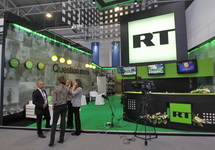
The new edition of the Information Society program developed by the Ministry of Communications provides for an increase in the budget financing of the media by 44.7 billion rubles, RBC reports . Of these, 23 billion in 2015-2017 will receive the Russia Today TV channel and the Russia Today news agency.
An increase in financing is due to government decisions to support the measures of Rospechat in the field of the media, the Ministry of Communications notes. The main part of the additional financing, the department intends to direct to "the expansion of Russia's participation in international information exchange." At the same time, the goals have been declared "ensuring the protection of the national interests of Russia in the information sphere, international cooperation in the media and the formation of an objective image of Russia abroad."
RT has the task in 2015 to increase the audience to 640 million people against 630 in the old version of the Information Society program. Further, the annual progressive growth of the audience is assumed, despite the fact that the old version provided for its reduction. In total, by 2020, the number of RT spectators should reach 700 million.
For IA "Russia Today", standards for the citation of its materials in foreign media are established. Already in 2015, this indicator is supposed to be almost doubled. In addition, the agency should ensure a constant increase in broadcasting on the air of foreign partnerships. In 2015, it should be 135 hours a day against 94 hours in 2014, and by 2020 to reach 166 hours.
On December 9, 2013, President Vladimir Putin ordered the liquidation of RIA Novosti and create an agency "Russia Today" on its basis. He also eliminated the radio station "Voice of Russia", and transferred all the property of both media to the newly formed agency.
On January 9, Lithuanian, Denmark, Denmark and Estonia Foreign Ministers Linas Linkyavici, Philip Hammond, Martin Ledehaard and Kate Pentus-Rosimann said that the European Commission should develop a plan for counteracting Russian propaganda . The ministers warned that "Russia quickly expands its campaign for misinformation and propaganda" in order to support "the political and military goals of the Russian government."
In a letter addressed to the head of the foreign policy department of the European Union Federica Mogherini, the ministers called for "a reliable and competitive information alternative to Russian -speaking residents and those who use the media controlled by the Russian state."