
Translated material
"Grad" among the clear sky
The passenger bus, following the Zlatoustovka-Donetsk route, fell under the artillery shelling at the Ukrainian block, near the city of Volnovakha in the Donetsk region. The tragedy claimed 12 human lives
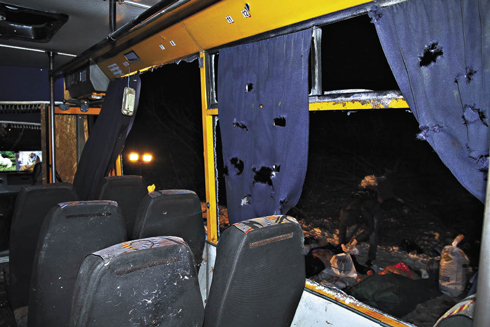
Bus salon, which fell under the shelling of a checkpoint near Volnovakha on January 13, 2015, Ukraine, Donetsk region
It happened on January 13th. Judging by the first testimonies of the victims published on the network and reports of OSCE observers, the bus moved from the Volnovakha towards Donetsk, stopped at the checkpoint for verification, but after ten minutes the shelling began. In the video from the scene that appeared on the Internet the very next day after the tragedy, the bus parked on the side of the road really stands at the place where the documents usually take place. According to the OSCE, at about 14:30 one of the Grad shells fell approximately 12 meters from the bus. Ten ten people died on the spot from the fragments, the two more died in the Volnovakha hospital, where 18 victims were delivered in total. As the doctors of the district hospital told NT, three have already been discharged.
Immediately after the tragedy, both sides of the armed conflict accused each other of what happened: according to the Ukrainian side, shots at the block-post were made from Dokuchaevsk, engaged in militias; The DPR insists that shelling is a provocation from the Ukrainian military. However, the DPR Prosecutor General NT reported that they have not yet had information about the details of the incident.
The Ukrainian prosecutor’s office of the Donetsk region, temporarily located in Mariupol, was inaccessible to comment, but a press release was published on its official website, in which all the wine is entrusted to the militants and it is said about the aiming fire of the “terrorists”, “released more than 40 shells”. 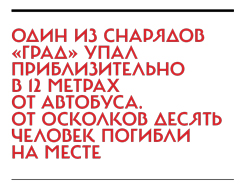
In an interview with NT correspondent, representatives of the OSCE monitoring group, who visited the place of the tragedy just three hours after shelling, refused to evaluate the scale of destruction at the checkpoint (checkpoint) in Volnovakha. At the same time, they confirmed: the bus is really damaged by the shelling by Grads. According to them, a mixed commission has already been created to investigate the incident, which included representatives of Ukraine, Russia and the DPR.
In mid-December, a month before the incident, the NT correspondent drove through this block post near Volnovakha. The former traffic police post converted under the checkpoint, where the fighters of the Ukrainian battalion Kyiv-2 were located, is a brick building, next to it are somewhat folded from bags of sandy fortifications blocking the movement along the highway and a couple of everyday life. Along the side of the signs: "Caution, mines!" To cross the block-post by bus, male passengers need to leave the salon and present documents. Women, as a rule, are left in the cabin. However, most travelers are usually women, so checking documents does not take much time.
The Volnovakha highway is one of the most popular routes connecting the territory of the DPR with the "large land". In particular, all flights along the Donetsk-Mariupol route are going through Volnovakha (there is a separate “branch” for the gold-water resistance from this highway)-dozens of passenger buses pass here daily. Residents of the capital of Donbass go to neighboring regions to withdraw money from plastic cards, get pensions or meet relatives. But from the "Ukrainian" he sat in Donetsk, according to the chief physician of the Volnovakh district hospital, Alexander Bezugloy, on the contrary, they go for medical help: in the capital of Donbass there are still diagnostic centers with equipment that are not in areas that are controlled by the Ukrainian military. And whoever was fired at, he could not help but know that the block-post near the Volnovakha was part of one of the most lively humanitarian corridors in the war zone.
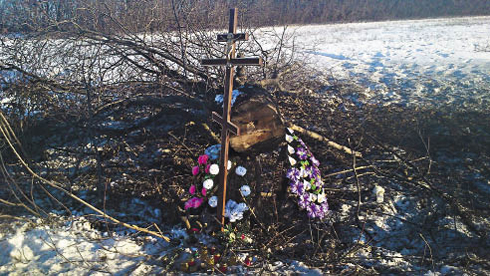
A wooden cross established by the fighters of the Ukrainian detachment at the site of the tragedy, Donetsk region, January 14, 2015
Photo: Alexander Gayuk/AFP, from the page on the Facebook of the Kyiv-2 special purpose battalion