
Translated material
The price of no return
How to live at a price of oil $ 40 per barrel? Simple answer: NO. Although the scenarios of this "in no way" are also different
In case of oil quotes at $ 40 per barrel, preserving the old model of the Russian economy, apparently, is impossible technically. What time will it take for the wick of the economic bomb to burn out and how exactly this bomb explodes - you can only find out experimentally. How the current Russian economic model behaves, finding himself in the realities of a ten -year ago, no one also knows: such a question has never been posed to anyone in the world.
Forecasts ... a weak ruble (as much as 50 per dollar!), Reducing investments on non-astatic 4 %, a year of zero growth of GDP and salaries-as of December 31, 2014, all the alleged economic consequences of the year, in which Russia initiated an armed conflict in Europe, fell under full-fledged foreign trade and political sanctions and began the transition to a limited political and political and political sanctions and the beginning Economic Autarchy.
There was no anxiety about this in the Kremlin and the White House. In the summer of 2014, at economic meetings, Vladimir Putin considered forecasts of the Central Bank if the price of Brent oil in 2015 drops to $ 60 for a barrel (the so-called stress scenaries of the Central Bank), and even in this almost incredible case, the White House team believed, there is no reason to wait for the disaster. A week before the New Year at similar meetings, the group of finance Minister Anton Siluanova presented the budget correction strategy for 2015 if oil costs $ 60 per barrel. According to this scenario, the country's economy fell by 4 %, the reserve fund was devastated to the second half of 2016, inflation at 10 %. True, the Ministry of Finance thoughts, it would be necessary to reduce non-unified and non-social state expenses (the construction of new roads, applied research and subsidies to all state organization), but the nominal salaries of the population will remain at about the same level, and from 2016 they will even begin to grow.
Sources in the White House itself, however, argue that at the same time, one of the meetings was considered an absolutely incredible scenario - with Brent prices at $ 40 per barrel. But nothing constructive came out of this discussion - the ministers quickly came to the conclusion that the discussions about what color the sky would be in the Last Judgment are useless. $ 60 per barrel Brent, with which the world economy graduated in 2014, was considered a bottom below which the submarine still does not swim.

... And this is exactly what happened: in mid -January, oil cost about $ 45 per barrel. A miracle can still occur, but on one condition: if in the coming weeks oil prices will unfold and will grow six months at the same pace that they fell since July last year. Even immediately, now, in January, the bankruptcy of half of the new oil and supply parameters will change the parameters of supply and supply in the global oil market no earlier than six months later, and most likely one and a half. When oil prices fall from $ 60 to $ 50 in the United States, only 3.5 % of drilling rigs stopped working.
In the meantime, oil on the exchange costs $ 50, you should think about how to live at $ 40 oil price.
But no way.
The evaporation of reserves all government calculations were built on the fact that the country would be enough for the country for 2-3 years-during this time, the economy will be adapted to new conditions, import substitution will earn, and by 2017, even $ 60 per barrel will be, in general, not so terrible. The Gaidar Forum last week (January 14–16), which took place in an atmosphere of universal confusion, showed: at a price of oil of $ 40 for at least the first quarter of this year, it is simply dangerous to wait for improvement of the price situation. It is almost impossible to take money to cover the budget deficit in the external market (low rating and sanctions), for the internal cost of loans (when the Ministry of Finance goes there with loans of 2-3 trillion rubles a year) will grow to 25-30 % per annum and above-this will instantly launch the 1998 default script, and in the Central Bank and the Ministry of Finance. Therefore, in 2015, you will have to spend a reserve fund. It is now about 5 trillion rubles, in fact, this money has already been spent, like the FNB funds promised by Rosneft, Novateka, Russian Railways.
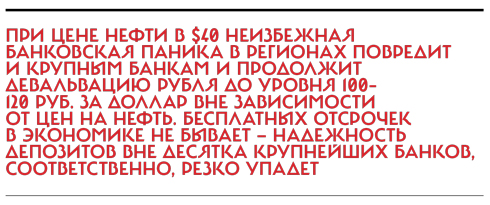
The most expensive problem is banks. At the end of 2014, the presidential administration expected that if oil would cost $ 60 per barrel, and the Bank of Russia policy would not change, then the license will be withdrawn from hundreds of small banks in the country. At the price of oil in $ 40, banking panic in the regions, which is inevitable with such a scale of hecatombe (tens of percent of the existing banking market, 10-15 % of banking capital), will damage the state of large banks and continue the devaluation of the ruble to the level of 100–120 rubles. per dollar, regardless of oil prices. There are no free deferrals in the economy - the reliability of deposits outside the ten largest banks, respectively, will drop sharply.
The Central Bank hoped to spend $ 60 about 1 trillion rubles on the pre -capitalization of the banking system of the Central Bank; With oil at $ 40 in the first half of 2015, it is extremely difficult to reliably estimate this amount: the head of Sberbank German Gref last week estimated the necessary amount at an additional 2 trillion rubles. Thus, 3 trillion rubles. For several years - this is what needs to be reserved for banking needs right now - it does not matter, from the budget or from the reserve fund, now this is the same thing.
The problem of the currency debt of companies, which was talked about the whole of 2014, is at $ 40 for the barrel already less significant than the problem of ruble debt. During 2015, Russian companies should pay off about $ 150 billion debt to external creditors. In the swimming of the ruble and the Central Bank reserves of $ 380 billion - the expenditure of the reserve fund and the part of the FNB will be accompanied by the sale of these currency assets, so their reduction to $ 200 billion is exaggerated. Refinancing of part of internal ruble debt in 2015 is a much more difficult task if you try to maintain inflation within the annual 10 %. Another 2-3 trillion rubles. The state will need to spend (or promise to spend in the form of state guarantees in one or two years) precisely on the salvation of private companies in a variety of ways.
In another situation, the State Bank would give money - the problem is that the resources of the state banks are exhausted. The private banking sector of the Russian Federation will not help either: in such an economy, it is super -rickety to lend everything at all. And the point is not in the high (17 %) key rate of the Central Bank (taking into account inflation in 2014 at 11 %, the real cost of refinancing is about 5-6 %)-it will almost certainly be reduced to 12-13 %. But even in this case, the reduction in lending for legal entities by 15–20 % already in the first quarter of 2015 is an extremely probable scenario at $ 40 per barrel. The result is a drop in investment in the economy by at least 10 %, and, most likely, more.
The budget itself at the price of oil of $ 50 per barrel is not available 3 trillion rubles. Revenues, the Minister of Finance Anton Siluanov said at the Gaidar forum. More than 2 trillion rubles. will require the salvation of companies and banks. Calculations at $ 40 per barrel - beyond the borders of the possible: leaving everything as it is, hoping for adaptation of the economy, will not work technically.
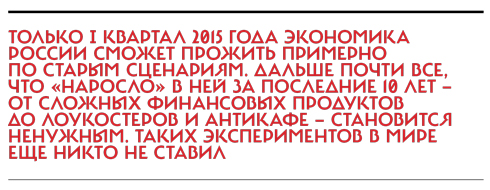
The fast road to nothing only I quarter of 2015 will be able to live and will live approximately according to the old scenarios at any current oil price. But in order to live this quarter, it is necessary to start the process of restructuring the economy to the level of development of 2003-2004 - almost everything that “sober up” in 10 years from that time - from complex financial products to low -cost airlines and anticafe - becomes unnecessary. Nobody has yet put such experiments in the world.
Given that just in 2015, Vladimir Putin began with grace with grace, the deofshorization campaign began, which will force a significant part of the major owners to finally choose between tax residency in Russia or in the West, in the coming months, we will see what no one has seen in the world: the 2015 sample with a large private sector, which is invested according to the 2004 standards, and mainly the state from the residues Nefteedollars. It is pointless to assume that power will make power in such a situation: there are no counting options. And any possible solution that will be implemented will change the nature of this power.
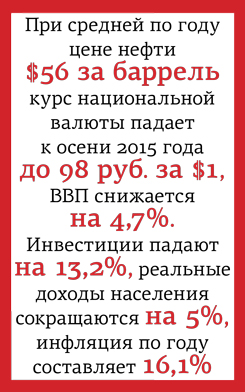
$ 60 per barrel of oil, which remains the most likely scenario for the development of the situation, is another matter. Of the calculations published today, the pessimistic version of the scenario of the most authoritative private analytical center working with the government is close to such indicators - the Center for macroeconomic analysis and short -term forecast (TsMAKP). Its basic introductory is a decrease in oil prices from $ 60 per barrel in the first quarter of 2015 to $ 48 per barrel in the III quarter with a rebound for the IV quarter to $ 55. On average, this gives the price of oil in $ 56 per barrel for the year. In this case, the course falls by the fall of 2015 to about 98 rubles. For $ 1, GDP decreases by 4.7 %for the year (due to moderate, 0.9 %, falls at the beginning of the year and a decrease in the last quarter of 2015 by 6.6 %). Investments in the year fall by 13.2 %, real incomes of the population are reduced by 5 %, inflation in the year is 16.1 %. In general, this is a picture - a tough crisis that is quite controlled by the government: it does not provide for any mass support of banks, nor large defaults for corporate obligations, and does not require a mass change of owners. This crisis is more serious than the previous one, but the economy was prepared better for it than seven years ago. During the year or two, goods and services that we are accustomed to in recent years will inexorably yield to more mundane things: cheap low-quality import substitution in all possible types.
One of the economists of Harvard University Kenneth Rogoff announced in Moscow: according to his express assessments, Russia after what is happening will take 6-7 years to restore pre-crisis indicators. From his further comments, it followed that he had in mind the script similar to the pessimistic calculations of the Central Department Store. However, today the forecast of the Central Department Store seems irrelevant - the trajectory of reducing oil prices is much cooler than the forecast, the recession of GDP in the first three quarters of 2015 is supposed to be deeper than in this forecast.
This is not to say that at $ 60 per barrel, nothing will change. The likelihood of "military mobilization" of the economy, the transition to inflationary financing of the expenses of the budget system, the return of the unconditioned ruble and the plurality of the course - all this is easily visible. But the liberalization of the economy under the flag of the creation of a “new entrepreneurial class”, which the government is talking about, is visible much worse. Such a plan would be possible - and, most likely, the government would launch it - with a moderate crisis. The whole question is how long we will be at the bottom of the oil pit. But if the crisis goes through a bad scenario (look above) - and despite the deceptive silence, we have already entered this scenario, then all sorts of calculations are inappropriate. As said for a completely different reason, "go and look."