
Translated material
Winter 2015
I do not want to see it ” - such a button authors of the news portal Meduza.io were hanged next to the daily changing numbers of the ruble exchange rate to the dollar and the euro at the cost of a barrel of oil. The former is non -notostable (on the eve of the New Year, $ 1 could be bought for 55 rubles, at the end of last week it was already at 65 rubles, € 1 - 75 rubles), but oil is spinning around 50 rubles. For a barrel with the promises of experts to fall even lower - to forty and even twenty dollars per barrel of black liquid. However, these are already shades of where we were.
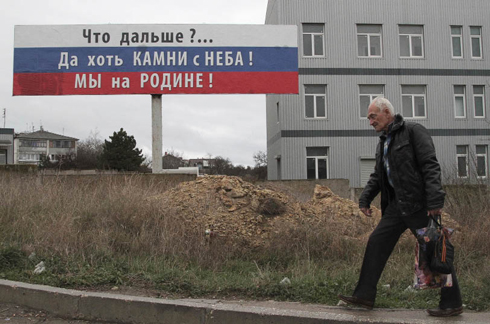
Crimea, Sevastopol, November 29, 2014.
In the New Year 2015, Russia is included with full -scale currency, financial, management, economic crisis. Opening prospects (more details - on page 28) are such that really - "I do not want to see it." The price tags in stores, as once in the now invariably woven nineties, rewrite every day. Official statistics do not have time for them, and the sly figure is again entering the circulation. Thanks to the grocery online stores that preserve the previous orders in the personal account-you can compare the prices of January 2014 by January of the current one: imported washing products went up by 26–29 %, relatives-by 13 %, canned tuna-by 63 %, sprots-by 44 %, vegetables-from 26 %(red onions)-up to 50 %(Cherry and Chesnok tomatoes). The mayonnaise and chicken breasts (for 5 rubles) fell in price, but they are "not available." And the reason for the increase in prices is by no means in weakening the ruble - this is the result of counter -sanctions, which economists warned: by punishing European and American manufacturers, they hit their own population with a butt.
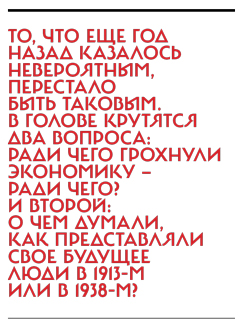
The swiftness of the collapse is fascinating: even in the spring it seemed-yes, stagnation, well, yes, the GDP in the coming years will balance around zero, back in the fall, in October-November, quite healthy economists convinced that the ruble was underestimated and by the end of the year the course would be around 35 rubles. for $ 1. “Black Tuesday” on December 16 became a shock: the bankers stopped giving any forecasts. The government de facto ceased to exist (about that on page 44), although the prime ministers and its ministers are still going to work on the Krasnopresnenskaya embankment. The president continues to believe that he still holds God by the beard, that the lost Fart, accompanying him all of his fifteen years in power, will return, the Saudis will not resist, the oil chill will be overwhelmed, the American slate will go bankrupt, the barrel will again grow over the Kremlin in an embrace with the two-headed Russian eagles, the sanctions are weak and fallen to a lot of money. He will cancel, the nightmare will end and he will be happy with Sechin. To tell yourself that the decisions of the annexation of Crimea and the unleashing of the Civil War in eastern Ukraine - it was a catastrophic mistake that adopted by him - personally - he could not. Because the next step behind this, if you think about the interests of the country,-“I am leaving, take care of Russia,” as Yeltsin once said, passing his power to him. In the democratic countries of the government, in such situations, early elections are announced-in our country, people in masks search the office of the Fund for Combating Corruption, who has been working for a long time to change their cabinets to something less comfortable. Ahead is the devastation of reserves, which can happen if not by the end of the year (and maybe by the end of the year, if catastrophic errors are multiplied, the economist Sergei Guriev believes - an interview with him on page 23), then by mid -2016, the impoverishment of not only the Russian province - there were already processes there (p. 28), but also of large cities. What - next? The war is all with everyone? Russian tanks in Europe? Nuclear war? Apocalyptic scenarios, so popular in the eighties of the last century, suddenly entered the discourse again. What seemed incredible a year ago ceased to be so. And two questions are spinning in my head: for what the economy was banging - for what? And the second: what did you think about, how did people imagine their future in 1913 or in 1938?
Photo: Pavel Rebrov/Reuters