
Translated material
Norman non -format
Why did not a four -sided summit in Ukraine - The New Times found out in Astana, Berlin and Moscow
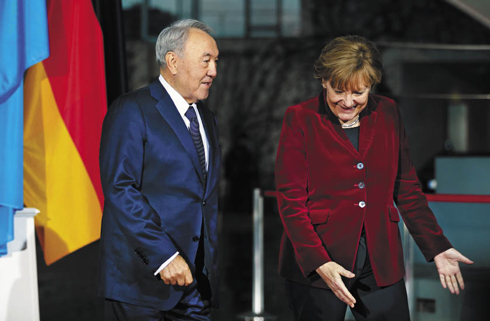
Nazarbayev made an attempt to persuade Merkel to come to Astana, Berlin, January 9 (photo: Hannibal Hanschke/Reuters) meeting at the highest level in Astana (Poroshenko, Putin, Merkel, Olland Plus Nazarbayev on the rights of the owner) was planned to be held on January 15. Putin and Poroshenko gave Nazarbayev a fundamental consent to participate in the summit even before the New Year. After that, Nazarbayev called Merkel and they agreed to continue preparing for a possible summit and meet in the near future - nothing more.
But Petro Poroshenko decided not to wait for the agreed decision of the meeting of Nazarbayev-Merkel and was the first to pronon to the Kazakhstan summit in the Norman format
* * For the first time, such a meeting was held in June last year in Normandy as part of celebrations on the occasion of the 70th anniversary of the landing there, and then in October in Milan. - At the end of December. And on January 10, it became clear that he was hurrying: on this day, Angela Merkel called Vladimir Putin and told him that it makes no sense to go to Kazakhstan until there would be “tangible progress” in the implementation of the Minsk agreements. And Berlin did not see progress primarily because after the New Year's lull in the southeast of Ukraine, clashes resumed, the most fierce-in the area of the Donetsk airport. In addition, according to rumors, Merkel asked Putin: can he name the approximate terms of withdrawal from the southeast of Ukraine of Russian military and weapons. The Chancellor did not receive a clear answer.
The mission in the rain January 9 Nursultan Nazarbayev suddenly arrives in Berlin. What is characteristic - with an unofficial visit. The German owners immediately referred to this feature of the protocol: they did not report anything about the program for the visit to reporters, there was no press conference. Only in television, did the frame flashed, as Frau Chancellor in a hurry to meet Nazarbayev, who was leaving in the rain in the rain.
Nevertheless, nevertheless: the Kazakh leader arrived in Berlin to personally persuade the Chancellor not to tear the summit, who promised Astana a lot of winning diplomatic glasses. But he had to leave the back - Frau Chancellor, apparently, was adamant. And even on the issue of cancellation of sanctions against Russia, Merkel’s position has not changed on Yota. In Berlin, they say that she directly told Nazarbayev: the EU will relieve sanctions only if the Minsk agreements are fully fulfilled.
On January 12 in Berlin, a meeting of the head of the Norman Four Foreign Ministry was held in Berlin, after which the head of the FRG Frank Frank-Walter Steinmeier actually confirmed the refusal of Angel Merkel to fly to Astana. “What is there to discuss if Donetsk is still full of Russian military,” NT told NT a diplomatic source in Berlin.
On the same day, Petro Poroshenko announced his readiness to provide the Donbass with the status of a special economic zone. True, he clarified that for this, new elections to local authorities under Ukrainian laws should be held in the region. Donetsk and Lugansk, of course, against. “We hope that Moscow at least in this matter will affect the separatists-then at least some base will appear to continue the dialogue in the Norman format,” the Berlin interlocutor of the magazine remarked about this. But Moscow has its own arguments. “Let them (Kiev) will first launch constitutional reform, determine the status of the Russian language (in the Donbass), and there we’ll see,” a high -ranking Russian diplomat said skeptically in a conversation with NT on the terms of anonymity. And he added that it is still not worth it to postpone the summit in a long box. “What are they (Europeans) waiting? While all disputed issues will be removed? And for what, one wonders, then sit down at the negotiating table? " - not without irony asked the diplomat.
However, “what the Europeans are waiting for,” Elmar Brock Elmar Brock: “The main point of the Minsk agreements is the border between Russia and Ukraine in order to stop the transportation of people and weapons. In Astana, we hoped to return to this issue, because we see: the conflict is gradually freezing, and in the east of Ukraine there are still 7,500 Russian soldiers ... As a result, I personally look at the situation without much optimism. ”
Moscow objects: it is impossible to close the border if it is not really demarcated
* The demarcation of the Russian-Ukrainian border began in 2010, when the states signed an appropriate agreement. In 2013, the bilateral commission began work, which determined on the place where exactly the border signs should be. They managed to install them only on the Ukrainian side on the border section between the Chernihiv region of Ukraine and the Bryansk region of the Russian Federation. In November 2013, after the start of events on the Maidan, the work of the commission was interrupted. .
The main thing that outside observers pay attention to is the participants of the Norman format act extremely inconsistent. And this applies primarily to Russia and Ukraine. As Deutsche Welle indicates when leaks from the presidential administration appear - it does not matter in Kyiv or in Moscow - the upcoming negotiations at the highest level, each time Berlin is in an awkward position. As a result, German official representatives have to “either, reluctantly, the post -fact of confirm this or that information that has been seated in print or darken to the end.” Messages about the summit in Astana - just from the second category.
In late December - early January, in Moscow they talked about the summit as an almost accomplished fact, while in Berlin they tried to pretend that they had just “heard” about the possibility. Moreover, judging by the working schedule of the Bundescantzler, published on the website of her office in the early days of the New Year, then starting from the afternoon of January 14, when Frau Merkel had to fly out in Astana, all her time was occupied with completely different events. For example, the day of the 14th-a meeting with the new Secretary General of NATO Jens Stoltenberg, in the evening of the same day-a performance at a New Year's reception for German bankers, and on the 15th, according to the working schedule-participation in the plenary meeting of the Bundestag, after which-a meeting with the president of Latvia. This speaks at least one thing: in Germany no one thought to consider the summit in Kazakhstan as a real agenda.
However, in Astana itself they do not lose optimism. On January 15, the press service of the President of Kazakhstan said that the meeting of the Norman Four is still supposed to hold in late January. This issue was added in the press service, Nursultan Nazarbayev discussed with Peter Poroshenko on the phone. In this case, the main thing now, as the previous time, is to coordinate everything with Europeans.
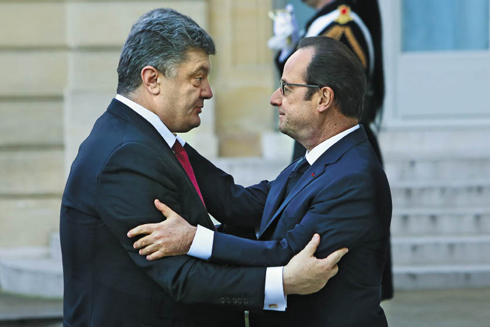
Poroshenko and Hollande met in Paris on January 11 due to Charlie-hebdo. But we also talked about Astana (photo: Thibault Camus/Ap Photo) , The Bundescanzler department recalls in this regard a “black cat”, which ran between Berlin and Astana back in July 2010. Then, according to the results of the visit of Angel Merkel to Kazakhstan, the signing of an agreement on the so -called “raw material union” between the two countries was expected. But this never happened. Nazarbayev did not sign the prepared document. Realizing this, Angel Merkel limited his stay in Astana by protocol -free six hours. True, in February 2012, the document was nevertheless signed in Berlin, after which the chancellor was under a hail of criticism from the human rights NPOs: they say, Berlin, thereby allowed Nazarbayev to break through the international isolation in which Elbasy (so the official title of Nazarbayev, the National Leader) was in Kazanoisen) after the brutal suppression of protests in Zhanaisen in December 2011.
But one cannot deny the fact that Nazarbayev today has a vote of trust in Moscow, Kyiv, and in the West. And as an intermediary, it can be more successful than Alexander Lukashenko, who has already provided the Minsk platform for negotiators. By the way, the Kazakh leader tried to intervene in the situation in March last year at the height of the “Crimean campaign”, but then Moscow politely but strongly hinted to Astana that she did not need her services. But Nazarbayev did not become calmer from this. He was most afraid of the growth of separatist sentiments heated by Moscow in the northern regions of Kazakhstan, inhabited mainly by Russians. In addition, in Astana, they could not help but pay attention to the ease with which Moscow abandoned the guarantees of maintaining its territorial integrity in the framework of the Budapest Memorandum of 1994 in exchange for its rejection of the status of a nuclear power. After all, the same guarantees were given to Kazakhstan ...
Boris Yunanov took part in the preparation of the material