
Translated material
Six ways to resist
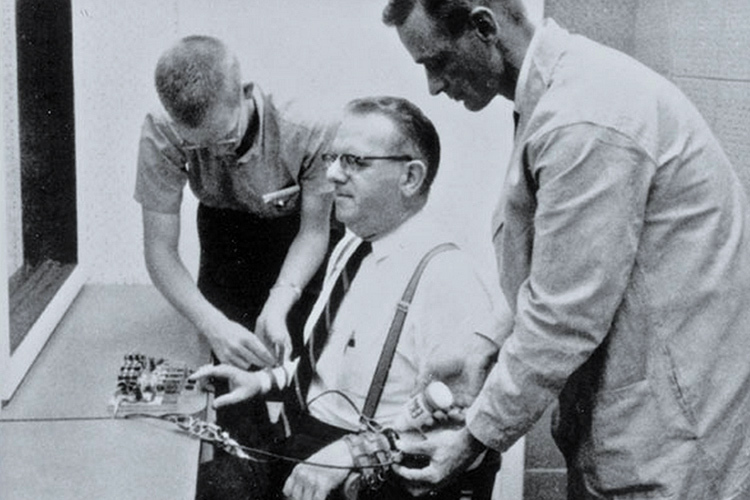
In the early 1960s, the social psychologist Stanley Milgram, the 28-year-old professor of Yale University, convincingly proved: the majority obeys the authority to such an extent that they are ready to beat the current of an unlucky person until he loses consciousness. To obey those who have the right to order is a deeply sitting instinct of each of us, regardless of education and status.
54 years later, Matthew Hollander, a graduate student at the University of Wisconsin in Madison (USA), became interested in the behavior of those few who refused to obey. He got 117 tape recordings of the Milgram experiment , preserved in the archive of Yale University, and was not too lazy to make a detailed decoding. It recorded pauses, intonations, unfair words, even “uh-e” and “hmmm”-everything that is deciphered by journalistic interviews without hesitation is rejected without hesitation. Hollander analyzed each of the 117 episodes as a step -by -step test for non -conformism, during which a person resists (or does not resist) the pressure of authority. The graduate student was looking for any hints that allow you to predict the outcome in advance - a person will beat the victim with the current to the end or get up and leave.
The experiment was, as claimed, by the laboratory model of the Holocaust.
Milgram himself took little conversations of the experimental - compared to collected statistics, which finally could explain the scale of the war crimes of the Second World War. The experiment was stated, by the Laboratory model of the Holocaust and set a goal to answer the question of where hundreds of thousands of people came from in Nazi Germany, who shot unarmed ones or served gas chambers. In May 1960, Buenos Aires was caught and taken to Israel Adolf Eichmann, a German official who planned the mass destruction of millions of Jews. A year later, the court began, about which Hannah Arendt writes his book “The banality of Evil”: Eichmann, she claimed, not a psychopath or sadist. Like hundreds of thousands of other people whose hands were made by the Holocaust. They simply acted in circumstances. Milgram managed to translate this reasoning into a plane of strict science.
When the results are ready and meaningful, he will declare in the radio interview: “Whether the concentration camps in the United States like those that we saw in Nazi Germany could be recruited for them in any small American town.” The national characteristics of the Americans have nothing to do with it: other scientists repeated the experiment in various countries, from South Africa to Australia - and became convinced that they deal with the universal psychological law, which works the same on different continents.
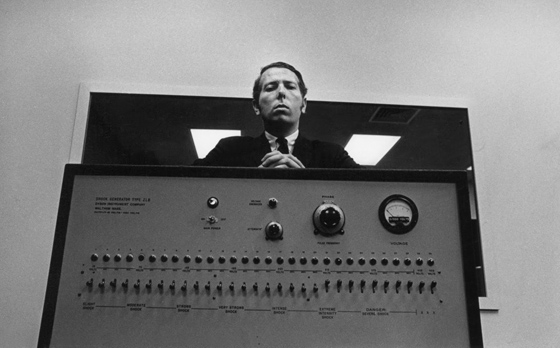 Stanley Milgram
How was Milgram's experiment furnished? The scientist came up with a scheme for several months where one person (experimenter) tells the second (this is an experimental) to mock the third (lumpy duck) - but in the scenery that make the whole situation socially acceptable. Volunteers recruited for four dollars were sure that they were participating in a psychological study about the usefulness of punishment in teaching languages. Everyone pulled lots to choose the role of a “student” or “teacher”, but - here scientists cheated - he always pulled a piece of paper with the word “teacher”. The "student" was an apple duck hired by an actor. The third, a solid man in a laboratory dressing gown, gave the “teacher” instructions and made sure that he would follow them.
The rules were the following: for each mistake, the “teacher” beats the current of the “student” sitting behind an opaque wall, and over and over the tension grows. (The “teacher” was allowed to feel what 45 volts are, and then they planted both in different rooms.) According to the script, at a mark of 75 volts “Student” for the first time makes it clear that he was painful (“OS”), at 120, he complains with a direct text (“Hey! It hurts me), and it requires stop immediately.
 Adolf Eichmann during the trial in Jerusalem
Complaints cause a “teacher” understandable discomfort. What is it expressed? In tape recordings, Hollander counted six types of resistance reaction. All of them are found both in obedient and naughty, the difference in details.
The first three methods - passive and resistance can be called only conditionally. The easiest way is to be expressively silent. Instead of asking the next question, the vast majority (obedient and naughty) for starters withstands a pause of a few seconds - it is time to take the initiative to take on the “man in the dressing gown”. The same goal is exclamations (“O Lord!”) And a loud grunt (“khm-khm”): this is also a way to make it clear to the victim that her problems are bothering us. A special case is a sudden laughter. Milgram himself surprised how often his experimental ones laugh and inappropriately laughed; He suggested that this laughter is nervous and certainly not sadistic. Hollander has his own explanation: laughter transfers the situation to another category - they say, the victim screams a ponaroshka, fooling around, and the “teacher” is convenient to convince himself to continue with a pure heart. Practical investigation: if an riot police who drags you into a car carrier, laughs - this almost certainly means that he is uncomfortable.
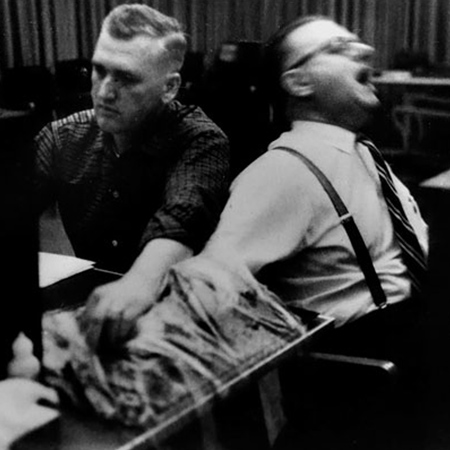
Three other reactions are examples of obvious resistance. At first glance, to clarify "Does it hurt you?" The victim has the most innocent thing that can be said aloud. The victim seems to be so complaining, we will not hear anything new. But this technique used only refuseniks exclusively. First of all, he recognizes the victim’s right to decide and automatically question the authority of the “person in a dressing gown” on the issue of the measure of punishment. Therefore, probably, different forms of the conditional “mercy to the fallen” - from the bread abandoned by prisoners of war, to the charity addressed to the prisoners - so annoyed by totalitarian authorities.
Questions to authority (“The student complains. Is it time to be interrupted?”) Almost everything is asked - both obedient and naughty. In this case, the “man in a dressing gown” has been prepared on duty phrases: “Please continue”, “The experiment requires you to continue”, “It is absolutely necessary for you to continue” and “You have no other choice, you must continue”. The subject is considered obedient if he beats the “student” three times with a maximum current of 450 volts - after he stops reacting to questions, knocking into the wall and even screaming. Any other outcome is considered disobedience.

Only 19 percent of the obedient - and 98 percent of the naughty - found the courage to declare the courage in direct text that they want to interrupt the experiment. But one statement is not enough: “a man in a dressing gown” in response insisted that it was necessary to continue. Among the obedient, only 6 percent decided to voice their desire at least one more time. The naughty did not hesitate to repeat their statement again and again, until the “man in the dressing gown” was forced to stop the procedure.
There are more “Milgrim” situations in life than I would like to think. This is not necessarily war crimes, hazing or persecution of dissenters in the direction of authority. For example, the Milgram experiment from time to time refer to the commissions to investigate the plane crash, when the first pilot with the second pilot, preserved by the black box, analyze the negotiations of the first pilot. And the need to deal with a black box usually arises when submission to authority was already worth the life of dozens or hundreds of passengers.