
Translated material
Slowly grind Ukraine
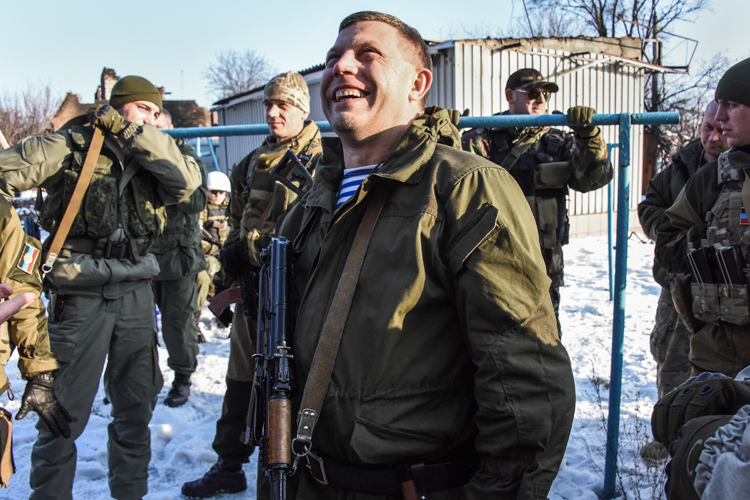
The breakdown of peace negotiations in Astana to resolve the conflict in eastern Ukraine laid an end to the prolonged period of relative silence on the Donbass fronts. The formations of the DPR/LPR, supported, according to Kyiv, Russia, went on the offensive in at least two directions: at the Donetsk airport and near the strategically important city of Debaltseve (through a settlement under the control of the Ukrainian army, iron and automobile highways connecting Lugansk and Donetsk) pass.
According to representatives of the General Staff of the Armed Forces of Ukraine, the situation on both sections of the front is “extremely difficult and quickly changed”. According to rather conflicting messages from the places of battles, the units of the Ukrainian army for some time even made their way out of the airport to Donetsk, where street battles began. Fierce shootings and artillery duels have not stopped there for several days. A truce ordered a long time to live, although in Moscow and Kyiv they declare their own attempts to restore it. In the breakdown of these initiatives, the parties, of course, blame each other. The situation is chaotic, but it is clear that the intensity of hostilities has increased many times, both quantitatively and qualitatively.
The Ukrainian side accuses Russia of delivering very formidable weapons to the militants - heavy firefighting systems of Pinocchio, which, in their combat characteristics, significantly surpass the traditional "grades". In the DPR and LPR, these accusations are not refuted, and on the sites of their supporters there is already information about the "birth of Aviation of Novorossia" with photographs of Su-25 attack aircraft. In addition, in the unrecognized republics they boast that “squeezed out the heavy ZZO“ Hurricane ”and“ Smerch ”from the dill. There is no officially confirmed information on this score, but it is clear that the formation of separatists during the period of the calm thoroughly armed and prepared for the new round of the military confrontation.
Now many are occupied by the question of what the meaning of the offensive, which, of course, could not begin without permission from Moscow. The most popular explanation is an attempt to strengthen the Moscow-Donetsk positions before the next negotiations with Kiev scheduled for January 21 in Berlin.
Kyiv was tactically interested in preserving the DPR/LPR in the current form and status.
However, upon careful consideration, this version looks unlikely. The fact is that the German Chancellor Angela Merkel has already stated that a serious dialogue can begin only if “significant progress” in the Donbass achieved. Under “progress”, of course, she did not mean the beginning of the use of the Buratino TOC and the fierce assault on the Donetsk airport, but something opposite-the withdrawal of troops, the ceasefire and the closure of the Russian-Ukrainian border to supply militants. Thus, the activation of hostilities can rather contribute to the breakdown of Berlin negotiations, and not at all to gain any additional arguments of one of the parties.
The cause of the offensive is somewhat different. Over the months of the calm, established after the conclusion of the Minsk agreements, the political, diplomatic and economic situation has significantly changed. After Kyiv’s refusal to finance the rebellious regions of the Kremlin, by an obvious manner, he was responsible for the destroyed and poor region with two million inhabitants suffering from hunger, cold and lack of drugs.
In the context of the growing economic crisis within Russia and the Ukrainian blockade of Crimea, also requiring huge injections, Donbass became too serious financial burden for the federal budget. In addition, the non -regulatory of the conflict does not allow the tired of the West to the West to cancel or at least soften the sanctions.
As a result, there was a somewhat paradoxical situation: the Novorossia project was conceived and implemented as a lever of pressure on Kyiv from the inside of Ukraine. But because of a number of political and diplomatic errors, he became a weight on the neck of Moscow, which Kyiv categorically refuses to outweigh to itself. Time plays against the Kremlin: without a peaceful agreement, sanctions will remain in force, which is already threatening the Russian economy very serious, if not catastrophic, consequences. In general, Kyiv turned out to be tactically interested in preserving the DPR/LPR in the current form and status, and Moscow - in the speedy deliverance from them.
Using this circumstance, the Ukrainian side can dictate its conditions in negotiations. In fact, Kyiv proposes to slowly discuss the conditions for the surrender of the self -proclaimed republics and Russia standing behind them. We are talking about the disbandment of illegal armed groups, the withdrawal of foreign troops and heavy weapons, restoring in full Ukrainian sovereignty over the Donbass and establish full control on the border.
The parties did not agree on whose conditions they will discuss exactly the surrender.
For Moscow, this would mean not only a documented recognition of its defeat, the final failure of the Novorossia project in an initially conceived form, but also something more serious-the transfer of the attention of diplomats from Donbass to Crimea. For the Kremlin, a similar turn with double fiasco is absolutely unacceptable. The Russian leadership has a completely different view of how this conflict should be regulated.
We are talking about recognizing the legitimacy of de facto authorities of the DPR/LPR, the reintegration of Donbass to Ukraine on the terms of wide autonomy with the ability to influence decisions made in Kyiv, as well as guarantees of free movement of people and goods through Ukrainian territory to Crimea and from it.
The requirements are clear. But there is a small problem: their implementation would also mean surrender, this time - Kyiv. It is quite clear why neither the West nor Ukraine are even going to discuss them. Actually, the meeting in Astana, like several rounds of negotiations earlier, fell off precisely for this reason - the parties failed to develop a common agenda, roughly speaking, did not agree on whose conditions they would discuss.
This is where the reason for the resumption of hostilities lies. Thanks to the western system of life support (loans), economically sick Kyiv can patiently wait for Moscow to agree to consider its agenda as a cargo of financial problems. The Russian leadership is deprived of such luxury. Every day, the disease progresses: the economic situation worsens, the gold and foreign exchange reserves are melting, GDP is reduced. And most importantly - there is nowhere to wait for help. That is why the Kremlin is critically important to conclude a peace agreement as soon as possible - on its own, of course, conditions. Moreover, it is best to do this before March, when the EU decides whether it is worth extending anti -Russian restrictions introduced a year earlier.
Well, if Ukraine refuses such an agreement, then all the worse for her: the wording “Coercion to the world” - and what is behind it - everyone has known since 2008. Of course, Russia is now not in the position to openly use its tanks and aviation, as it was in Georgia, but it is quite able to provide maximum military-technical assistance and send them to battle.
Professor Edward Walker at the University of California in Berkeley in November described the likely tactics as follows: “The Kremlin hopes to slowly grind Ukraine until it is forced to surrender. Such a plan would include a long military conflict, during which the Ukrainian army will retreat step by step until Kyiv realizes that it has no way out, except for the conclusion of peace on the terms of the Kremlin. ”
It is enough to apply a series of high -profile defeats that are important not so much strategically as symbolically.
In fact, as in 2008, this will not mean capturing the capital and the occupation of the entire territory of the country. This is useless. For overall success, it is enough to demonstrate their superior power, to deprive the enemy of the will to resist, to cause panic among the civilians and the requirements for the government "to end the war at all costs is not even worse." Upon reaching these tasks, Moscow will be able to dictate its conditions for concluding peace to Kyiv, and not vice versa.
Actually, approximately in such conditions, after the defeat of Ukrainians near Ilovaisk, a peaceful process was launched in Minsk, to which representatives of the DPR/LPR were first allowed. Prior to this, the Ukrainian side did not want to hear about their participation in any consultations.
Since the main task of the advancing militants will be the demoralization of the enemy, it will not need too much effort to solve it - for example, the capture of large settlement centers and/or the complete liquidation of the Ukrainian army. To do this, it is enough to apply a series of high -profile defeats that are important not so much strategically as symbolically.
If we take into account the current situation on the Donbass fronts, three potential targets for the attack are obvious at once. First of all, this, of course, is Donetsk Airport, which became a kind of Brest fortress for Ukrainians - a symbol of stamina, courage and unbending of their soldiers and officers. Without a significant military significance, the truly legendary airport is extremely important from a psychological point of view. His capture, no doubt, would be a very serious blow to the combat spirit of the Ukrainian army and, no less important, people. With a great degree of confidence, it can be assumed that its possible fall will at least cause a mass depression in Kyiv.
The second potential goal of separatist formations may be the city Debaltseve mentioned above. This settlement from three sides is surrounded by territories controlled by separatists. Even a non -specialist, when looking at the operational card, becomes obvious that protecting it from complete environment is a rather difficult task. The militants repeatedly tried to surround him earlier, they will probably try again.
Well, the third dangerous direction is Mariupol. The environment or even the threat of the environment and assault on this city can cause panic and the mass outcome of tens of thousands of civilians. For the country as a whole, a similar development of the situation at the front will also become a great shock. More importantly, the real threat to Mariupol will become a kind of hint of Kyiv: if a ground message with the Crimea is not unlocked in a good way, then the same task can be solved in a bad way-with the “cutting of the corridor” and large losses for Ukraine.
According to the latest news from the war zone, in the first two sections of the front - fierce battles are going on at the airport and Debaltsev. For Mariupol, everything is relatively calm, but the militants were activated north of him - in the area of the city of Volnovakha. A few days earlier there were killed 12 passengers of a regular bus, accidentally falling under a separatist missile blow. In the case of the capture of the Volnovakha, Mariupol will be surrounded by the formations of separatists from the north and east. If we take into account that south of it is the Sea of Azov, only one way will remain free - to the west, to the Crimea and Kherson.
It is important to note that for Ukraine, this whole situation can become doubly difficult. As it became clear in the summer, the Russian leadership cannot allow the formations of the DPR and the LPR to tolerate military defeat. When the militants began to hand over the city outside the city in June and July, army formations came to their aid without identification marks, later bashfully called the "vacationers". According to the firm conviction of the Ukrainian side, these were the Russian military personnel, in advance disputed chevrons from their form and painted numbers and insignia on military equipment. Actually, it was with their efforts that the Ukrainians were defeated near Ilovaisky, and the DPR/LPR significantly expanded the zone of their control.
There is no reason to believe that in winter these people will refuse to militants in similar courtesy if the Ukrainian army is able to render a worthy rebuff. Moreover, the capabilities of the “vacationers” can be involved in the event that the DPR/LPR is delayed with the achievement of pre -intended borders. Since the time in the new stage of the war is a decisive factor, Ukrainians may encounter “vacationers” in battle in the near future. In addition, the formation of the “Air Force of Novorossiya” with photographs of combat aircraft, which is widely advertised on the network, leaves the opportunity to engage in assault aviation against the Ukrainian army (also, apparently on vacation).
Apparently, the general outcome of the war in the Donbass will be determined in the next few months, and this decision will not be peaceful - rather, it is worth expecting fierce battles. Ukraine will be able to win if its soldiers and officers continue to demonstrate the same resistance as at the Donetsk airport, and their fellow citizens will not fall into despondency and pessimism due to quite possible failure and even defeats at the front.
In turn, for Vladimir Putin, the onset of militants that began is the last opportunity to force Ukraine to the world on their own conditions and achieve the abolition of at least part of the sanctions. If this campaign crashes, the Kremlin will remain alone with even more rigid Western sanctions, broken groups of the DPR/LPR, the hungry Donbass, preserved by the blockade of Crimea and the rapidly approaching economic collapse of the whole country.