
Translated material
Man consists of glasses and hats
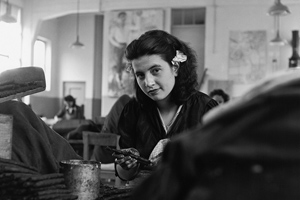
In the St. Petersburg Center “Rosfoto”, until mid -February , the Theo Fry , the Swiss photographer, the same age as the XX century and the artist, who was able to combine dry fixation and poetry in his pictures. How - the devil knows him. Magic. Despite the fact that the Fry, which is included in the clip of classics of reporting photography, stands out against the background of many of its strict objectivity.
Fry's work is a find for an exhibition project. Because he shot as if halls, in separate series - voluminous, large, exhaustive. He was drawn to large -scale plans: to go around the country and shoot life in each of the cantons; document the life of the military from and to; Create a photochertus of one city. In these series, there is absolutely no pure poetry, visual abstractions-this is rather the journalism of the extra-class. Only the introductory, the first hall of the exhibition consists of more or less abstract personnel: a girl, frozen in a jump, an empty house, an expressive peasant family at dinner. Further - only tasks and their solution, questions and answers. Journalism and civil lyrics.
The idyllic image of Switzerland cracks at the seams. Fry is the land of civilization, which means the land of people.
Almost all the works of Fry, who lived a long life (ninety years), occurs on the thirties to five. And this is not the choice of curators - the main building of his work is really there, in the Second World War, its foreboding and its consequences. In the time when reality has acquired forms, which are extremely expressive in anticipation of the disaster and in the experience of its result.
Fry builds the worlds of her photos from details. In his photographs, there is nothing but nuances, details. A person here consists of clothes, a suitcase, glasses, hats. Space - from carts, hoe, guns, houses. The idyllic image of Switzerland - mountains, cows, meadows - cracking at the seams. Fry is the land of civilization, which means the land of people. Even if, as such, these people suddenly do not turn out to be in the pictures - then objects say for them. A number of portfolios hanging on a wooden wall, under family photographs, tells everything about the house, its inhabitants - the owners of these portfolios - and about their relatives, looking at us from other people's pictures.
Fry works on the border of poetry and research, art and science. He is the chronicler, a chronicle, diligently fixing and registering. His pictures cannot be called random evidence, this is rather a detailed census. The most characteristic in this sense is the series of the end of the thirties, when the photographer came up with each canton to travel, make a photo study about the organization of life, life and economy in each of them. Fry is not interested in life at all, but her device. What is the self -government? What are the milkmaids and drinking boots? Where are the cows buy? And what breed? How much cherries are collected in season? How do children in these cantons finally study - in Uri there are more excellent students or in Bern?
Chronicle of Cantonal Council meetings are the only pictures in which there are adult men. On the rest, only dry aunts and grimy children.
And again - details. They turn the study into poetry, give the inventory the power of a lyrical statement. The peasant family, diligently, completely in biblical opening the mountain, to plant potatoes on it. The legs standing next to a bucket of paint and mop. A number of hats, jackets and glasses, figures with raised whitish hands: this cantonal council is sitting. Fry is training her viewer. He accustoms to look more carefully, and over time you see more and more in his pictures. For example, that a chronicle of meetings of cantonal councils are the only pictures in which there are adult men. On the rest, only dry aunts and grimy children.
Another series is a strict chronicle of the life of the post -war Zurich. Again, a thorough inventory. Mountains, lakes, wealthy townspeople, market with all products. For example, his “tram cleaner” is made of rails, hose, barrels on wheels, which is pulled along. The most characteristic picture in this series is the one where the price tags are simply photographed. The classic journalistic frame is such a sin not to scurry into an advanced one in a difficult year of crisis. Cherry costs so much, so many apples, and a kilogram of lamb ... But Fry sees not only a fact. In these photographs, reality is organized poetically, picturesque.
But perhaps the most expressive Fry acts as a military commissar. In this capacity, he was mobilized - and honestly fulfilled his duties. Switzerland participated in World War II (only flowers to the windowsill were put up in Bern in our minds there) - had an army, mobilization was announced, but there was almost no active hostilities, only in the forty year, on the way to France, the Nazis broke with the aircraft of the Alpine country. Fry took off everything he saw. And he saw not horrors, but everyday life. Teachings, sleep, washing, letters home, building a parade ground.
Here, on the example of a military series, you somehow especially understand that the ease of Fry's photographs is illusory. The Fraevsky method of hunting for reality is not a blitzkrieg, but a long and exhausting expectation and binding. He lived in these villages for weeks, wandered around Zurich for days in search of heroes.
After the war years, Fry moved away from photographic affairs - since the mid -fifties he was no longer only a photographer. He shot, of course, but he began to engage in charity more, worked in the Red Cross. And this fact does not look amazing. The temptation to put aside the camera and step to the object, to interact with it always. And the Fraevskaya reality - detailed, expressive - all the more urged him to follow her. His departure from the photograph to asceticism was rather a natural step. From the poetic protocol, from the most close attention to the object - to dissolution in it.