
Translated material
The former forever
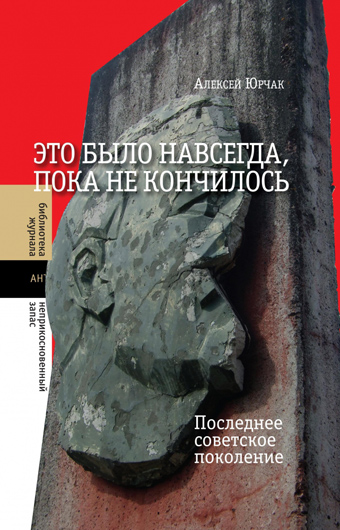
The book of Alexei Yurchak “It was forever until it ended. The last Soviet generation ”was published in English in 2006 and since then I managed not only to get an important award of Wayne Vuchinich awarded by ASEEES (asvei, the Association of Slavic, East European and Euro-Asian research), but also to become a mandatory reading for everyone who is interested in the USSR in general and the period of its existence, which in the official discourse of those times figured it as a time as they figured “Developed socialism”, and in perestroika as “a period of stagnation”. Some Western historians - in particular, Juliana Fürst - call it “mature socialism”, and Yurchak himself uses the term more neutral and, it seems, the most successful - “late socialism”. The Russian version of the book, published eight years later, as the author himself writes in the introduction, “became slightly larger in volume than the English version. It more intently examines some phenomena of late socialism (and others, on the contrary, are described in less detail), some research and analytical approaches are more detailed, slightly more generalizing theoretical retreats. ”
The end of the Soviet era is an event that disturbs not only the Russian “elite”, which finally drowned in the cold salty waters of the imperial resentment, but also theorists. The suddenness of the collapse of the USSR, its surprise are poorly reflected in the framework of both traditional approaches to the problems of the collapse of states and relatively new ones, in particular, with the names of Jared Diamond , Niala Ferguson and Robert Rotberg (an article in this kind, dedicated to the USSR, was published by Sergey Roganov a year ago). Yurchak refuses to explain surprise as such, exhaustively described by the folklore skim of just those times that tells about the book: “I wake up - hello: / there is no Soviet power,” but explores the conditions, as Vladimir Belyaev writes in the preface, “its unexpected collapse is not a reason (supposedly led to the collapse), but that made the conditions possible, although it was possible, although it was possible , although it was possible, although it was possible. And not inevitable). " Since Yurchak sets himself the task of not explaining, but the study of conditions, he is not that he directly refuses the representativeness of the material under study, but, trying to “find some areas in which internal and some time invisible shifts and changes took place in the late Soviet system, selects part of the material“ for research not norms and rules, but deviations from them ”, because the author notes, as the author notes, as the author notes, as the author notes, as the author notes, as the author notes By quoting Schmitt, “the exception is more interesting than the normal case, <...> it not only shows the boundaries of the application of the norm and the rules, but also the wider conditions, within which these norms and the rule are formulated,” and “the material is obviously selected according to the principle of“ representativeness ”is focused on the analysis of already known norms and conditions.” This approach, methodologically, apparently justified, nevertheless leads to the fact that the material falling in the field of vision is mainly related to the Soviet “educated city class”. This fact does not make the book less interesting or important-the point here is still in the frame proposed to consider the corresponding period-but it should be, it seems, taken into account with its careful reading. What frame are we talking about?
For the analysis of Soviet reality, a new language is necessary, going beyond binary oppositions and primitive moralism - unlike the dominant language of the "liberal historiography and historiography of the Cold War."
Firstly, when describing the Soviet reality, it is offered to abandon binary oppositions, “such as suppression-resistance, freedom-non-freedom, though lies, official culture-counter-culture, official economy-second economy, totalitarian language-counter-language, public subjectivity-private subjectivity, conformism-non-conformism, real behavior-pretense, true person-mask”. As the Yurchak notes, the use of a Soviet subject, based on such oppositions, deprives the vote-it is not taken into account in any case, because due to oppression and fear, this voice allegedly cannot be considered true. ” In fact, “the meaning of many cultural phenomena of Soviet life, including those that were officially resolved and which the authorities could even promote itself, sometimes differed from the literal meaning of party performances and programs, and sometimes contradicted it. Soviet reality was much ambival and more paradoxical than it appears in today's binary descriptions. ”
Secondly, in connection with the foregoing, it is proposed to pay attention to the fact that “a significant number of Soviet citizens in the pre-perestroika years perceived many realities of everyday socialist life <...> as important and real values of Soviet life, despite the fact that in everyday life they sometimes violated, modified, or simply ignored many norms and rules established by the socialist state and the community party ". According to the researcher, the analysis of this ambivalence needs a new language that goes beyond binary oppositions and primitive moralism - unlike the dominant language of the "liberal historiography and historiography of the Cold War." Yurchak compares post -socialist studies with post -colonial here: the latter also faced at a certain moment the need to develop a new language, free from the “European perspective” of a look at the historical process.
 © New Literary Review
Thirdly, the author draws our attention to the Lifor Paradox known to political scientists, which consists in the inevitability of the gap between the practical applications of state ideology and its discourse. The latter is forced, in the types of aircraft, “constantly appeal to a certain“ objective ”that cannot be doubted by the truth,” however, beyond its borders. Thus, “the ideological discourse of the state cannot put this truth into question, but at the same time does not have sufficient means to prove its loyalty” - in fact, we have a specific formulation of Gedel's incompleteness (see here and here ). The paradox of Lefor is something like a slow-off bomb, which at any moment to undermine the legitimacy of state power, however, as Yurchak writes, “for the time being, this paradox is hidden by the dominant figure (Master) -built into the ideological discourse-the ruling subject, which differs as the owner of unique knowledge of this external objective truth.” At first, “this paradox was hidden by the dominant figure, which led ideological discourse. At first, the role of this figure was played by a revolutionary political and art avant -garde, which, located outside the ideological discourse, constantly commented and evaluated it from this external position, making his adjustments to it, ”and then, according to Yurchak,“ the role of the dominant figure of the Soviet ideological discourse passed to Stalin, ”and he now had access to the outerly canon of ideological truth, and he had access to the outerly of ideological truth. Personally evaluating various ideological and other public statements on the subject of their correspondence to this canon and personally making appropriate editorial remarks and corrections in them. ”
However, later, “the position of the dominant figure of the Soviet ideological discourse, capable of considering and commenting on this discourse from the outside, was destroyed. That is, not just a specific subject that took an external position in relation to ideological discourse disappeared, but in general the very opportunity to take such a position. ” The paradox of Lefor, previously hidden, came to the surface in the end, and, as Yurchak believes, "it was more important to reproduce the exact structural form of ideological statements and rituals, than to climb too detailed into their literal meaning." The ideology thus loses its immediate pragmatist and turns into what Yurchak after Bakhtin calls the “authoritative word”, whose power over the audience is not that “she necessarily agrees with him, but that she perceives him as the only possible.”
Fourth, Yurchak proposes, relying on the theory of Austin's speech acts, to abandon the usual idea of doubles. The Soviet citizen did not think one thing, but said the other - this is generally a false opposition. Say, voting at the Komsomol or party meeting, the Soviet citizen for the most part did not express his own opinion about the candidate or his views, as in the usual political system. Instead, he reproduced himself as one of the “normal” Soviet subjects, “inscribed in the existing system of norms, relations and positions, with all the restrictions and capabilities following this <...>”. The same, according to Yurchak, happened with the rest of the statements and rituals of “authoritative discourse”. Their content and meaning were much less important than the very fact of their commission.
In the course of the presentation, the author introduces several more important concepts - in particular, the fact that he, using the term Bakhtin, calls the “immovability” of Soviet subjects in relation to authoritative discourse. Any intelligible retelling of this theoretical apparatus in the minimum fullness-not to mention the fact that the book includes a fairly decent volume of the material on which Yurchak demonstrates the resource of his approach-would take too much space. However, the idea of the overall picture is probably given above the cursory retelling.
With separate logical moves of the author or even with their whole series, one can argue that many do-more precisely, they did after the release of the book in English ( here , for example,-and here more ). It can be discussed, in particular, how much the role attributed to Stalin in the book corresponds to reality - or whether the Yurchak gives too little space, relatively speaking, to the “thaw” period. It is important, however, that the model he proposed allows us to resolve many contradictions that are insoluble in the framework of the previous approaches. In addition, the reconstruction of the Soviet subject undertaken in the book is, upon closer examination, very useful for reflection on the subject of the current, post -Soviet - or rather, even not post -Soviet, but Tom that will appear (or has already appeared) to him.
“It was forever, until it ended” today - an obligatory part of any serious conversation about the post -Soviet, post -socialist and generally about modern Russia. It was mandatory until now, however, mainly outside Russia. Now to digest and somehow integrate into your picture of the world this unexpected, unobvious, and probably even a provocative book will have a relatively wide Russian reader. He, this reader, of course, would cope, he did not cope with that - but it is still interesting what would come of it.
Alexey Yurchak. It was forever until it ended. The last Soviet generation. - Per. from English. M.: New Literary Review, 2014. 604 p.