
Translated material
Life is a failure
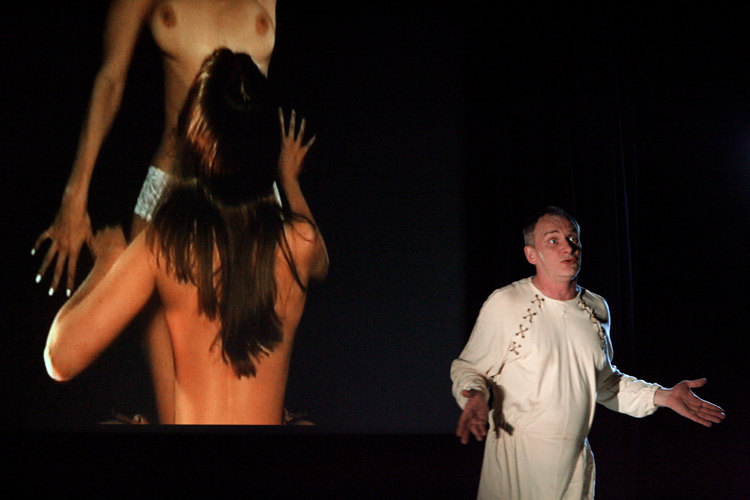
A woman comes out to the audience and begins a monologue. Well, how is the monologue? Not the one that the monologue is read by the actors, remaining in the ray of light in front of the quiet hall; Which is placed inside an unsolvable collapse, which opened in the middle of the drama and seen by a supercurrent plan. No, this one just stands between the rows and says. Partly tells his story, partly tries to explain it, partly - to understand. There are two men in this story, they are different, and they also treat it differently, and it also treats them differently, but there are no direct reasons and consequences here, so go figure out what and why, and here it is trying. Sometimes he sits on his free place, sometimes he approaches a large unpleasant window behind the auditorium, which goes out the courtyard, and looks there, looking for not so much any hints as the dull void of an ordinary landscape, having stuck on which the inner vision may become a little clearer ... into another window, which is already scattered, a knock is heard. Simple, ordinary - so not fate knocks on the door, so the man knocks out the window (if, for example, it passes in the evening in the yard and does not know that the theater is outside). The woman squints, but continues to speak. The knock is repeated, then more. Finally, interrupted in a little suitable place, she throws a jacket, pulls off the curtain-and lets the workers who just brought red linoleum to the stage. And they lay it down, and pull it out for this curtain, before that the former was closed, and the decoration has already been prepared behind it (well, almost prepared, with linoleum, they were late); Then they make boxes, from which the actress takes out two chairs and puts it on the stage, so that the musicians can go out with their instruments and play Bach, and here the performance will begin, although maybe it has long begun when the actress came to the audience, and maybe even earlier.
Of course, there is nothing new, of course, there is nothing new, since the time of dad Brecht, who has not done this, destroying the illusion and making the means of expression part of the content; In the midst of the 2010s, such tricks, as a rule, gives out a moveton. But for the "mansion" theater, which has been living in the yard on Kamennoostrovsky Prospekt for a quarter century, such removal is not a one -time and not even regular technique: this is not a “technique” at all, this is a way of functioning the local space, strictly speaking - a way that this space generates. Method as an environment. And therefore, the essence is not in the extraction as such (it is “mansion” in the theater and to notice it is wise, it is so normally and ordinary), but in the arc describing the workers, passing from the window on the stage, and from which all the previous existence of Daniela Stoyanovich is, as it were, somewhat aloof. There is a stage space with a curtain and thin. The design is a violent, irreparably real St. Petersburg court, both of them are material and concrete as red linoleum. And where is the theater? And aside. Where the actress, going into the hall even with a detached curtain, tried to find words to explain and to understand. More precisely, where she did not succeed. More precisely - it succeeded, but the words were not the same. And even more precisely - therefore, they turned out to be the wrong ones that succeeded.
The Mansion Theater, miraculously and against all the rules, survived the relic of the nineties, when there were almost two hundred theaters in the city-almost the only one (along with Ahe) of the currently existing people who have retained the spirit of the one, the only one hundred of Russian years, of a free era. Here they do what they consider to be necessary, “without asking anyone,” and therefore “elect / idol for their hearts” with the exactingness, which distinguishes free artists from those, whose genuine and despotistical artist is invariably life circumstances. (A Khudruk in the “mansion”, in fact, is not at all - there is only Dmitry Podnozov, who more drags the theater more than leads to him, and who, in response to questions about the concept and strategy, redirects the interlocutor to the main boss, and to the question where to find it, answers that “there are different versions.”) And this means that nothing interferes with the performances of the "mansion" theater. The main law of art: to tell, ultimately, exclusively about your own device. And thus - to identify the device of the theater as a whole. Whoever, no matter what and with whom here, any local performance testifies to the theater in the same way as any person testifies to the universe (insofar, of course, since it is free). Nevertheless, the “Viennese Apocrypha”, the monoscope of Daniela Stoyanovich, staged by Alexei Slyusarchuk in “Raspberry” Ingeborg Bakhman, speaks of the “mansion”, perhaps more and more clearly than others.
The Mansion Theater, miraculously and against all the rules, survived the relic of the nineties, - almost the only one of the currently existing ones that has retained the spirit of the one, the only one in the last hundred of Russian years, of a free era.
It's not about the plot, of course, and not even about the specifics of techniques - at least about the material that reveals the method. Thus, most theaters, careful to blur the established conventions and cultural codes, raise the slogan “Theater is here and now” to their hastily tailored banners and see the right guarantee of a “living”, creating action. At first glance, the “mansion” is from their own number: here, as it is nowhere to appreciate the acting improvisation, which is laid between the milestones of replicas, as if temporary hanging bridges are circled, not disdaining with weeds and forgotten intonation. But when Stoyanovich - or her heroine - still there, in the hall, argues with the help of the text Bakhman that he does not understand how to pronounce the word “today” how you can decorate what is happening to you into the text, and that only suicides can use the word “today” - the slogan “here and now” is radicalized to such an extent that it turns into its own opposite. The theater, claiming the impossibility of any theater. Those who scream about “here and now” usually seek vitality and authenticity, not seeing the difference between them; The mansion theater who decided to be the theater constantly states the mortality of any moment living in an attempt to catch and reproduce life. Eight years ago, the play “Fando and Fox” was here with the subtitle “The Book of the Dead based on the play by Fernando Arrabal”, and whether it is the performances of Slyusarchuk, Vladimir Michelson, Julia Panina or Klim - this marginal attribution to them everything. This is by no means a “aesthetics of death” in the decadent sense, with languor in the gaze and rustle of Muar: this is just such a close peeping in life that it inevitably begins to look like dying. And because mortality is the main difference between the living and the dead, and because peering kills, because its intention is to understand and name, and this is the format of the necrologist. Putting a performance means to show a love of life, killed love of life; It is no accident that the most famous performance “The Mansion” is “meek”, where the branded Dostoevsky rabies of the monologue is understood to the end: any possession - be it love or naming - the more murderous the more sincere. Nowhere are the performances do not stick to the finale as inevitably as in the "mansion". If you manage to look at the sun, then it rolls up.
This, of course, is not a method, it is only his substantiation - the justification of that strategy for protecting life from the theater, which the theater is obliged to develop in order to talk about life - and nevertheless lasts. The strategy of the "mansion" is where it is as dangerous, and most precisely it is called inaccurate. People with a good taste usually shun the "mansion", even when respectfully; Here, after all, they do not just put Pavich or Lipskov - here they welcome Castaneda, where else. From whitish smokes, meaningful decorations and existential monologues, from the point of view of people with a good taste, it sometimes carries such, you know, spirituality, such denselypsic esoteric (the most gloomy of the back of the freedom of the 90s), which should be recognized as its marginal position, the “mansion” is obliged by the not-changing conjuncture of the theater process. The problem is not that people with a good taste are usually swords, but that uncertainty is painful. Brodsky wrote that mysticism is a sign of failure in an attempt to cope with spiritual tasks. That's right. But failure is the only thing that the theater can do if he does not want the production process to turn into a control shot into the material, and the performance at the release is an necrologist. If the “mansion”, to the horror of people sane and sober, fills the scene with mystical twilight, then this is only because at dusk there is a chance for a mistake. The one that distinguishes people from cruel demiurges, in whom masters of art love to flirt so much. The one that keeps from dead pride, preferring her unprofitable panic of humility. Only only shooting for defeat is accurate; Negotiations are painful, dangerous and put to the touch, for their goal is to maintain life in a situation of death. Theater is a place for negotiations.
In mathematics there is the concept of asymptotes - a line that is endlessly approaching another, axial one, and will never approach (well, except in eternity). The strategy of the "mansion" could be called "asymptotes poetics" - or, the same thing, an apocryphus carried out in the title of the current performance. Actually, all the action here is built in the mezemo -numeral, intermediate space (similar to the one in which Rasin always placed his tragedies): the performance is an apocrypha of life, avoiding by all his might to become a canon. Donigely inaccurately in relation to both - and reality with its fluid unjustness, and art with its mania of constructions. Always staying away from the arc, which connects the courtyard with the decorated scene. Throughout the action, the heroine, who was confused between two men, will draw on transparent figures hung on the stage, the icons illustrating her monologue: coffee pots, cups, crosses ... And in the final, it will consistently connect them, mounting them into a coherent plot, arrows, red as linoleum. And thereby ending - with himself and with the performance. The story of life will be pronounced and built and therefore turn into the history of death. As a classic tragedy, there is an attempt to avoid death, delaying the denouement, so the watch monologue of the heroine of the Vienna Apocress is an attempt not to say, not to formulate, not to understand. The attempt is in vain, because the theater with its whole being contributes to understanding, and therefore only lasts insofar as it is able to resist its nature, that is, like the hero “meek”, not for long. So any critical article about any performance “The Mansion” is only a drawing of red arcs among the icons planned by the action that fits the material-and it only relies on the fact that it may have been unable to cope with the set spiritual task. Faulkner proposed judging artists by their defeats; The "mansion" turns defeat into a task, reverending humility for the highest morality of aesthetics. For life is more humble than death and that is why it is more theatrical.