
Translated material
Coapaling repair
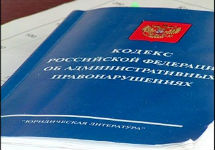
The State Duma has submitted a draft new Code of Administrative Offenses, which has already become famous because of the proposed ban on visiting rallies for guilty citizens. So far, the authors of the document (Dmitry Vyatkin, Vladimir Pligin - "United Russia", Alexander Ageev - "Fair Russia") has prepared only the common part. A special part, describing specific offenses, apparently will be made later.
The “facets” studied the bill and noted the main changes in comparison with the current Code of Administrative Offenses.
Offenses are divided into three categories: rude, significant and less significant. In accordance with this, a gradation of punishments and the terms of prosecution are accountable.
There is an opportunity for a temporary ban on visiting public events (demonstrations), other mass events and certain (court) places for a period of 3 months to a year. The current Administrative Code provides for a ban only on visiting official and sporting events.
There is the possibility of a temporary ban on air travel for violation of order in aircraft for a period of 6 months to 3 years.
The list of types of administrative penalties is added correctional labor involving 5-20% of the income for a period of 15 days to 2 months. In this case, the amount of the retained funds should be no less than the minimum fine for significant offenses (5 thousand rubles). One part of the bill states that they will be applied for gross offenses, and in the other - that will be applied for significant (possibly, a technical error is made). Variants cannot be applied to disabled people of group I, pregnant women, women with children under three years of age, to military military personnel, as well as cadets of military educational institutions.
The list of punishments is added to the liquidation of a legal entity or the termination of activity as an individual entrepreneur. This punishment will be applied for conducting activities without proper permission (license) or in the absence of a mandatory membership in a self -regulatory organization or a certificate of admission to a certain type of work, which is necessary by virtue of the law.
The concept of administrative responsibility of an individual entrepreneur appears. Individual entrepreneurs can be imposed on fines several times higher than on ordinary individuals.
The lower and upper boundaries of fines calculated in rubles are installed (there are other ways to determine the size of the fine).
For rude offenses:
For citizens: 10 - 100 thousand rubles.
For IP: 100 - 400 thousand rubles.
For officials: 200 - 800 thousand rubles.
For legal entities: 5 - 60 million rubles.
For significant offenses:
For citizens: 5 - 10 thousand rubles.
For IP: 25 - 100 thousand rubles.
For officials: 50 - 200 thousand rubles.
For legal entities: 1 - 5 million rubles.
For less significant offenses:
For citizens: 0.5 - 5 thousand rubles.
For IP: 2.5 - 25 thousand rubles.
For officials: 200 - 800 thousand rubles.
For legal entities: 5 - 60 million rubles.
For one administrative offense, it becomes possible to impose one main and two additional punishments (in the current Code of Administrative Offenses a maximum of one main and one additional). Additional punishments can be:
• confiscation of the instrument of the offense;
• deprivation of a special law or license (according to the current Code of Administrative Offenses, only deprivation of a driver’s license can be an additional punishment);
• expulsion outside the Russian Federation of a foreigner or stateless person;
• ban on attending events and air travel;
• Liquidation of a legal entity or termination of activity as an individual entrepreneur.
The statute of limitations for prosecution for ordinary offenses increases from three months to a year.
The period during which the person is considered to be brought to administrative responsibility is maintained only for less significant offenses (year); For significant offenses, it increases to two years, for rude - up to three years. In order to qualify gross violation as repeated, it will be enough to be held accountable twice in three years.
And finally, another innovation is an article on criminal orders . The violator of the Code of Administrative Offenses, which acted "in pursuance of an order or order for him," is exempted from administrative responsibility - the one who gave the order will be answered. However, "a person who committed an administrative offense in fulfillment of a deliberately illegal order or order is administratively liable on a common basis."