
Translated material
Did the patriarch go into politics?
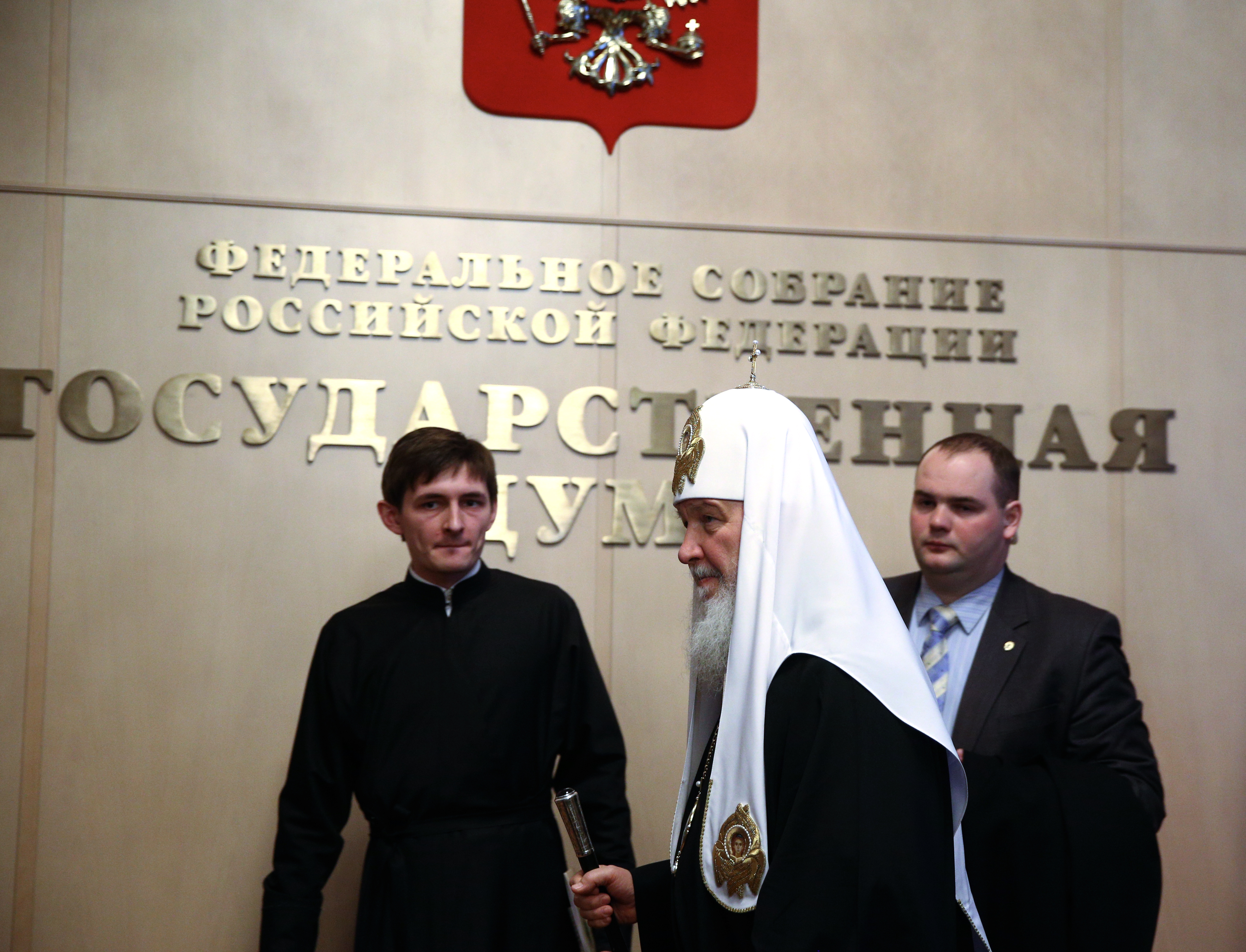
The performance of the head of the Russian Orthodox Church in the Duma is discussed by Vladimir Vigilyansky, Alexey Melnikov, Lev Regelson
Vladimir Kara-Murza Sr.: The main sensation of the last Thursday was the appearance of Patriarch Kirill on the Duma rostrum.
Did the patriarch go into politics? Such is the subtitle of our today's conversation with our guests - Alexei Melnikov , a member of the Bureau of the Yabloko party, and Leo Regelson , the historian of the Church, the author of the book "Tragedy of the Russian Church" and in recent years - the closest employee of his father Gleb Yakunin.
Alexey, you were a deputy of the Duma. Did you have a surprise for the current appearance of the Patriarch on her podium?
Alexey Melnikov: No, it was gone. The fact that the Patriarch today came to the State Duma, and what he said there, from my point of view, corresponds to what the leadership of our country does.
Vladimir Kara-Murza Sr.: That is, he, as it were, became the ideologist of the “vertical” of power?
Alexey Melnikov: I listened carefully to the performance of the Patriarch. I have not heard him for a long time. And I can notice that, firstly, he has a very confused speech, purely outwardly it makes a very difficult impression. Reading a piece of paper of many of its theses, lack of boundaries, logic. Nevertheless, a few thoughts are traced through all this performance: "I am a loyal part of power. We believe that the political order that is established in the country is good, the best, it is not necessary to change it. I do not like freedom." Whatever curtsy he does in the direction of this concept, no matter how he is stipulated, but freedom was today the subject of criticism.
I think that this performance fits into the line of our leadership: the confrontation of Europe, the confrontation of what can be called European political order. And in this sense, this is a continuation of what was in Grozny on Monday - the procession that Ramzan Akhmatovich Kadyrov organized there.
Vladimir Kara-Murza Sr.: Lev Lvovich, what impression did the Patriarch speech? Alexei believes that the speaker was worried and confusedly explained his thoughts.
Lev Regelson: It is difficult for me to judge this, I delved into the meaning of the text more than his psychology. This is the first big way out of the patriarch after a crushing failure in Ukraine. In my opinion, he was about ten times in Ukraine and preached the idea of the "Russian world" there, apparently promising the leadership of the state that he would persuade Ukrainians to remain in the arms of Russia. The result was the exact opposite - he pushed the Ukrainians, especially the Orthodox from Russia, and he does not go there anymore, even for large holidays. He is greeted with screams: "Get the Moscow priest!" That is, with the idea of the "Russian world" he suffered a great failure.
But some time passed, during which he did not particularly lean out. And now the Patriarch again declares himself as a spiritual leader, as was thought earlier. "Symphony of the Church and the state", the patriarch should be the bearer of spiritual, moral values. I recall a funny episode when Medvedev was president. Patriarch Kirill stood next to Medvedev. And he said: "Symphony of the Church and the state." Medvedev looked at him. Well, for him, the symphony is music. And it meant that the symphony is a coordination. Well, then you need to look further what exactly he offers.
Vladimir Kara-Murza Sr.: Father Vladimir Vigilyansky , rector of the Church of the Holy Martyr Tatiana, came out directly with the studio.
Vladimir Nikolaevich, we know that at the beginning of the work of the current parliament there was a ban for clergymen to be elected into it, even to appear there. Why do you think this restriction has gone into the past over time, and today the whole country saw the Patriarch on the Duma tribune?
Vladimir Vigilyansky: Indeed, it is forbidden to be elected to parliament or even local authorities. And to appear - why not? The patriarchs were on the Council of Europe. I traveled with Patriarch Alexy, he performed there. There are no restrictions in this sense.
Vladimir Kara-Murza Sr.: And how do you explain that after a long abstinence, the Holy decided to break this taboo and came to the parliament?
Vladimir Vigilyansky: I say once again, there is no taboo regarding performances. In addition to the fact that he is a patriarch, he is also just a citizen of our country. Therefore, if he is invited with any performance, it seems to me that there are no prohibitions.
Vladimir Kara-Murza Sr.: What seemed to you the most important in his speech?
Vladimir Vigilyansky: It seems to me that he, as a religious leader, tried to find something in common that could connect not only generations, but also people with different party aspirations, from different social groups. He said that he unites people. I think this is now a very important argument for a religious figure.
Vladimir Kara-Murza Sr.: Alexei, it seemed to you that the main thing in the speech of the Holy Patriarch is a unifying note?
Alexey Melnikov: If this were said in a moral sense, if this had not been related to politics, it would be one conversation. When, as Vladimir Nikolaevich says, that it should unite people, turns into what is preserving the existing political order ... It is said that "this is just a beautiful Duma, it is necessary." He still came to the Duma not in personal quality. The Patriarch made political statements. A large number of clergymen sat in the meeting room. Therefore, this is not a question regarding the moral side of the matter when they do not concern politics. This would be understandable, acceptable - not on the rostrum of the State Duma.
I believe that still there is no need to invite clergymen to the State Duma. Our church is separated from the state. Our television is very loyal to the performances of representatives of various faiths, you can see this, always express your opinion, write. There are no prohibitions here. But to do completely indicative things and invite a representative of one of the faiths to the State Duma - then we must call representatives of all other faiths, if this happened. I believe that after all, these were political statements, a political position was expressed here-moreover, a protective position. And in this sense, what the Patriarch represented, of course, is part of this system.
But I do not think that such a position that our respected interlocutor expressed, speaking of Ukraine, is beneficial for the Orthodox Church. Because after all, the association with people who are in power is harmful here. And probably, the Patriarch’s position and led to rather sad consequences for the Russian Orthodox Church in Ukraine. In any case, for now. And it would be better, from my point of view, if the Russian Orthodox Church was still distanced from power, if it were outside the authorities and was engaged in its own business.
Vladimir Kara-Murza Sr.: Lev Lvovich, was the appearance of the Patriarch in the hall as a show with elements of action showing that the messenger of the God-chosen power came?
Lev Regelson: Of course, everything was very pompous as expected - both at Christmas readings and in the Duma. But I am more interested in the content. And this is what can be considered interesting and partly new. The patriarch unfolds the concept of the historical unity of Russia, starting with Prince Vladimir. Moreover, it gives this classification: ancient Rus', the highest value and dominant - one might say, faith, in the next centuries - sovereign, when a small country became the Great Empire. And then the most interesting, after the 17th year-the revolution. "How can such a terrible phenomenon be designated in some word? But there was something positive there." And he says: "Yes, justice." That is, a rush to justice. Then the Soviet era - there was also a lot of things. But there was the concept of "solidarity". Finally, the post -Soviet time. And he suddenly says: "And now the highest value is dignity."
Regarding the first two definitions - faith and sovereign - I will not argue. I accept sovereign if it is Christian, when it is correctly understood. I have absolutely no anti -imperial pathos. But since 1917, all these three terms, of course, cause a deep protest. I think this is all a lie, and authoritatively uttered. This is an attempt to combine the incompatible, an attempt to overcome the past without overcoming it.
Vladimir Kara-Murza Sr.: Father Vladimir, should you more clearly and clearly dissolve from cooperation with godless power during the reign of the Communists? Or is Lev Lvovich right, that this did not sound?
Vladimir Vigilyansky: I categorically disagree with opponents. There were sharp words, for example, a lie. Your speech said that supposedly in the patriarchal speech there was a certain recognition of the God -chosen power. Of course, this is not true - neither one nor the other.
I assure you that the Patriarch has a sense of historicism. I heard a lot from him very sharp words regarding the revolution, atheistic power, and so on. But here was the task not to disconnect, but to unite. Therefore, he refrained from such things. He spoke about the "Civil War" in the minds. And now there are civil confrontations of all kinds. In this speech, I saw a call to leave behind the brackets everything that disconnects people in search of some things that unite them. And it is impossible not to notice this. And this is already called a lie at least dishonestly, let's say.
My first opponent is looking for some political messages of the Patriarch. Well, it’s like in a joke: you need to climb onto the closet and so stretch your neck to see a naked lady in the window of the opposite house. Of course, there was none of this. It is enough to listen to the text of his speech in order to understand that it was political things that have been done. On the other hand, bewilderment regarding legislative acts related to the wishes of believers. And only a superficial look can see some kind of lacquered picture here. For 30 minutes, quite a few claims to the legislative branch have been made in a soft form. So all these invented formulations - anything, but only to shade the church and its Primate - look in the trend of anti -church, atheistic, Bolshevik propaganda, which we have suffered for 70 years.
Vladimir Kara-Murza Sr.: Let's listen to the opinion of father Mikhail Ardov , Archpriest of the Autonomous Orthodox Church and rector of the Temple of the Martyr Tsar Nicholas II. He believes that the position of Patriarch Kirill on the problem of abortion is absurd from a Christian point of view.
Mikhail Ardov: In the newly published speech of Patriarch Kirill, I was completely struck by his arguments about abortion. Generally speaking, now no one, except for the church historians, remembers this, but in the pagan ancient world, the murder of the infant was not considered any crime at all. We remember how in Sparta they threw somewhere children that they did not need. And only Christianity explained to people that a born and not an unborn child is a person, and killing him is the same sin as killing an adult and any other person. Therefore, when he said that it is necessary to make abortions paid so that only wealthy people can do them, this, one might say, does not climb into any gates. It is like what was in the Catholic Church in the XI-XV centuries, in the famous indulgence: if you are wealthy, your wife can kill the child in the womb, and if you are poor, then give birth. This is from a Christian point of view perfect absurdity. And we must understand this. I think that some, of course, in the Patriarchate understand this.
Vladimir Kara-Murza Sr.: Alexei, was the thought of property selectivity really strange?
Alexey Melnikov: It seemed to me that the Patriarch did not even think about it. He spoke completely different. This is an old position regarding abortion, it is known.
Vladimir Nikolaevich, I am not very clear how the truth can disconnect people. It turns out that when the Patriarch speaks with you, he says one thing, referring to this period. And from the rostrum of the State Duma, he talks about solidarism, which existed in Soviet times. This position is not very clear to me. It seems to me that the truth can be bitter, unpleasant, it can hurt people, but the truth is what we all need, and this cannot disconnect.
As for political things in the performance of the patriarch - the text is available, it can be read. The man spoke in the State Duma, addressed lawmakers. And if I noticed any unity, then this is the unity of the hall and the patriarch. And the position expressed about abortion is the old position of the church. In general, this is a matter of relations between secular power and church. And this is not only a Russian question, as I understand it.
And another very important thing. Please do not assume that people who say that the church should not be an element of power, an element in a protective dialogue, oppose the freedom of conscience, against the Russian Orthodox Church. It would probably be more correct to talk about the Orthodox Russian Church. People appear (and I, in particular, have such a position) against the Church to be identified with the state and with the authorities. In no case is it about the fact that people of liberal beliefs want to deprive people of freedom of conscience in order to somehow oppress or humiliate the Orthodox Church. And in no case should you say that people who are negative about communist times do not accept the Bolshevik revolution, that they take the same position in relation to the Russian Orthodox Church as the Bolsheviks.
Vladimir Kara-Murza Sr.: Lev Lvovich, clearly sounded in the speech of the Patriarch the rejection of the godless power with which they were forced to cooperate?
Lev Regelson: I think that this may not be the most important thing. Although I must admit that in other speeches a lot was said about this. The church really sharply dissolved from that era and from atheistic power.
But there is another moment. The Patriarch proudly says that 15 years ago the Russian Orthodox Church canonized about a thousand new martyrs. This is what my book is written about this, because this topic "hurts" all my life. The fact is that the new martyrs are the same church figures, bishops, priests, from whom the Patriarch himself came out and the entire line of Sergius of Stragorodsky. The root on which the structure called the Moscow Patriarchate has grown. And of this thousand new martyrs, I think most were sharp and merciless critics of the organization that arose in the 27th year-in principle, completely new, not the direct continuity of the pre-revolutionary Orthodox Russian Church. Then they even changed the name. Sergius Stragorodsky usurped the power that it has been proven. He was denounced by the authoritative of these new martyrs.
And it is amazing that Patriarch Kirill, speaking of this as a wonderful achievement, does not even consider their criticism, does not answer her. In principle, reconciliation is a great, wonderful thing. All Christians want peace. But as the Prophet said: "They say" peace ", but there is no world." In order for the world to have a world, firstly, however, secondly, you need to understand, forgive, take all these pains in the heart. And if you just smear and say that there was solidarity ... But the solidarity of the Chekist executioners with prisoners of the Gulag, including church ones, is obtained. How is it like that?! How can you forget the Holodomor, forget 15 million special settlers-peasants who have disappeared in Siberia?! As Solzhenitsyn said, a fracture of the Russian ridge. This needs to be ill, rebuild - and then the world will be in Russia. But this is not proposed. Why did I say a sharp word "lies." I deliberately said this - so that it is remembered. Lies in the arrangement of accents. Otherwise, this cannot be called. And at the same time beautiful words, everything is smooth, everything is wonderful ...
Grand Duke Vladimir - I deeply revere him. But if you delve into, then in the court of God it will be the main exposure of both the revolution, and the churches, which became solidarity with this revolution and greatly contributed to the success of the Bolsheviks. And after the 27th year, she was just her henchman. And even under Stalin - there is nothing to say. Such praises, such was glorification! .. In Russia, they love to talk very often about the Antichrist. So he, Antichrist! Well, not Antichrist, of course, but the closest prototype in history. This is a "great butcher", the greatest villain of world history. And he is officially and unofficially famous, with complete sincerity, which is the worst, with heart love ... A lot of materials about this. And how can we talk about solidarity here?! And the longing for Stalin still lives in the hearts not only, unfortunately, clergy. Because he is a demiurge and creator of this organization. There was no such organization - the Moscow Patriarchate. In the 43rd year, Stalin created her strongly. Three bishops remained. And he ordered his agents to travel around the camps and ask the clergy: "Do you recognize Metropolitan Sergius the head of the church?" They answered: "I admit." "With things to exit and in Moscow. Do you recognize? Sit on." That was the selection. And from the "recognized" collected the cathedral. So the patriarchy arose.
Vladimir Vigilyansky: It’s just amazing to listen to Lev Lvovich! Если перед вами текст выступления, надо все-таки быть честным. О какой солидарности говорил патриарх? Не о солидарности с чекистами, не о солидарности со сталинистами, – патриарх говорил о солидарности с людьми, которые встали на защиту Родины, которые все вместе, несмотря ни на что, защищали Родину во время войны. Именно об этом! Так можно выстроить свои рассуждения, перечислять те или иные злодейства сталинизма и поворачивать это дело таким образом, что виноват во всем патриарх, который солидаризируется со сталинистами. Это нечестно с вашей стороны! Это просто пропаганда относительно того, чтобы навесить на патриарха те или иные ярлыки. Патриарх был очень сосредоточен. Там было выверено каждое слово. И только в каких-то фантазиях это можно интерпретировать так, как это делаете вы.
А что касается первого оппонента, то хочу сказать, что обвинять церковь в консерватизме – это по меньшей мере невежественно. Действительно, любая церковь очень консервативна, потому что она живет по законам, которые были придуманы не ими, а 2 тысячи лет назад. И "прогибаться под изменчивый мир" никакая церковь не будет. В этом смысле он прав. Но в слове "консерватизм", если помнить о русских консерваторах, мыслителях и так далее, не только нет никакого отрицательного компонента, но там намного больше положительного, чем у тех, которые вели Россию к революциям и к большой крови, к тем ужасам, о которых говорил Лев Львович.
Лев Регельсон: С вашими последними заявлениями я согласен.
Алексей Мельников: Обвинять церковь в консерватизме невежественно, но все-таки церковь – консервативный институт? И что же здесь тогда невежественного?
Но моя позиция заключается в другом. Есть светское общество. То, что касается церкви, ее внутреннего устройства, ее общения с людьми, – это ее частное дело. Но указывать, говорить о том, что те или иные установления, представления церкви должны стать государственной политикой, – это совершенно другое. У нас светское общество. Есть свобода совести у людей, есть свобода общения. Если церковь считает, что аборты не нужны, у меня нет против этого никаких возражений. Она может разговаривать с теми людьми, которые считают себя прихожанами церкви, им это объяснять – и все. А вот говорить так, как предлагает патриарх, что "есть люди, которые платят налоги, но они не согласны с абортами, и давайте тогда мы эту норму ликвидируем", – извините. Я не согласен с партией "Единая Россия" или не согласен с деятельностью президента страны Владимира Владимировича Путина. И что, я буду выступать за то, чтобы ликвидировать финансирование их деятельности на соответствующих государственных постах?.. То же самое и здесь. Поэтому давайте все-таки отграничим церковь со всеми своими представлениями. Никто на нее не покушается, не хочет ее уничтожить. Пожалуйста, пусть она отстаивает и высказывает свою позицию.
А что касается исторической позиции, – я думаю, что в отложенных реформах России вина охранителей, которых вы называете консерваторами, не меньше, чем у радикальных революционерах. И в этом смысле не надо представлять дело таким образом, что люди, которые выступали против необходимых, разумных, ненасильственных, постепенных изменений, не несут ответственности за то, что потом произошло. Они несут ответственность за это. То же самое происходит и сейчас. Когда стране нужны мирные перемены, когда они необходимы, говорится другое, и в частности в речи патриарха: "Вот эта система политическая лучшая, ее надо сохранить, пусть она существует", – фактически звучит именно это. Дума самая лучшая, и вообще все самое лучшее. Хотя проблемы нарастают, они серьезны, на них необходимо давать ответ, а не прятаться в консерватизм.
Владимир Кара-Мурза-старший: Протоиерей Михаил Ардов находит параллели в позициях православной и католической церквей.
Михаил Ардов: В современном мире у церкви есть две обязанности. Например, в Москве в Рождественскую и Пасхальную ночь в храмы приходит максимум 1,5 процента людей. Значит, все остальные, естественно, хотя им кажется иной раз, что они христиане, – они не христиане. Тот, кто не постится, не причащается, – это отпавшие от церкви люди. Вот ими надо непосредственно заниматься и руководить.
Но есть другая, очень важная миссия церкви в таком мире, в каком мы живем, – это нравственная оценка всего, что происходит, в том числе действий современных властей. И тут вот какая интересная история. Получился некий синхрон. Потому что как раз в эти дни римский папа, который ездил на Филиппины, куда-то еще, призвал католиков не размножаться. И это при том, что католическая церковь долгие годы запрещала противозачаточные средства. То есть что он им предложил (может быть, полное воздержание) – это некоторая загадка.
Но, вообще-то, мне кажется, что с годами противоестественный союз с католиками становится все более реальным. Вспомним, что митрополит Никодим, главный учитель, больше всего почитаемый Кириллом и его единомышленниками, был филокатоликом. И даже, как мы знаем, умер чуть ли не на руках у римского папы на аудиенции в Ватикане. И я думаю, если бы не имущественные споры, которые происходят на Западной Украине, поскольку КГБ разгромило в свое время и практически уничтожило Униатскую церковь, отобрала у нее все храмы, всех епископов посадили в тюрьму, преследовали священников, – если бы этого не было, то вообще, вполне возможно, уже был бы полный альянс.
Владимир Кара-Мурза-старший: Лев Львович, как вы считаете, способна ли Русская православная церковь вернуть себе позиции на Украине в качестве, может быть, миротворца, посредника? Или она уже с этой миссией распрощалась?
Лев Регельсон: Я не настолько хорошо знаю ситуацию на Украине. И я не считаю себя вправе об этом высказываться.
Я поставлю другой вопрос. Как долго сохранит патриарх Кирилл и возглавляемая им административная структура позиции в России? Ну, споры идут. Вопрос только времени. Потому что если народ церковный узнает, что там творится, что они делают, о чем они говорят, то от них останется нанопыль, да и та – только в памяти. То есть более кошмарной ситуации в истории церкви не было никогда, я как историк это говорю. И при этом все такое благолепное, замечательное.
Патриарх Кирилл выступал перед Думой, а пророк современный – отец Глеб Якунин, который всю жизнь беспощадно обличал преступления этой церковной иерархии, – он сейчас выступает перед Собором новомучеников, тех настоящих церковных людей, которые стали жертвами той организации, которую ныне возглавляет патриарх Кирилл. Я говорю очень резко. Раньше я был более сдержанным. Но я сейчас начинаю все больше понимать, насколько отец Глеб был прав в своей категоричности. Вот как стоит вопрос. Поэтому я и сказал слово "ложь" – потому что эти слова красивые, но реальности они не соответствуют. Больше того, они противоречат радикально и исторической реальности, и реальности современного состояния церкви.
Владимир Кара-Мурза-старший: Действительно ли внешнее благообразие маскирует кризис или смуту в рядах Русской православной церкви, как считает Лев Львович?
Владимир Вигилянский: Такое впечатление, что я нахожусь в каком-то непонятном сообществе. Я внутри этой церкви пребываю, но никакого кризиса я не вижу. Могу свидетельствовать совершенно об обратном. Но доказывать это здесь мне довольно странно. Достаточно посмотреть выпуски хотя бы по одной какой-то ветви социального служения церкви города Москвы. Это ежегодные выпуски по 200-300 страниц. Нет ни одной больницы, ни одного детского дома, ни одного заведения, где содержат престарелых людей, в которых православные люди, прихожане Московского патриархата не участвовали бы в этой жизни, не помогали и так далее. Я мог бы рассказать про свой храм, но не буду, потому что бессмысленно и бесполезно что-либо говорить. Я не знаю ни одной правозащитной организации, ни какой-либо другой структуры, которая с такой интенсивностью делала бы богоугодное дело. Вот если бы отсутствие – тогда можно было бы говорить о каком-то кризисе. Но это только прибавляется и прибавляется.
Поэтому мне это как-то дико. Это как говорить о чем-то, чего совершенно нет. Очень трудно что-либо говорить, если есть какие-то политические установки и предвзятые мнения, формулировки, застывшие на протяжении многих десятилетий. Мне все это странно. Возражать этому я не собираюсь. Люди спасаются – это главное. Есть сердцевина церкви – Евхаристия (благодарение), любовь к ближнему. Вот если этого нет, то тогда, конечно, кризис и ужас. Я выступал когда-то в обществе правозащитников. И я спросил: "Кто из присутствующих правозащитников усыновил хотя бы одного ребенка? А вот в моем храме прихожане усыновили 18 детей. Дьякон усыновил двух детей. У него самого три ребенка, а он еще двух взял из детского дома". Так что не надо нас учить, как выполнять свои христианские обязанности. И мне возражать довольно трудно.
Узнайте, спросите, но не архиереев, не священников, если не хотите... Не архиереев, которых первый оппонент не пускает в какие-то общественные места, что им запрещено, видите ли, выступать там или там: живите в каком-то огороженном гетто, как это делали при советской власти. Узнайте у прихожан, людей самых разных профессий, самых разных возрастов, что делается в церкви. Только такой у меня остается призыв.
Владимир Кара-Мурза-старший: Отец Владимир, согласитесь, что правозащитники, например отец Глеб Якунин, сидели в тюрьмах, чтобы вы могли спокойно служить. И они не могли не то что усыновлять приемных детей, но порой и свою-то семью не успевали завести.
Давайте послушаем отца Михаила Ардова, который считает, что современная Русская православная церковь несет на себе явный отпечаток советского времени.
Михаил Ардов: Вот еще что. Мы должны не забывать, что такое Московская патриархия. В 1943 году ее основал товарищ Сталин с помощью Молотова и полковника ГБ Карпова – как помощницу советской власти. И она всегда честно и преданно служила власть имущим. Это продолжается и сейчас. В свое время Хрущев закрывал семинарии, монастыри и так далее, но на международной арене епископы Московской патриархии говорили, какая здесь свобода веры, как здесь все хорошо, что марксистский социализм, который здесь пытались установить, никак не противоречит христианству, он христианству сродни.
Я в свое время придумал такую грустную шутку: слово "патриарх" в современной России надо немножечко перевернуть и называть этого человека не патриархом, а "архипатриотом".
Владимир Кара-Мурза-старший: Алексей, по адресу ли упрек правозащитникам, что они не усыновляют детей? Например, Сергею Адамовичу Ковалеву или Валерию Васильевичу Борщову, вашим однопартийцам?
Алексей Мельников: Мне кажется, что Владимир Николаевич воюет с тем, против чего вообще возражений нет. Кто же возражает против того, что православные священники, или вообще священники помогают людям, что они служат людям, что они делают эту полезную работу? Но почему, Владимир Николаевич, вы считаете, что эти люди помогают, а правозащитники – нет?.. Я не хочу сказать, что они удостоились от вас каких-то плохих слов, но как-то вы к ним относитесь негативно. Хотя, наверное, везде есть разные люди. Они тоже делают много полезного для людей. И я вам тоже могу рассказать из своего опыта, сколько людей выражают благодарность правозащитникам за то, что им помогли. Речь идет об этом.
Второе мое соображение – не к вам, Владимир Николаевич, а просто общая претензия к тому, что церковь является носителем нравственности, морали. Пожалуйста, никто этого делать не запрещает. Но есть светская мораль, есть нравственность, которая не является церковной, наверное. И в этом смысле считать церковь институтом, который может всех поучать, – думаю, что это не совсем правильно. Вот вы говорите о гетто. Нет, речь о гетто не идет. Речь идет о том, что то, что касается государства, – это отдельно. А вот то, что касается свободы слова, свободы совести, возможности служить, помогать людям, отсутствие каких-либо ограничений – всего того, чего наша страна добилась, начиная с 90-го года, – это важно. И мне кажется, что есть определенная граница.
Вы извините, но политические партии не идут в церковь, не вербуют своих сторонников среди священников. Потому что, наверное, люди разумные, которые работают в политике, понимают, что это другое, это не надо трогать, не надо стараться это приватизировать. И то же самое, мне кажется, должно быть и в обратную сторону. У церкви есть свое большое место в обществе. И если это место будет основано на принципах свободы, о которой сегодня патриарх говорил в разных аспектах, то это будет, я считаю, разумный компромисс.
Владимир Кара-Мурза-старший: Лев Львович, патриарх наградил Дмитрия Киселева, телепропагандиста Кремля, – означает ли это какое-то участие в политике? А с другой стороны, например, он приостановил служение отца Сергия, который был исповедником Михаила Ходорковского в Краснокаменске, его как бы оттеснили от церковной кафедры.
Лев Регельсон: То, что патриарх награждает светских деятелей, – я в этом ничего плохого не вижу.
Владимир Кара-Мурза-старший: Избирательно.
Лев Регельсон: Естественно, избирательно. Кто-то ближе, кто-то – нет. Мне это не кажется важным.
Вот с отцом Владимиром у нас хотя и острый, но диалог все-таки совершился. Я должен ответить. Никогда я не хотел бы бросить камень в адрес приходского духовенства и церковных приходов. Я тоже пробыл в Московской патриархии почти 50 лет, причащался там, священником ходил. И когда я говорю о кризисе, я имею в виду одно – глубочайший раскол между правящей кастой архиерейской и собственно церковью, то есть церковным народом и духовенством, которое этот церковный народ окормляет. Бедственным является состояние именно епископата, причем в его административном аспекте. Я не говорю уже о нравственных моментах. К Кураеву обращайтесь с этими вопросами.
Но помимо отца Глеба, есть свидетель – отец Павел Адельгейм, его не успели отлучить от церкви, как говорится, его убили. Его великая книга называется "Догмат о Церкви". Всем рекомендую почитать. Это такое свидетельство!.. Это священник, который прошел все мытарства и в лагере, и в приемных епархии. О том, как епископ уничтожал все, что он делает, – приходские школы, больницы. Я знаю десятки других священников, которые проявляли необычайную инициативу, особенно в начале 90-х, вместе со своими общинами. И каждый раз эта инициатива была задушена, пресечена волей епископата. Почему-то инициатива снизу вызывает страшную тревогу и враждебность со стороны правящего сословия. Вот где катастрофа и беда. А о внутреннем состоянии епископата, отец Владимир, вы прекрасно знаете. Не будем сейчас это обсуждать публично.
А отца Глеба запретили за то, что он начал публиковать агентурные документы о том, что практически все епископы без исключения заключали контракт с КГБ в качестве агентов, получали клички. И за две недели, когда были открыты архивы, отец Глеб успел туда попасть и проделал огромную работу, сделал сотни выписок, пока опубликовал 10-20. Вот за это его отлучили от церкви.
Отец Павел Адельгейм этого не делал. Он только рассказывал о своей жизни приходского священника. И настоящая трагедия – это когда враг церкви не большевики, не КГБ, не какие-то внешние силы, а когда врагом церкви оказывается ее же собственное руководство, ее же собственный епископат. Такая редчайшая ситуация возникала один-два раза в истории. И это просто не вмещается в сознание, потому что это за пределами здравого смысла, тем более христианства. Тем не менее это факт.
Владимир Вигилянский: Я не буду тут ничего возражать. У меня свидетельства обратные. Я знаю десятки замечательных епископов, которые являются носителями того старого духа, который и держит церковь. Бюрократия существует, безусловно, но она существует везде, в любой организации. Есть, возможно, недостойные епископы. Но никакой катастрофической картины здесь не наблюдается. Я знаю епископов, которые сами себе готовят еду, сами моют полы в своей келье, не стяжателей.
Владимир Кара-Мурза-старший: Ну что ж, мы пока только поставили проблему. Очевидно, надо развивать эту тему?
Алексей Мельников: Моя позиция заключается в том, что церковь должна быть независимой от власти. А то, что касается проблем внутреннего устройства церкви, – ну, церковь их должна решать внутри себя. Это не дело власти. Я считаю, что одна из проблем – это очень серьезная зависимость. И это общая проблема для всего нашего общества, где вообще очень многое зависит от власти. Общество должно быть плюралистичным, в нем должны существовать разные независимые структуры. Вот тогда это будет совсем другое, не то, что есть сейчас, когда все выстраивается в единую линейку.
Я думаю, что было бы очень неплохо, если бы депутатам Государственной Думы показали фильм Андрея Петровича Звягинцева "Левиафан". Это не критика церкви, это рассказ о нашей жизни, о том, что собой она представляет, ее художественное воплощение. Я думаю, что, может быть, депутаты Госдумы как-то иначе посмотрели бы на нашу страну.
Владимир Кара-Мурза-старший: Я напомню, что Глеб Якунин тоже все время старался найти такую конфессию, чтобы не сотрудничать с Московской патриархией, тем более – с властью. И иногда ему это удавалось.