
Translated material
Bunny captivity
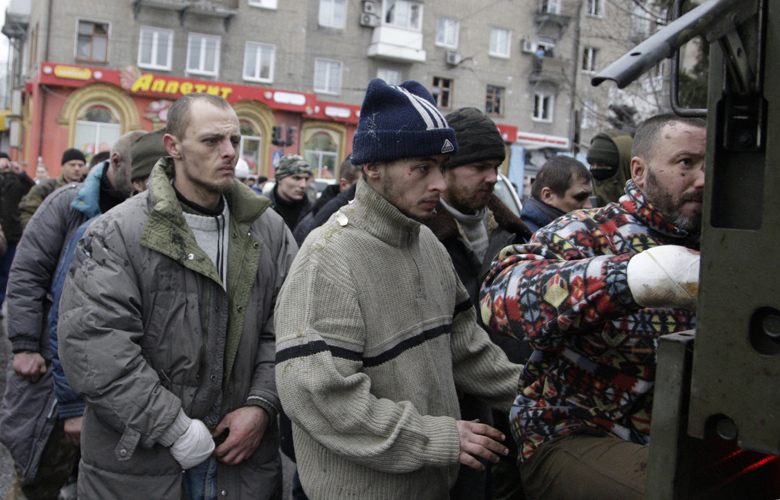
- Are you ashamed? - We hear a voice asking questions on the knees to a person, and see a microphone with the inscription "Lifenuz". “Do you know how many people died here today?”
“Yes,” the prisoner replies. - Ashamed.
- Why are you ashamed? - the same voice asks rhetorically, perfectly, so to speak, merging with the cries of the crowd.
Another plot is a conversation with a prisoner, Vadim B. , where he pronounces clearly: “More. I. on them. Serve. I won’t go ” - after a barely noticeable interruption, without a question, looking into the camera.
In the report “tired of fighting” , which became the reason for the statement of Dunya Miyatovich, the representative of the OSCE on the issues of the media freedom - she called the report “unethical and unacceptable” - the correspondent persistently asks the prisoners: “Where were the deployed? What is your task? " In a longer fragment of the conversation , one can hear the same questions as if from another prince, they ask the same questions (“What part are you from?”), And it is also incomprehensible whether the investigator is asked by the journalist.
“Yes,” the prisoner replies. - Ashamed.
It seems to the correspondent that any word - the enemy, according to the local performances that came “from there” - will open the secret door and terrible depths will open. But there is no doors, it has long been torn off by an explosion, there are ruins and continuous holes - nothing is found but human pain, fear and despair. He is just a living witness of hell. General hell, it should be noted.
Plane, unlike a journalist, is not free. Around there are people who have just returned from that very battle, and any wrong word can become fatal. And he answers the questions as prisoners always answer: I am a driver (an quartermaster, a cook), my business is small, I did not fought for long, you think I wanted to fight, and everything is like that. Correspondent refrain: "What brigade are you from?" - And the other prisoner who lies on the gurney: “A family of troops? What brigade are you from? " All this sounds in a businesslike way, but this is not the war to pry out the numbers of the units, especially since they are all more or less known. The soldier answers like any soldier: I don’t know how I know why I know.
In another famous video , prisoners are interviewed from what areas they are - as if we are not talking about the 21st century, but about the XVII. But the question is asked with such seriousness, as if a secret door will open again now and an important sign will fly out from there-so that we all finally “understand”-however, there is also nothing but pain and fear with which the names of Ukrainian regions, areas, towns and villages are pronounced.
“I went because they forced” is a stamp, everyone also speak captivity, and any propaganda uses this to say: now, a soldier of foreign armies is forced to fight by force, and ours are fighting at the call of the heart. This is designed to disorganize those who see this video. Now all these videos are perceived as a story not only about prisoners, but also about those who do these videos; Uncontrolled effect. Because everyone already knows how and why this is done.
What exactly do we want to hear from a person who is captured, deprived of his own will?
The most perhaps the most unusual is the question of shame. There were other wars on the territory of the former USSR, where they did not ask questions at all. But the journalist, formally located in the territory of another state and in the “alien war”, as asking questions about shame, is doubly pointless. Now there is no more point in this than asking a flying projectile, is it a shame for him from which brigade he is. What exactly do we want to hear from a person who is captured, deprived of his own will? .. Probably, we want him to open our souls - and this, of course, will happen, there is no doubt. That's right now.
The interviewing of the prisoner is such a Kabuki Theater: all the roles - strong and weak - are painted, strong asks, the weak is silent, lowering his head. This is a game with a well -known morality. Ritual, exchange of rhetorical figures. You can ask any questions (from which area, from which team, is it ashamed), but in fact any question is a statement of the right of the winner and nothing more: “You are completely in my power.”
Questions regarding shame - despite the extreme degree of frankness - exactly the same demonstration of superiority. Anyone who asks for shame should, by definition, should know more about him than the responsible. But here everything is simpler, Lacan said: there is nothing important here, but who . Those who ask questions are the discourse, the main and the main one. Approximately the same questions are asked by secondary heroes to James Bond in James Bond films. Spectators understand that they are not set in order to get an answer. Their goal is to deprive the answering will and dignity, their remnants, in captivity, which, so, in itself, deprives of dignity and will.
The correspondent behaves so because he, in essence, has nothing to ask about. And at that moment he tries on all the roles he knew: an investigator, a military, conditional peaceful resident - all those whom he sees around is pure psychology. He asks questions, as it were, “on their behalf” - because he does not have his own role. Loss of self -identification, they say in such cases. But the journalist actually does not “know” that he is a journalist. He does not know what here, in this situation, can "from himself." What are the journalist has their own rules and their own role. Because he is a part of the car that has long decided for him.
This machine removes personal responsibility from you - this is attractive. The machine itself organizes disputes where no one argues; He asks the listeners questions in which the answer is known in advance. Speaks on behalf of truth and does not need evidence. Endlessly speaks of others, without saying anything about himself. This machine is a huge rhetorical, tautological figure. Due to the lack of its own meaning, it uses meanings from the past, as well as from films and books. Everything looks like something that has already happened-but at all at once. The convention is formally observed - they provide assistance to the wounded, give the bodies of the dead relatives - but then the archaic practice of “re -education” of prisoners - with the help of a crowd, which also knows its role.
Now the question is actively discussed: whether it is correct to respond to propaganda by propaganda. If you answer mirror, then you will have to ultimately repeat and all this too; But for this, you still need to have a special passion and mood-something like Zamyatinsky "we". I do not think that this can be copying automatically, repeated-not to mention the fact that before you need to throw some universal things out of your head, and ideally, not to know them at all. For this, all you need to have specific experience and talent; And it would be better, in my opinion, they can’t have them at all.