
Translated material
Memory. Dmitry Ushakov
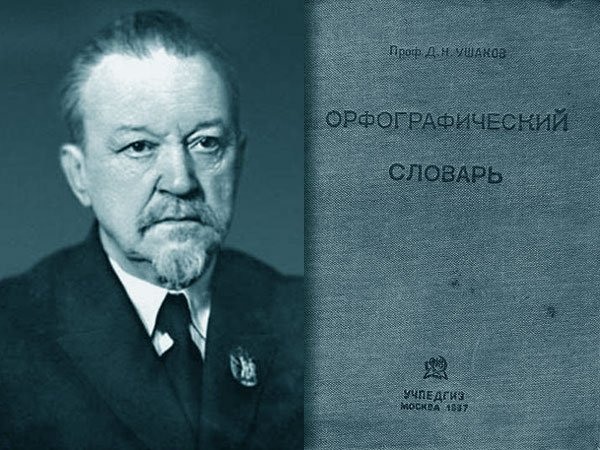
On January 24 (12), 1873, philologist Dmitry Ushakov, the creator of the famous explanatory dictionary of the Russian language, was born.
Personal business
Dmitry Nikolaevich Ushakov (1873–1942) was born in Moscow, in the house at the intersection of Vozdvizhenka and Krestovozdvizhensky Lane. The father died when the boy was two years old, and he grew up in the house of his grandfather from his mother - the Protopresviter of the Assumption Cathedral of the Moscow Kremlin Dmitry Novsky. He received primary education at home, and in 1882 he entered the first Moscow six -class gymnasium, in 1889 - to the seventh grade of the fifth Moscow gymnasium, which was on the corner of the Povarskaya and Bolshaya Molchanovka. After graduating from the gymnasium in 1891, he became a student at the Historical and Philology Faculty of Moscow University. The teacher of Ushakov at the university was Professor F. F. Fortunatov, under whose leadership Ushakov wrote the candidate essay “Preferences at Homer”. After graduation, Dmitry Ushakov from 1896 to 1913 worked as a teacher at school. In 1900 - 1901 he passed the master's exams and gave two trial lectures: “The main directions in the study of the Russian folk epic” and “Moscow dialect as the basis of the Russian literary language”. Since 1907, he began to teach at Moscow University at the Department of the Russian Language, where he worked until 1935, having passed the posts of Privat-Tocent, senior assistant, full-time associate professor and professor. From 1939 until the end of his life, Dmitry Ushakov was in charge of the Slavic sector of the Institute of Language and Writing of the USSR Academy of Sciences. In addition to the university, Dmitry Ushakov both before the revolution and after taught in many other educational institutions: at the highest female pedagogical courses (1907-1918), at the highest female courses (1909-1919), at the highest female courses by V. A. Poltoratskaya (1910-1919), in the Higher Military-pedagogical school (1919-1922), at the Literary Institute. Bryusova (1924-1925), at the State Institute of the Word (1920-1925), at the editorial and publishing institute of the OGIZ (1932-1933). He wrote one of the first domestic textbooks on the introduction to the linguistics “A brief introduction to the science of language”, which has survived nine publications. From 1920 to 1929, Dmitry Ushakov was a valid member of the Research Institute of Language and Literature Ranion, and from 1923 to 1927-the chairman of his linguistic section. On January 15, 1936, Dmitry Ushakov was approved to the scientific extent of the Doctor of the Linguistic Sciences of the Higher Attestation Commission of the People's Commissariat of People's Commissariats, and in 1939 he was elected a corresponding member of the USSR Academy of Sciences. In October 1941, he was evacuated from Moscow to Uzbekistan. Dmitry Nikolaevich Ushakov died on April 17, 1942 in Tashkent.
What is famous
Dmitry Ushakov became famous as the compiler of the four -volume “Explanatory Dictionary of the Russian Language”, the first edition of which was published in 1935-1940. This was the first Soviet regulatory dictionary, with sufficient completeness reflected the vocabulary of the literary language. The dictionary was distinguished by well -developed descriptions of the meanings of words, as well as a system of droppings indicating the features of their use. Words in this dictionary were equipped with brief etymological certificates. The author’s team, led by Dmitry Ushakov, included such prominent scientists as V.V. Vinogradov, G. O. Vinokur, B. A. Larin, S. I. Ozhegov, B. V. Tomashevsky. The dictionary contained more than 90,000 vocabulary articles.
What you need to know about
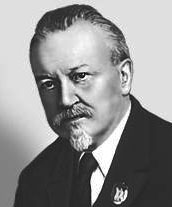 Dmitry Ushakov
In addition to Russian lexicography, it should be noted the contribution of D. N. Ushakov in two areas: spelling and dialectology. He took an active part in the draft reform of Russian spelling. In 1911, his book “Russian Spelling” was published, where during the analysis of the relationship between literary pronunciation and spelling, the need for the reform of Russian spelling was theoretically justified. The draft reform project prepared in 1912 by the Academy of Sciences was implemented only in 1918. In the 1930s, Dmitry Ushakov headed the spelling commission of the People's Commissariat of Education and headed the Russian language department of the Institute of Languages and Writing of the Peoples of the USSR.
As a dialectologist Dmitry Ushakov, since the creation of the Moscow Dialectological Commission at the Academy of Sciences in 1911, its chairman F.E. Korsha, and after his death in 1915 he headed the commission. The purpose of the commission was to create a dialect map of the European part of Russia, including the dialects of the Russian, Belarusian and Ukrainian languages. A huge amount of material was collected for this, and the map was published in 1915, accompanied by an essay with the characteristics of dialects of all three languages. In 1931, the dialectological commission was liquidated at the initiative of N. Ya. Marra.
Direct speech
“I was lucky to communicate with Dmitry Nikolaevich for more than 20 years - from the first years of student to his death in 1942 ... We constantly met at his house, working on the project of Russian spelling reform, on the preparation of university programs. Often, the sounds of Beethoven’s sonat, ballads or shopen’s fantasies came to us: this is behind the corridor, in another room, Konstantin Nikolaevich Igumnov, a friend of Dmitry Nikolaevich, who lived with him in the same apartment, was preparing for the next concert. ”
From the memoirs of R.I. Avvanesov.
For the first time in domestic lexicography, a complex and multidimensional system of stylistic settings was developed and applied, which are such a network of contrasts and comparisons, which allows you to see several functional-stylistic and emotional-value hypostases of the word: literary-vernacular, literary-regional, book-high, neutral-special, general, official-official-official-official-official-official-official-official-official-official-official Chancellery, etc. For the first time I preferred to the dictionary (in the 1st volume) outline of orthoepy and morphology. This is the first explanatory dictionary to register words that entered the language in the late 10s-early 30s (about a thousand). For the first time, vocabulary articles are dedicated to the most common morphemes (there are articles about prefixes of anti-, without-, and some other, about the first parts of complex words of two, battles, etc.). For the first time in domestic lexicography, it is clearly said about the difference between the dictionary of the language and the encyclopedic (and this difference is observed in vocabulary articles) ""
Xanpira E. I. “Explanatory Dictionary of the Russian Language” edited by Ushakov (to the fiftieth anniversary of the 1st volume.
This dictionary often causes an aesthetic feeling. It is unlikely that anyone will be reading it in a row, except for specialists. But each reader who delves into it with attention, it is suddenly stopped by the excellent in accuracy and grace by determining the meaning, a bright quote-illustration, a subtle distinguishing between meanings. Ushakov (and his co -authors) were especially successful in the definition of verb values (as well as Dalya - the meanings of nouns): this was affected by the dynamism of the era, and the intellectual mobility of the character of D. N. Ushakov himself.
M.V. Panov
He had to communicate with people, and he really talked with teachers, and students, and graduate students, actors, doctors, with singers, with directors, with anyone, up to officials of various departments who did not know how to write the name of their own institution. And he willingly talked with them. Sometimes it seemed: why does Dmitry Nikolaevich go to the phone when he can do something important? But he walked, and he taught us not to fence away from practical life ...
A. A. Reformatsky
12 facts about Dmitry Ushakov
- The father of the scientist Nikolai Vasilievich Ushakov was an outstanding Russian oculist doctor .
- Many students of Dmitry Ushakov became famous Linguists: R. I. Avvanesov, P. G. Bogatyrev, G. O. Vinokur, A. A. Reformatsky, V. N. Sidorov, R. O. Jacobson, S. B. Bernstein and others.
- For many years, Ushakov, who taught at school, told his students when they expressed displeasure that they had to work in high school: “I sincerely wish you to work at least 5-6 years in high school - this will enrich you for life.”
- At the beginning of his work, D. N. Ushakov, together with N. N. Durnovo, discovered in the Moscow pronunciation a new type of reduction of vowels - Ikan. Now this is a phenomenon that has become almost universal, first -year students are studied as part of the “younger norm” in Russian pronunciation.
- Roman Jacobson, who worked in Prague in 1920, but had not yet decided to finally emigrate from Soviet Russia, asked Ushakov in a letter to whether he should take the proposed position of a professor at the University of Saratov. Ushakov answered with a postcard: “When you want to dance, we must remember not only about the stove from which you dance, but also about the wall to which you dance.” Jacobson remained in Prague.
- In 1921, Dmitry Ushakov was included in the commission, which prepared documents for negotiations with Poland, before the conclusion of the Polish-Soviet agreement on the holding of the Soviet-Polish border. For this, it was planned to take into account data on the ethnic and linguistic affiliation of the population of the border regions. However, as a result, the dialect data when concluding the Soviet-Polish agreement were not taken into account.
- Dmitry Ushakov was a recognized connoisseur of the correct Russian pronunciation. For many years, he was a consultant to the radio committee, well -known actors Evdokia Turchaninov and Vasily Kachalov turned to him for advice.
- I was Ushakov an expert and dialectic speech. As G. O. Vinokur recalled: “Dmitry Nikolaevich’s favorite reception was that he said to each student in his first year in the Russian language, where he came to Moscow from. This made an indelible impression on those present. "
- In the preparation of the explanatory dictionary, the so -called “political editor” (in fact the censor) reproached Ushakov from the fact that both Soviet and non -confortive words got into the dictionary. After it turned out that the editor was so accepting the instruments of "Sov." and "Nesov." The verbs are perfect and imperfect.
- In the phonotex of the Institute of the Russian Language of the Russian Academy of Sciences, a recording of the lecture of Dmitry Ushakov “On Moscow pronunciation”, read in 1940, is kept.
- Dmitry Ushakov was awarded the Orders of St. Stanislav of the III degree, St. Anne of the III degree, St. Stanislav II degree and the Order of the "Badge of Honor".
- Once in the evacuation in Tashkent, Dmitry Nikolaevich began to study the Uzbek language and composed the Russian-Uzbek phrasebook.
Materials about Dmitry Ushakov
Article about Dmitry Ushakov on Russian Wikipedia
Documents in the Archive of the Russian Academy of Sciences
Dmitry Nikolaevich Ushakov: Muscovite, whom everyone loved
I. Krylov, he did not think of himself without Moscow roots ...
M.V. Panov. Dmitry Nikolaevich Ushakov. Life and creativity