
Translated material
Brave Hearts and Future of Ukraine
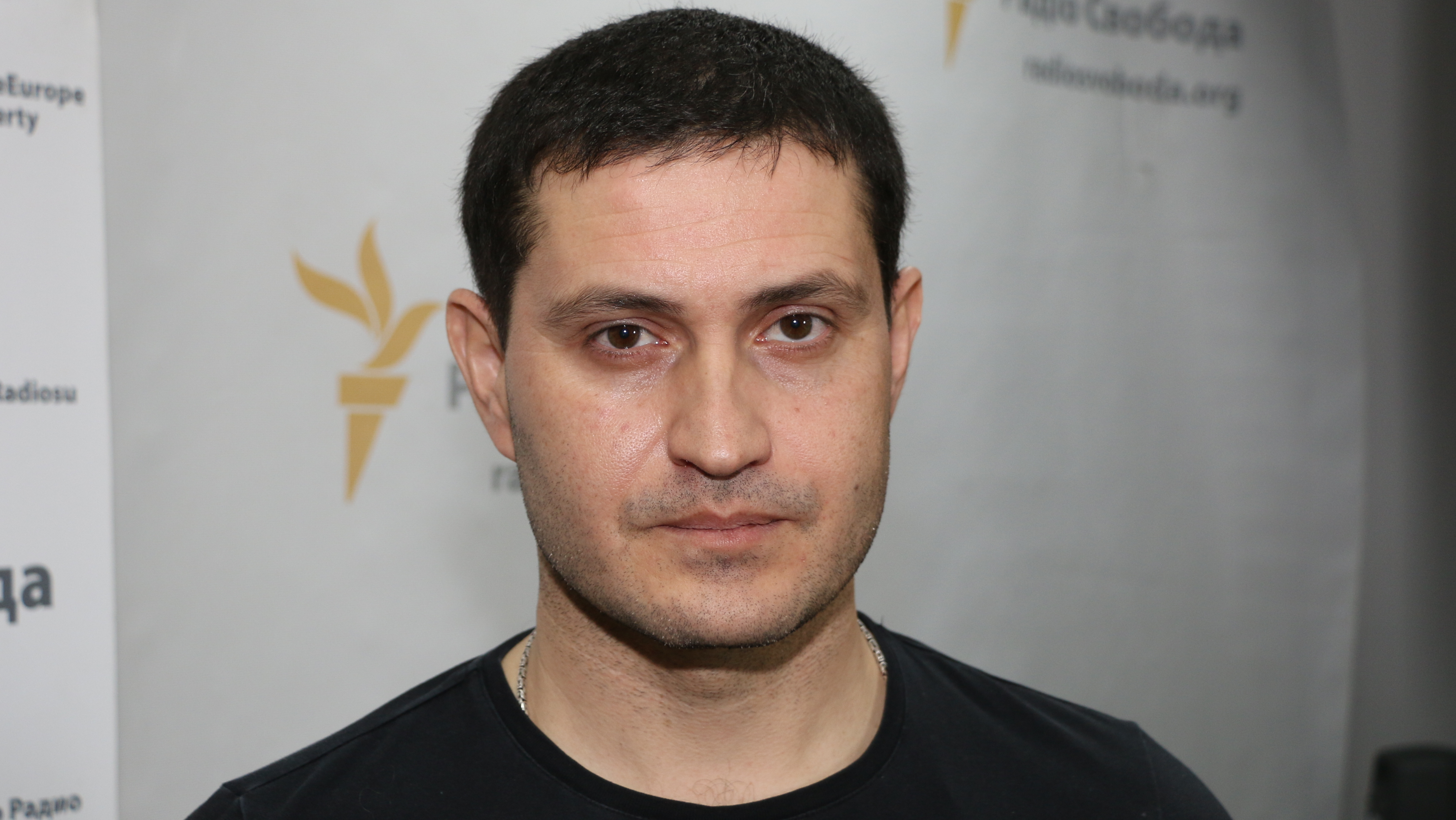
Vitaly Portnikov: Our guest today is a Ukrainian director, actor Akhtem Seytablae . Akhtema is known to the Russian viewer from the film Haitarma , which last year received Nick, one of the highest awards of Russian cinema. Incidentally, he received just against the backdrop of famous events around the Crimea, which gave a cultural event also political engagement.
I would like to start a conversation with Akhtem not about his cinematic activity, but about television. Akhtema recently spoke in unusual and for Ukrainian television, and, I think, for himself, he was the host of the “1+1” TV channel “Brave Hearts”. This program was devoted to those soldiers who today participate in the anti -terrorist operation conducted in Ukraine. This is an unusual genre for modern television. On the one hand, this show, as if, in the very idea, an entertainment program, and on the other hand, we are talking about tragic events, about people, the very choice of which already predetermines the tragic fate. I know what program I remembered when I watched your show? I don’t know if you remember her ... There was such a program on the central television of the Soviet Union, it was called “with all my heart”, it was led by Valentina Leontyeva. On the one hand, then it seemed that it was very Soviet television, and on the other hand, there were real people - war veterans, people who passed the war, who had tragic fates. They met each other in decades. The fact that they survived then could not be hidden by any propaganda, no gloss. And the host was quite difficult to emotionally perceive this, and the people themselves, because in this, in their life there was something real that distinguished this transmission from other, pseudo-optimistic programs to which we were used to, which made up the essence of the television ether. It seemed to me that “brave hearts” is also a program about the present.
At the forefront, we tried to put a story that there is always a place for the human feat
Akhtem Seitablaev: Firstly, thank you for feeling our program like that. We really tried to make her real, first of all, because the heroes are real and their stories are real. This was the difficulty - to arouse the audience interest in this kind of program. After all, it is obvious that there is an information flow and those knowledge of the viewer who are thanks to news stories, thanks to the departments of many journalists in the ATO zone. There was a difficulty in front of us - what new can we offer the viewer about the seemingly widely known events that occur in our country? Therefore, at the forefront, we tried to put a story that (no matter how trite it sounds) there is always a Human feat, whether it is a volunteer feat, whether it is a feat of men and women who protect the country with weapons in their hands, but this is a feat: doctors, volunteers, and of course, for me, first of all, this is a feat of volunteers, because the whole country is volunteering. Actually, the program once again convinced me that without volunteers and the country, probably, it would not have been. We said that in some way our program is a mix of “Wait for me”, and from the central television program that you mentioned. We tried to make it real. To what extent managed to emotionally hold the viewer - I do not know. There are quite a lot of people who specifically wrote to me and called in our editorial group, thanked for the program, for talking about real people, but along with this they said that "there are a lot of tears." And we set ourselves the task so that the aftertaste that we would like to leave was still saturated with hope, precisely because this story, first of all, about such people, very often dead. But those who remained: their relatives, friends, guys, twin, - they came to the program with such a charge, spoke for the most part that, in spite of everything, our country, the battalion, that reconnaissance group, the matter that they are engaged will continue. I don’t know how much we helped Ukrainian viewers to believe in ourselves, to believe that we are a really great country, and the great people who live in it, but we honestly tried to do it.
When Soviet, Russian tanks were on foreign land, many representatives of Russian society did not feel the dangers of war for themselves
Vitaly Portnikov : Akhtem, your story about these calls once again convinces of the obvious fact that many people who live in Ukraine today do not want to feel that the country is in the war. The fact that this is not felt in Russia can be explained, this is according to the formula of Alexander Galich: "Citizens, the Fatherland in danger: our tanks on a foreign land." When Soviet, Russian tanks were on foreign land, many representatives of Russian society did not feel the dangers of war for themselves. But when the same does not feel the danger of danger in the country on whose land the tanks are located, this is already a serious problem.
Akhtem Seitablaev: Yes. And, judging by the ratings of the program (I don’t know how much it can be trusted, I am a completely new person on television, but, apparently, this is attached to no small importance), our viewer had our program. But I can’t say that a third or half of the country, again, relying on ratings, I could not. I know what programs went at this time on neighboring channels. Of course, for me personally, how was it a big question: does it understand at least half of the country, that literally 300 kilometers from us is a war for this country? I am in no way going to condemn, call, nor say that there are no, do not look at anything other than such programs as “brave hearts”, but these are the questions that I, probably, if I try, can answer - why this is happening. But as a person who was lucky to get acquainted directly with so many people who returned from there, who are there and do a lot of actually for the country, of course, many things are incomprehensible to me.
Vitaliy Portnikov: When you talked with these people who really went to fight, conquer the territory of the Donbass, you did not ask them the question, why was there no such impulse when Crimea left? After all, this was a similar situation: also troops, also a siege of Ukrainian units, the same decision that actually brought Crimea from under Ukrainian jurisdiction. Then there was no such mass movement of people who were ready to protect their territory (we will not even discuss the political context: the decision of the authorities and so on). You talked about volunteers, about volunteers, about the readiness to go somewhere-this was not.
I have conspiracy theories about Crimea - that it was some kind of geopolitical trap for Comrade Putin
Akhtem Seitablaev: For me, this is more than a sore question. We almost always touched on this topic with volunteers and military, especially with volunteers and military. As I can judge by the answers that I heard, probably, by and large, were not ready. I myself, on these days, on February 25-26, was in the Crimea, I saw my own eyes how the first stages of the annexation took place. I rented an apartment just opposite the building of the Council of Ministers. For two days there was absolute silence, according to our internal Crimean Tatar post office, we were told that now, from an hour to an hour, the central government in Kyiv will deal with this situation, because in principle it cannot be. I have information, it, of course, has not been documented in any way, but I met in Crimea with several dozen people who came from Kyiv, who were ready to support the Crimean Tatars when they went to Square on February 24. But it did not reach practical participation. Most of the volunteers who are now fighting in the east of Ukraine directly say that it was the delivery of Crimea. I have some conspiracy theories about Crimea - that it was some kind of geopolitical trap for Comrade Putin.
Vitaly Portnikov: You say it like Heydar Jemal , such a Russian political scientist, mystic. He also believed that it was a trap, that in no case should you go there.
Crimea in recent decades is a reserve of communism
Akhtem Seitablaev: For some reason, I still think so - that, probably, this is some big game in which Ukraine is a mousetrap, but not a valid player. Therefore, most people with weapons suggest that it was a mediocre surrender. You know very well that Crimea in recent decades is a reserve of communism. More than 700 thousand pensioners, most of them considered Crimea as an honorary pension after the works of their righteous and dreamed, most likely, about the times of their youth and that their life from a material point of view will be much better when Crimea joins Russia. This is also an important factor. It is still not clear to me why many ethnic Ukrainians living in the Crimea were very amorphous about this situation. A simple example: when on February 24, about 15 thousand Crimean Tatars went to the Verkhovna Rada building in Crimea, because very few Ukrainians stood nearby - literally up to 200 people, no more.
Vitaly Portnikov: Maybe it's not about ethnicity, but in political consciousness? In Crimean Tatars, maybe political consciousness coincides with ethnicity, and Ukrainians are used to ...
Akhtem Seitablaev: In Crimean Tatars, this is very vividly: 300 years of relations with the Kremlin, which did not lead to anything good for them. And, in fact, the last 70 years ... Each Crimean Tatar in the family must have a dad, grandfather, grandmother, mother, who were somehow repressed by the Soviet regime - the Kremlin. You are probably right: more skill and more lively memories. Although it is not very clear to me that such a large empire has done such a good thing that it was so forgotten so quickly, with such a great hope that Harrodin Ukraine is worse than with weapons in the hands of the Russian Empire. I don't understand. There are a lot of questions for me. Probably time will judge why it happened just that. If we talk about people who, it seems to them, call a spade a spade, they note that it was an elementary inability and fear of a direct fight with Russia. When Donbass happened, then ...
Vitaly Portnikov: Probably there was no choice.
Akhtem Seitablaev: Yes, probably there was no choice. I have the feeling that they treated the Crimea (at least during independence), like some strange appendicitis, not quite accurately understanding why it is needed. Some strange, incomprehensible, with these Crimean Tatars, which are always outraged by something and always require something, with the threat of the so-called “fifth column”. In this - I am absolutely convinced - the journalists played a significant role. If you need names, I can name them, because I specially recorded some programs from the central channels at my time.
Vitaly Portnikov: From the central Ukrainian?
Akhtem Seitablaev: Yes. On the central Ukrainian channels, some journalists made video reports that in the Crimea, in the mountains of the Crimean Tatars they were training with instructors from Al -Qaeda - however, without showing a single specific frame where this is happening.
Vitaly Portnikov: Yes, I remember, such an idea was. She was always justified by the fact that there were such complex relations among all the authorities of Ukraine with the Mejlis of the Crimean Tatar people. Now we see such mutual understanding, but we must admit that until this moment it was not.
Akhtem Seitablaev: In addition, in fairness it must be said that not only with the Crimea there was such a situation - I mean that the central government did nothing for the regions as such, just Crimea is a litmus piece of paper. In my opinion, there was absolutely no understanding of how to make sure that it was not necessary in the Ukrainian language, but it is fashionable to speak. There were practically no cultural actions, as a result of which, for example, the young generation would like to speak the language of the country in which they live. But at the same time, as you know very well, there was no infringement of the Russian language. Of all secondary schools, in my opinion, 15 were in the Ukrainian language, 5 or 7 in the Crimean Tatar, and everyone else was with the Russian language.
Vitaly Portnikov: What is happening with the Crimean Tatar language now? Is there any adaptation to new realities, adaptation to the current government, or the adaptation of the Crimean Tatars to those realities that are now developing in the Crimea?
Crimean Tatars are not going to leave Crimea, if this is not associated with a specific danger to a family member or for the family as a whole
Akhtem Seytablaev: I think that adaptation among the Crimean Tatars occurs in any case, because most of those who, fortunately or unfortunately, I don’t know, probably, are not subject to direct repression by the authorities, you need to live. Here, for example, is my mother, who is almost 80 years old. She says to me: “I probably would have received even a fundamentally Ukrainian pension, but I need to go to the territory of mainland Ukraine for this.” It is difficult to imagine how a person at the age of 80 will go to the territory of mainland Ukraine (all the more now) in order to receive a Ukrainian pension. When people are forced to receive auswees in order to survive elementary, I cannot condemn them. Even, probably, I will urge them to receive these auswees in order to elementarily move or be able to get a piece of bread for my family. Not everyone stands in the markets and not everyone works as minibuses, many people work in the civil service: teachers, doctors. There are absolutely specific instructions: there is no Russian passport - it means that you do not work. There is no Russian passport - it means that you can’t conduct any activities at all, especially in the civil service, you cannot work as a teacher, a doctor, or a nurse - almost nowhere if it is connected with the budget. Crimean Tatars from Crimea are not going to leave, as we know, if this is not associated with a specific danger to a family member or for the family as a whole. Probably, this is correct, because the solutions to the problem of such a large number of refugees I still do not see and do not hear about it.
Vitaly Portnikov: This applies not only to Crimea. In general, it seems to me that it is strange to discuss the issue of refugees here, because the Crimean Tatars returned to the Crimea - this is their homeland. I admit that there are political reasons for leaving: people leave their homeland for political reasons. I admit that some people, for example, of Ukrainian origin, leave the Crimea, because they do not want to come to terms with such a legal situation and because they have a large homeland - Ukraine. But I don’t understand where to go to the Crimean Tatar, if he lives there, rooted, came there, strove to always be there, in Bakhchisarai, in Simferopol, anywhere. I don’t know how much politics can make a person change the life civilization choice, and I’m not sure that this should happen. It seems to me that it should be the other way around, that a policy needs to be redeemed under a civilizational choice. The question is how?
Akhtem Seitablaev: Honestly, except for the faith that “flour will change”, there are few arguments, except that we were not in the lists of peoples living in the territory of the Soviet Union, for almost 50 years. Now there is no Soviet Union, but we are. I don’t know what can happen, besides what is happening - I mean sanctions, a drop in oil prices, the inability to support Crimea and fulfill the promises that were given - about some incredible salary, an incredible pension. Again, on the example of my parents and other relatives, some of whom work in schools - two months ago, the salary was 27 thousand rubles, and today it is 15 thousand rubles. We are not at all about the fact that they will again receive the very first salary, which some, of course, were delighted. All this turned out to be (as, probably, it should have been) just a big bluff and a certain purchase.
Now many people compare the Ukrainian situation with the Israeli
Vitaly Portnikov: Now many in Ukraine are comparing the Ukrainian situation with Israeli - Ukraine also opposes superior forces, it is also part of the geopolitical game, almost the same as Israel since 1948, forced to build statehood almost from an empty place. But there is another example - what was in Israel until 1948. After all, the Jews in Israel (the then Palestine) lived until 1948, and there were a minority in it for many decades - on the earth that they considered their own and which belonged to another state, no less powerful than the current Russian state (it was more powerful - the Ottoman Empire, then the UK). And in this minority they could also only think that they retain the national hearth in the hope that someday this national hearth will become a full-fledged state. I think, a decade before the appearance of Israel, no one imagined that this dream could be fulfilled. Мне кажется, что существование в своем национальном очаге (если это именно твой национальный очаг, а не чей-то еще) - это и есть выход из ситуации. По крайней мере, история это доказывает во все века.
Ахтем Сейтаблаев: Может быть, и так. Мой отец всегда говорил, наполовину в шутку, наполовину всерьез: «Крымских татар должно быть больше. И мы, мужчины, должны все для этого делать». Не знаю, только ли в этом выход. Голду Меир когда-то спросили: «А как вам удалось выжить?». Она ответила: «У нас не было альтернативы». Мне кажется, что и роль пассионариев, людей, которые одержимы идеей о том, что они хотят жить в определенной системе координат, хотят будущего для своих детей, для детей своего соседа... Как бы утопически это ни звучало, но мне кажется, что если есть какая-то критическая масса людей, одержимых такой идеей - жить в нормальном мире, на нормальной безопасной улице, в хорошем чистом городе, без страха за своих детей, - а вокруг них будут практики, технократы (можно по-разному их называть), которые знают, как это сделать практически, но впереди все же будут люди с такой утопической идеей, - тогда, на мой взгляд, что-то, наверное, может получиться. Пока я, к сожалению, не вижу ни Шарля де Голля, ни Голды Меир в украинском политикуме, при всем моем уважении к тем, наверное, правильным и дающим лично мне надежду на перемены к лучшему людям, - таким, например, как Эка Згуладзе . Вчера я ее слушал, и мне почему-то хочется верить, что, начиная с ГАИ, у нас постепенно начнет что-то меняться.
На Шарля де Голля и Голду Меир должен быть запрос в обществе, они не появляются сами по себе
Виталий Портников: На Шарля де Голля и Голду Меир должен быть запрос в обществе, они не появляются сами по себе. В украинском обществе был запрос на восстание (на Майдан), - оно произошло. А когда появляется запрос на сильных политиков, оно тоже, мне кажется, очевидным образом приходят.
Ахтем Сейтаблаев: Запрос, по-моему, есть.
Виталий Портников: Последний вопрос: когда вы получали в прошлом году «Нику», вы ощутили в этом начало какого-то интереса, понимания российским обществом крымско-татарской проблемы как таковой (или ваш фильм был воспринят как чисто художественный акт)?
Ахтем Сейтаблаев: Нет, конечно. Во-первых, я очень долго думал, ехать или не ехать, очень много советовался с людьми, мнение которых уважаю. Первоначальный позыв был — нет, причем выступить, сделать это громогласно. Но потом я начал подробно разбираться, а кто же, собственно, эти киноакадемики? Среди них - Андрон Кончаловский, Эльдар Рязанов, Олег Басилашвили. Потом я услышал от Ады Николаевны Роговцевой : Ахтем, ты должен поехать именно к этим людям, которые в Москве имеют смелость выражать свою гражданскую позицию и говорить вещи, за которые их могут просто посадить; наверное, будет правильно тебе, будучи крымским татарином, приехать с Украины и поддержать их там. Когда я приехал в московский Театр оперетты, мы попали в окружение людей и услышали, о чем они нас спрашивают, что они говорят, более того, что произносится со сцены во время этой церемонии, я убедился, что мы приняли правильное решение. Я не знаю, каков на самом деле процент тех людей, которые поддерживают нас на Украине, - таков ли он, как говорят официальные средства массовой информации в России, но для меня лично очевидно, что их гораздо больше. Нам (я говорю, в первую очередь, о себе), наверное, нужно, по крайней мере, делать все, чтобы они тоже там ощущали нашу поддержку. Вот, например, Айдер Муждабаев, заместитель главного редактора «Московского комсомольца», - я его просто прошу, чтобы он был помягче в своих высказываниях, потому что то, что он говорит, будучи заместителем главного редактора одного из популярных в России изданий, у меня лично вызывает беспокойство конкретно за него. Так что, я думаю, люди слышащие, люди сопереживающие - а таковые есть и в России тоже - никогда не забывали про то, что есть Крым, есть крымские татары, про то, что надо как-то налаживать другие взаимосвязи с Украиной, не путем силы.