
Translated material
Russian scientists for the second time in history completed in Antarctica to the Lake Lake Vostok
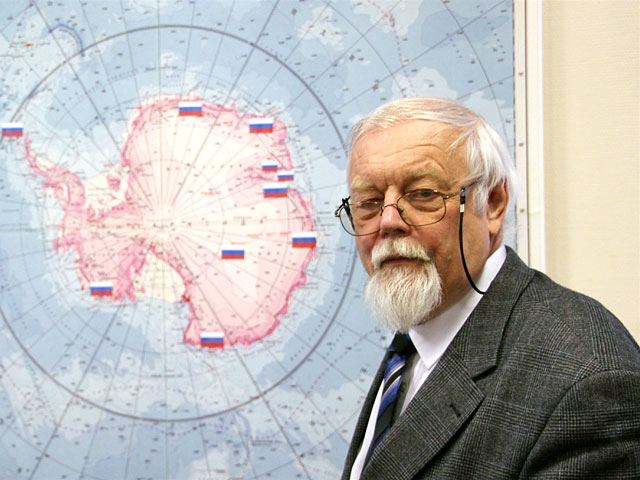
Russian scientists drilled a well to the relict lake of the East in Central Antarctica, TASS reports. “The penetration into the lake occurred today at 13:12 Moscow time, I received a telegram from Antarctica at 18:10,” Valery Lukin, head of the Russian Antarctic expedition, told the agency.
He said that "four hours after passing the border of the ice shell, a drill shell was raised to the surface with a column of ice core, the length of which is 71 centimeters." The total depth of the well was 3 thousand 769 meters 15 centimeters. This is the amount of the length of all ice cores extracted from the well.
Penetration into the lake is the second in history. The first was carried out 3 years ago, on February 5, 2012. Then they also calculated the total depth of the well. “Today we got 15 centimeters more,” said Valery Lukin. This, according to him, is due to the fact that the second well is drilled with some deviation from the original barrel.
Valery Lukin also said that after a drill shell was taken out of the well, the level of bolt fluid rose 25 meters. “As far as the water has risen, it is impossible to say, it will be possible to measure the length of a new water plug only after two days, when the rising water freezes,” explained Valery Lukin.
Drilling work here began in 1989. After the first penetration into the lake on February 5, 2012, the water rose 380 meters and it took three seasons to get to the lake again. The task of drilling work this season is to open the lake and again clog it with a trafficel of ice in several meters so that access to a unique pond for research purposes is subsequently constant.
This season, drilling resumed from a mark of 3 thousand 724 meters. Four meters before lake water, work was stopped by more than a week to prepare for penetration. Scientists checked the density of the filling fluid (a mixture of kerosene and freon) at different depths and leveled it, checked the well, lowering the video camera there and successfully experienced a sampler, specially designed and manufactured in the St. Petersburg Institute of Nuclear Physics (Piyaf) to take samples of lake water.
Whether the device will be used this year or in subsequent seasons is not yet known.
Lake Vostok opened the 33rd Soviet Antarctic expedition in 1987 by a geodetic method. Its dimensions are 50 by 250 kilometers. At the first opening of the lake, frost-resistant bacteria, previously unknown to science, were discovered in the water sample, but it is impossible to say with 100 percent confidence that these are the inhabitants of the lake, since a bolt fluid from the well fell into a three-year ago. A special sampler was created to obtain a clean sample of lake water and the study of its composition. The lake, according to scientists, was clogged with ice about half a billion years ago.